COSMIC LEARNING LAB

PATH 15 · MATTER BELOW THE ATOM

Subatomic Particles

Look inside an atom and you find electrons around a nucleus; look inside that nucleus and you find protons and neutrons made from quarks. Modern physics describes these particles as ripples in fields that fill space. A small set of particles and rules builds nearly all familiar matter, although important mysteries remain.

10 CHAPTERSDEEP-DIVE GUIDEILLUSTRATED
10-PAGE FIELD GUIDE01020304050607080910

A LIGHTER FIELD GUIDE

One idea.
Then the next.

Start with the short explanation in each chapter. Open “Go a little deeper” only when you want more detail. The final line shows how the next chapter follows from the one you just read.

01CHAPTER

Matter becomes fields, particles, and probabilities.

Below the atom

IN PLAIN LANGUAGE

Here is the big picture: Matter becomes fields, particles, and probabilities. The main point to remember is this: Atoms contain nuclei and electrons.

See the fuller scientific explanation +

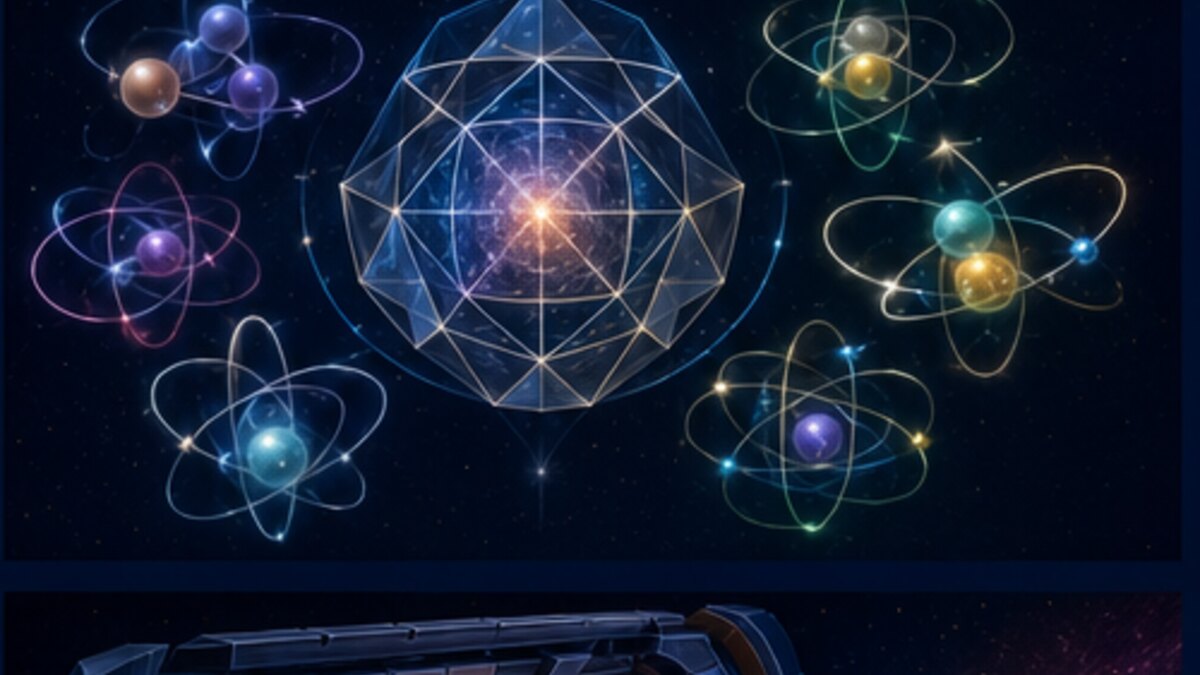
Atoms are not the smallest units of nature. Electrons occupy quantum states around nuclei, nuclei contain protons and neutrons, and those nucleons are built from quarks and gluons. At present, quarks, leptons, and several bosons show no measured internal structure and are treated as elementary within the Standard Model.

A subatomic particle is not well described as a tiny classical ball. In quantum field theory, particles are discrete excitations of fields that fill space. They can be created and destroyed when energy, momentum, charge, and other conserved quantities allow, while their measurable outcomes are governed by quantum amplitudes.

THE POINTS TO REMEMBER
Atoms contain nuclei and electrons
Protons and neutrons are composite; quarks and leptons are elementary in current experiments
Particles are quantum-field excitations, not miniature classical objects

NEXT Now that this piece is in place, we can turn to Quarks and color confinement.
Below the atom
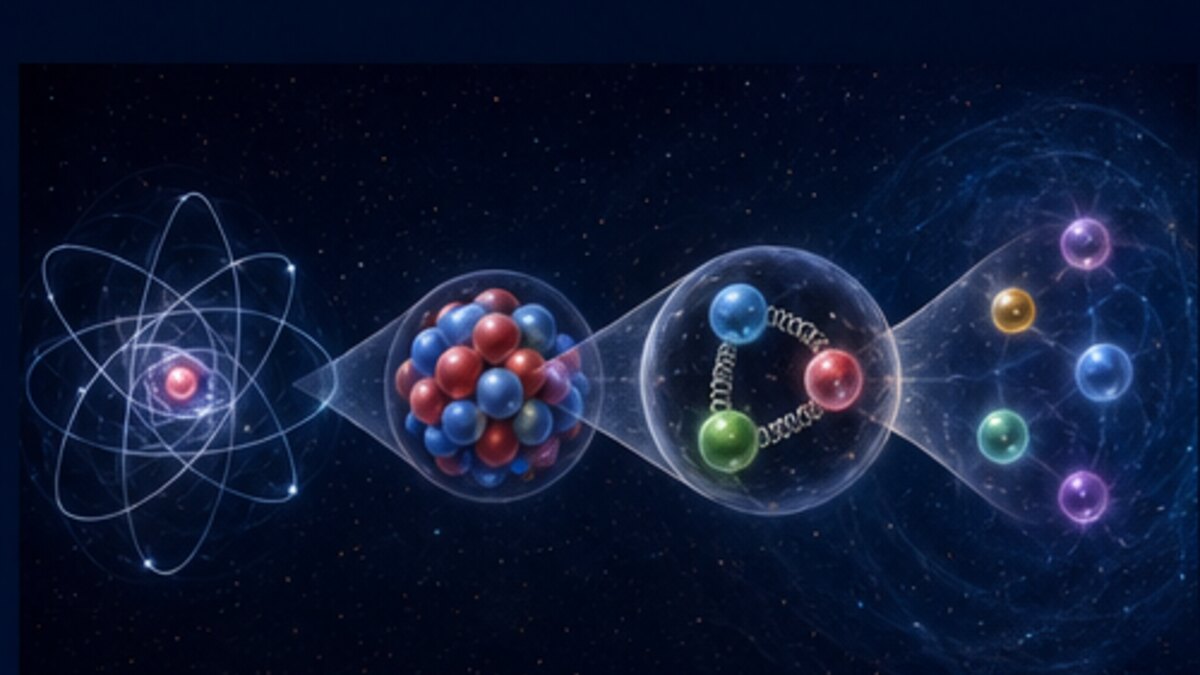
Successive levels of structure lead from the atom to the elementary fields used in modern particle physics.
02CHAPTER

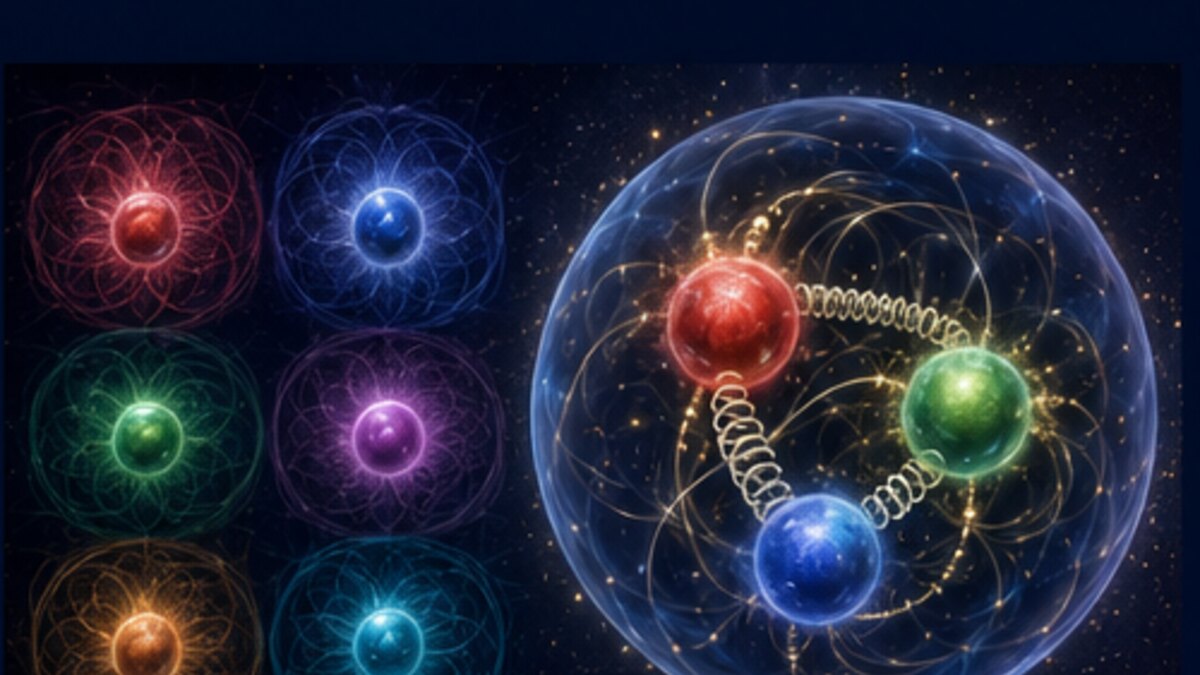
Six flavors build strongly interacting matter.

Quarks and color confinement

IN PLAIN LANGUAGE

Here is the big picture: Six flavors build strongly interacting matter. The main point to remember is this: Six quark flavors carry fractional electric and color charge.

See the fuller scientific explanation +

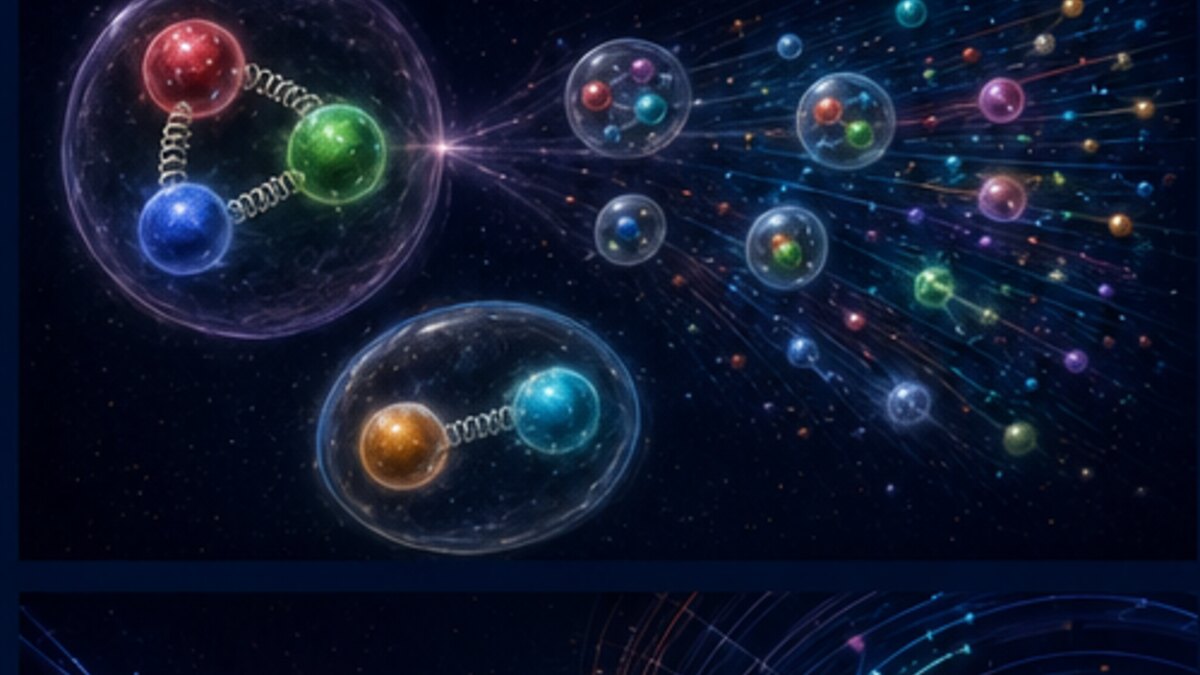
Quarks come in six flavors: up, down, charm, strange, top, and bottom. They carry fractional electric charge and a strong-interaction charge called color. Ordinary protons contain two up quarks and one down quark; neutrons contain one up and two down, accompanied by a dynamic sea of gluons and short-lived quark–antiquark pairs.

No isolated quark has been observed because the strong force does not fade in the simple way electromagnetism does. Pulling quarks apart stores energy in the gluon field until new hadrons are created. At very short distances the interaction weakens—a property called asymptotic freedom—allowing high-energy scattering to reveal quarklike constituents.

THE POINTS TO REMEMBER
Six quark flavors carry fractional electric and color charge
Color confinement prevents free quarks under ordinary conditions
Asymptotic freedom makes quarks behave more independently at short distances

NEXT Now that this piece is in place, we can turn to Leptons and neutrinos.

Quarks and color confinement
Quarks are confined inside color-neutral hadrons by a constantly interacting gluon field.
03CHAPTER

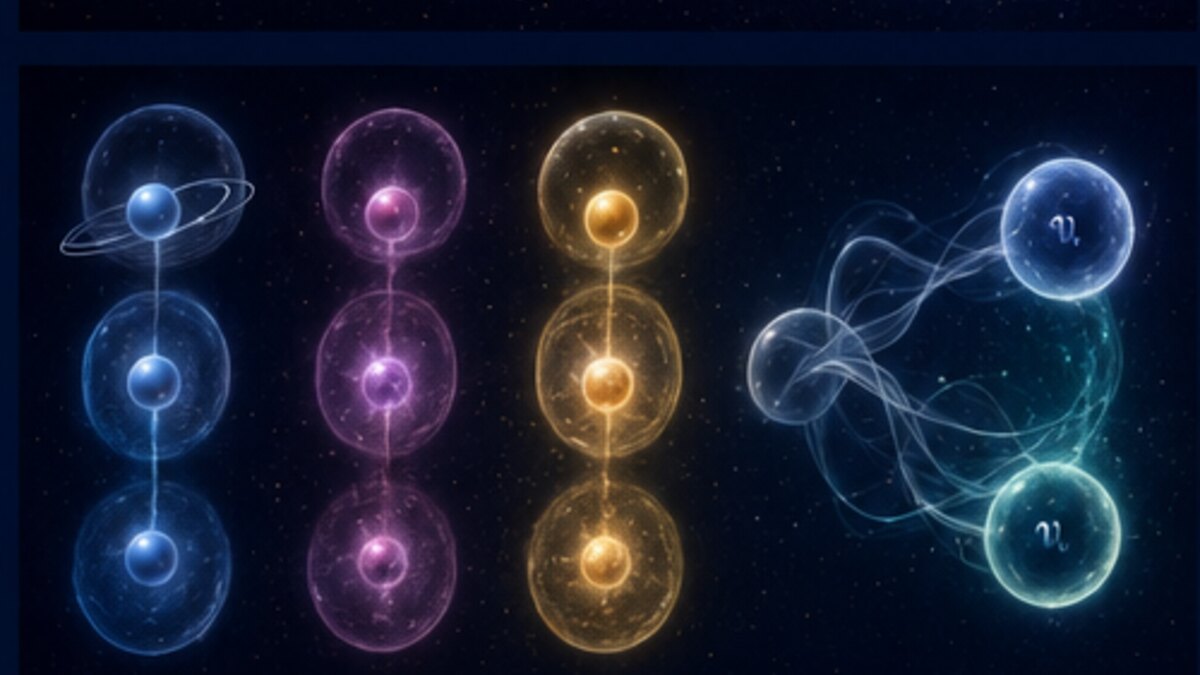
A second matter family avoids the strong force.

Leptons and neutrinos

IN PLAIN LANGUAGE

Here is the big picture: A second matter family avoids the strong force. The main point to remember is this: Leptons occur in three generations.

See the fuller scientific explanation +

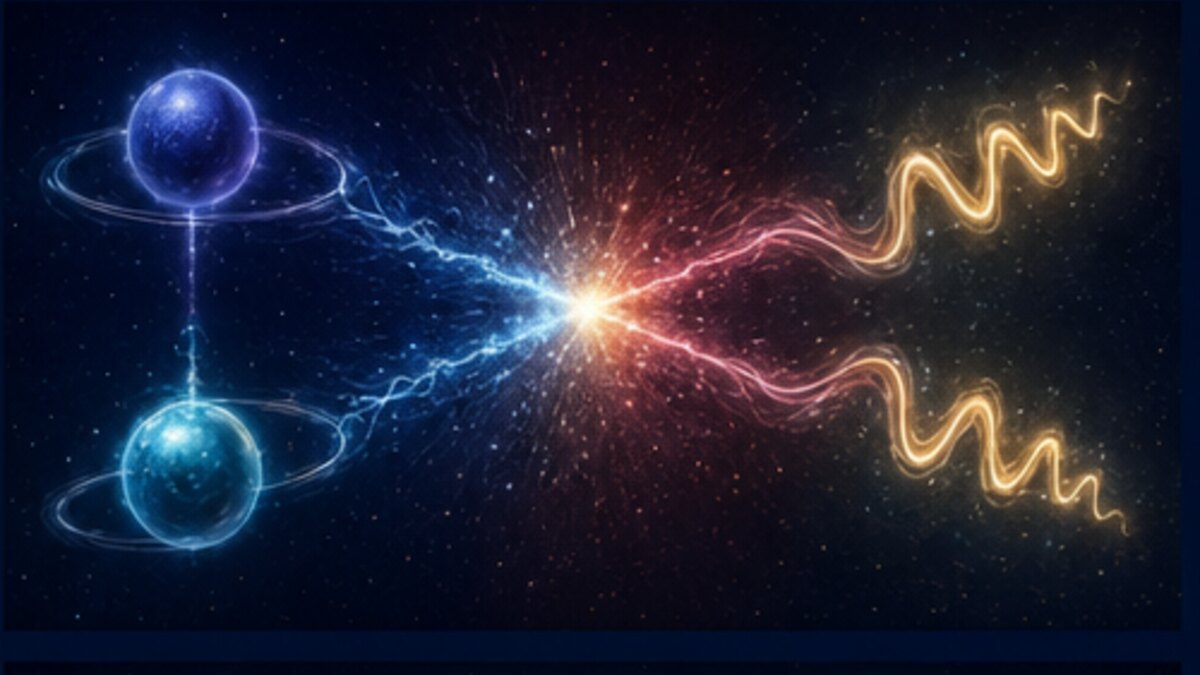
The charged leptons are the electron, muon, and tau. Each has a corresponding neutrino, producing three generations with the same interaction pattern but very different masses. Electrons stabilize atoms; muons and taus are heavier and unstable, decaying through the weak interaction.

Neutrinos have no electric charge and interact only weakly and gravitationally, so trillions pass through a person each second. They change flavor while traveling, demonstrating that they possess mass even though the minimal Standard Model originally treated them as massless. Their absolute masses, ordering, and possible matter–antimatter nature remain open questions.

THE POINTS TO REMEMBER
Leptons occur in three generations
Neutrino oscillation proves that neutrinos have mass
Neutrino properties point beyond the minimal Standard Model

NEXT Now that this piece is in place, we can turn to Force-carrying bosons.

Leptons and neutrinos
Neutrino flavor change is a quantum interference effect measured over terrestrial and astronomical distances.
04CHAPTER

Interactions are exchanges among quantum fields.

Force-carrying bosons

IN PLAIN LANGUAGE

Here is the big picture: Interactions are exchanges among quantum fields. The main point to remember is this: Gauge bosons mediate the Standard Model interactions.

See the fuller scientific explanation +

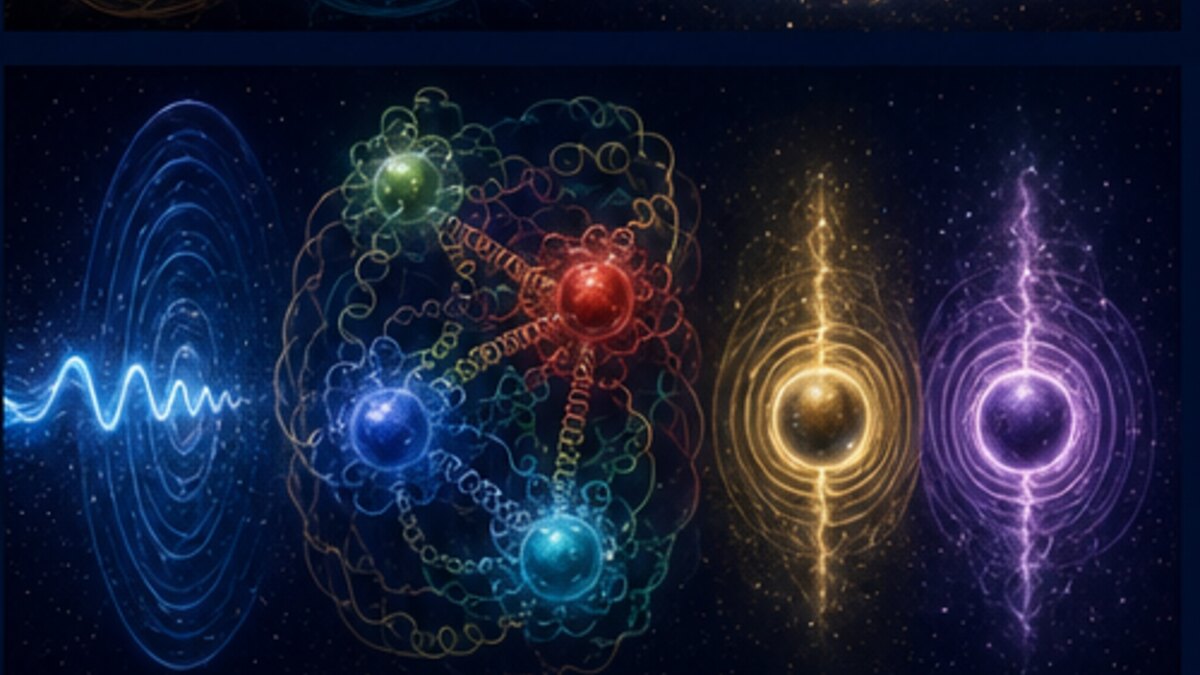
The photon mediates electromagnetism, eight types of gluon mediate the strong interaction, and the W+, W−, and Z bosons mediate the weak interaction. In quantum field theory, saying that a force is carried by particles is a shorthand for interactions among fields represented perturbatively through exchanged quanta.

Massless photons give electromagnetism unlimited range, while massive W and Z bosons make the weak force effective only across subatomic distances. Gluons are massless but carry color charge themselves, causing nonlinear self-interactions and confinement. Gravity is not included in the Standard Model, and a quantum graviton remains hypothetical.

THE POINTS TO REMEMBER
Gauge bosons mediate the Standard Model interactions
Boson mass and field behavior influence interaction range
The graviton is not part of the experimentally confirmed Standard Model

NEXT Now that this piece is in place, we can turn to The Higgs field and particle mass.

Force-carrying bosons
Different gauge bosons encode the distinct rules of electromagnetic, strong, and weak interactions.
05CHAPTER

A universal field changes how elementary particles move.

The Higgs field and particle mass

IN PLAIN LANGUAGE

Here is the big picture: A universal field changes how elementary particles move. The main point to remember is this: The Higgs field breaks electroweak symmetry.

See the fuller scientific explanation +

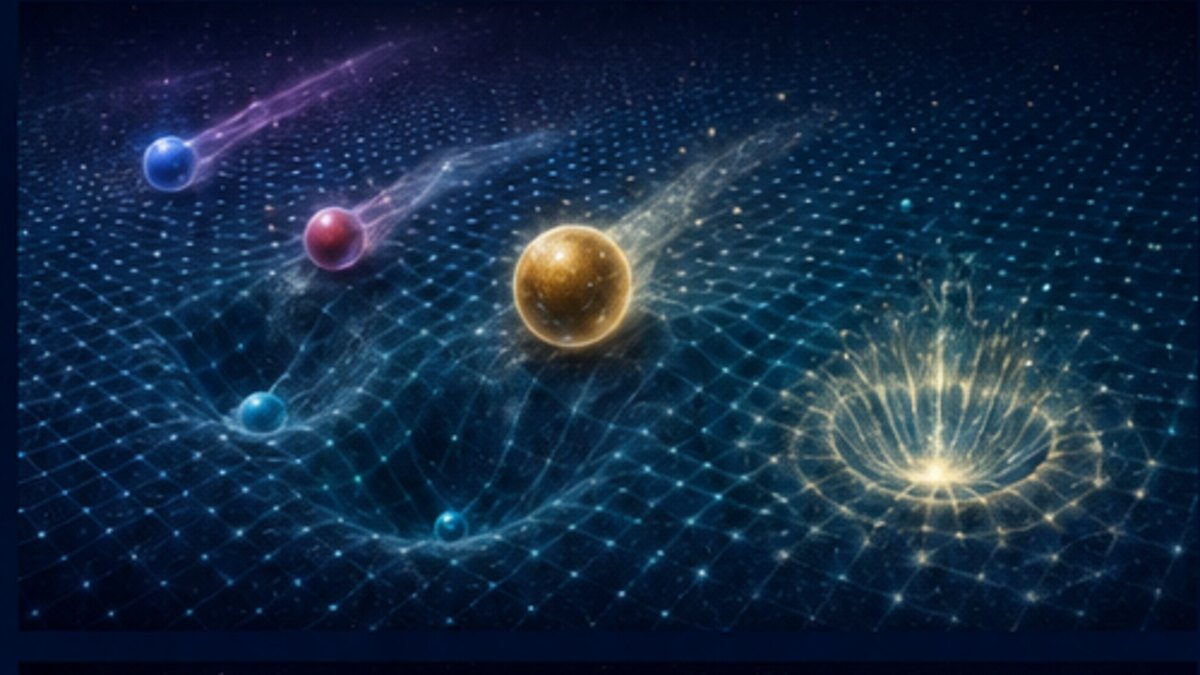
The Higgs field has a nonzero value throughout empty space. Electroweak symmetry breaking allows elementary particles such as W and Z bosons, quarks, and charged leptons to acquire mass through their coupling to this field. The Higgs boson, discovered in 2012, is a measurable excitation of the field.

The Higgs mechanism is often oversimplified as the source of all mass. It supplies the elementary masses appearing in the Standard Model, but most of the mass of protons and neutrons—and therefore most familiar matter—comes from the energy of confined quarks and gluons through the strong interaction. Neutrino mass may require additional physics.

THE POINTS TO REMEMBER
The Higgs field breaks electroweak symmetry
Coupling strength helps set elementary-particle masses
Most proton and neutron mass is QCD energy rather than constituent Higgs mass

NEXT Now that this piece is in place, we can turn to Antimatter.

The Higgs field and particle mass
The Higgs boson confirms an all-pervading field while leaving the origin of its own properties unexplained.
06CHAPTER

Every charged matter particle has an opposite counterpart.

Antimatter

IN PLAIN LANGUAGE

Here is the big picture: Every charged matter particle has an opposite counterpart. The main point to remember is this: Antiparticles match mass and reverse relevant charges.

See the fuller scientific explanation +

For each particle there is an antiparticle with the same mass and spin but opposite additive charges. The positron is the electron’s antiparticle; antiquarks carry opposite electric and color charges. Neutral particles may be distinct from their antiparticles or, in special cases, could be their own antiparticles.

Matter and antimatter can annihilate into other particles, but annihilation is a transformation rather than disappearance into nothing. High-energy radiation and collisions also create particle–antiparticle pairs. The observable universe contains far more matter than antimatter, so known differences in particle behavior appear insufficient to explain the cosmic imbalance.

THE POINTS TO REMEMBER
Antiparticles match mass and reverse relevant charges
Annihilation converts mass and kinetic energy into new excitations
Cosmic matter dominance remains an unsolved problem

NEXT Now that this piece is in place, we can turn to Hadrons: baryons and mesons.

Antimatter
Pair creation and annihilation reveal the symmetry—and small asymmetries—between matter and antimatter.
07CHAPTER

Quarks combine into a rich spectrum of composite particles.

Hadrons: baryons and mesons

IN PLAIN LANGUAGE

Here is the big picture: Quarks combine into a rich spectrum of composite particles. The main point to remember is this: Hadrons are composite color-neutral states.

See the fuller scientific explanation +

Hadrons are color-neutral objects bound by the strong interaction. Baryons contain three quarks and include protons and neutrons; antibaryons contain three antiquarks. Mesons contain a quark and an antiquark. More exotic arrangements such as tetraquarks and pentaquarks have also been observed as resonances.

A hadron is not merely the sum of fixed constituent masses. Gluons constantly split and interact, virtual quark pairs appear, and the entire quantum state contributes energy and momentum. Particle collisions commonly produce jets: collimated sprays of hadrons that preserve information about the original high-energy quark or gluon.

THE POINTS TO REMEMBER
Hadrons are composite color-neutral states
Baryons and mesons have different valence-quark structures
Jets translate unobservable quarks and gluons into detectable hadrons

NEXT Now that this piece is in place, we can turn to Quantum numbers and symmetries.

Hadrons: baryons and mesons
The particle zoo is largely a spectrum of different strongly bound quark configurations.
08CHAPTER

Particle identities are defined by transformation rules.

Quantum numbers and symmetries

IN PLAIN LANGUAGE

Here is the big picture: Particle identities are defined by transformation rules. The main point to remember is this: Quantum numbers specify how states behave and transform.

See the fuller scientific explanation +

Particles are classified by mass, electric charge, spin, color, weak isospin, flavor, and other quantum numbers. Spin is intrinsic rotational motion with no exact classical analogue. Fermions have half-integer spin and obey the exclusion principle; bosons have integer spin and can occupy the same quantum state.

Modern particle theory is organized by symmetry. Continuous gauge symmetries determine allowed interactions and imply conservation laws, while discrete charge, parity, and time-reversal transformations test deeper patterns. Some symmetries are exact, some are broken, and subtle violations such as CP violation are experimentally essential.

THE POINTS TO REMEMBER
Quantum numbers specify how states behave and transform
Gauge symmetry determines interaction structure
Broken symmetries reveal important physical differences

NEXT Now that this piece is in place, we can turn to Interactions, decays, and amplitudes.

Quantum numbers and symmetries
A small set of quantum numbers organizes the apparent complexity of the subatomic world.
09CHAPTER

Particle events are probabilities constrained by conservation laws.

Interactions, decays, and amplitudes

IN PLAIN LANGUAGE

Here is the big picture: Particle events are probabilities constrained by conservation laws. The main point to remember is this: Conservation laws restrict possible reactions.

See the fuller scientific explanation +

Unstable particles decay when lighter final states satisfy conservation rules. A neutron outside a nucleus can beta-decay into a proton, electron, and antineutrino through the weak interaction. Lifetimes and branching fractions arise from interaction strengths, available phase space, and quantum amplitudes.

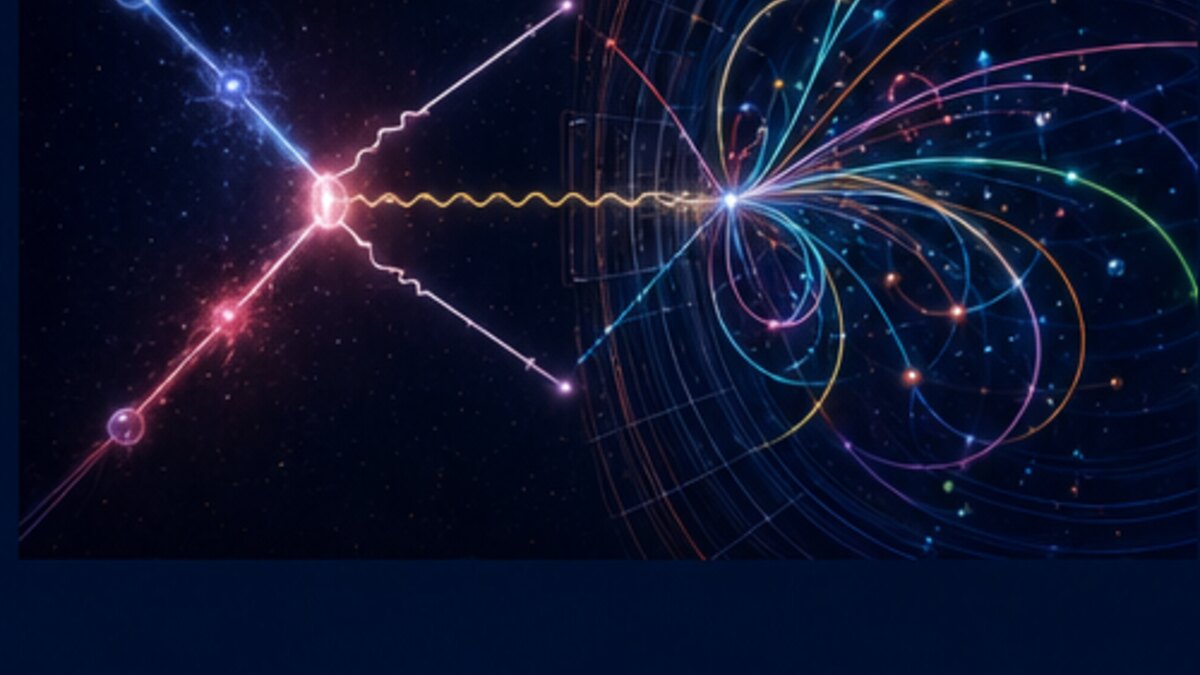
Feynman diagrams are bookkeeping tools for terms in a perturbative calculation, not literal snapshots of hidden particles traveling along drawn paths. Amplitudes for all relevant alternatives are combined before probabilities are calculated, which produces interference. Detectors then reconstruct a statistical pattern from many individual collision events.

THE POINTS TO REMEMBER
Conservation laws restrict possible reactions
Decay rates depend on amplitudes and available final states
Feynman diagrams represent mathematical contributions, not microscopic photographs

NEXT Now that this piece is in place, we can turn to Accelerators, detectors, and the frontier.

Interactions, decays, and amplitudes
Curved detector tracks are reconstructed evidence; the underlying quantum interaction is described by amplitudes.
10CHAPTER

Experiments turn invisible interactions into measurable traces.

Accelerators, detectors, and the frontier

IN PLAIN LANGUAGE

Here is the big picture: Experiments turn invisible interactions into measurable traces. The main point to remember is this: Detectors infer particles from interactions with matter.

See the fuller scientific explanation +

Accelerators use electric fields to raise particle energies and magnets to steer and focus beams. Collisions concentrate energy into a tiny region, creating heavy short-lived states. Layered detectors measure tracks, deposited energy, timing, particle showers, and missing transverse momentum; no detector simply takes a photograph of an elementary particle.

The Standard Model predicts collider measurements with remarkable accuracy, yet it omits quantum gravity and does not explain dark matter, dark energy, the matter–antimatter imbalance, neutrino masses, or the pattern of particle generations. Colliders, neutrino observatories, underground searches, precision measurements, and cosmic messengers attack these gaps from complementary directions.

THE POINTS TO REMEMBER
Detectors infer particles from interactions with matter
Independent detector layers reconstruct each event
Known unanswered questions require physics beyond the Standard Model
Accelerators, detectors, and the frontier
The frontier combines accelerators, precision experiments, and astronomical observations to search for missing physics.

THE ESSENTIAL THREAD

Three ideas worth keeping.

  1. 01Quarks and leptons make matter; bosons carry three of the known forces.
  2. 02Most everyday mass comes from energy inside protons and neutrons.
  3. 03The Standard Model works beautifully, but it is not the final story.

CONTINUE WITH PRIMARY SOURCES

Explore the evidence.

CERN: The Standard ModelCERN: The Higgs BosonCERN: How a Detector Works
NEXT LEARNING PATH

Astrobiology

Continue your journey →