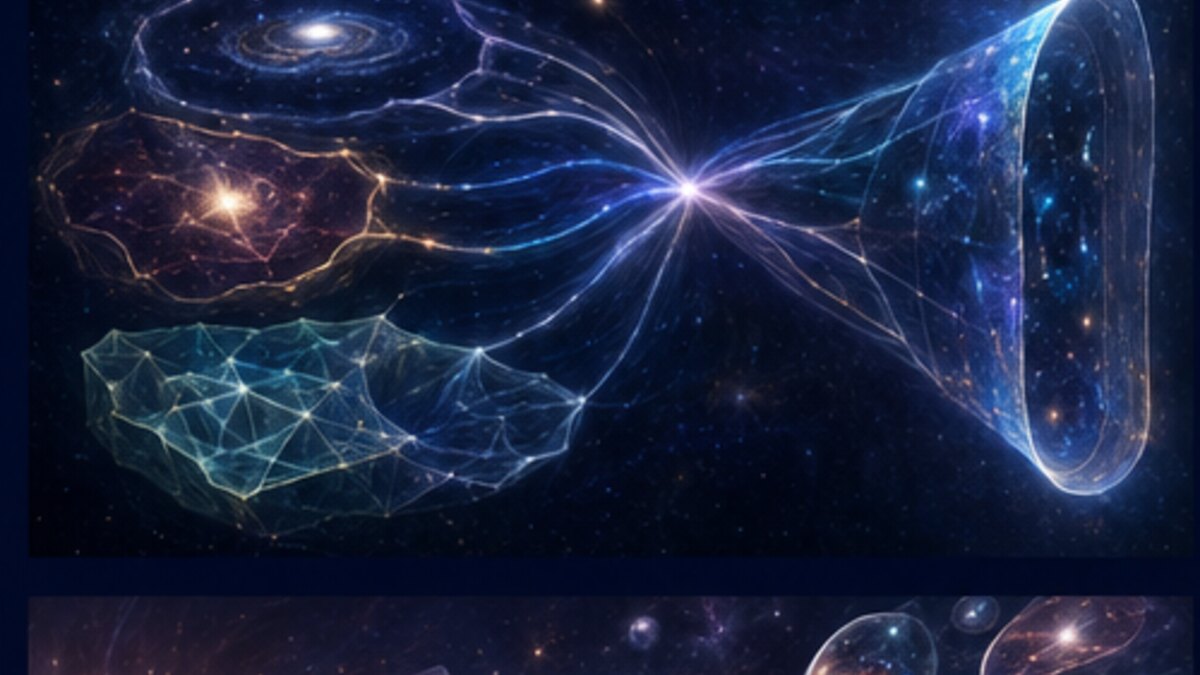
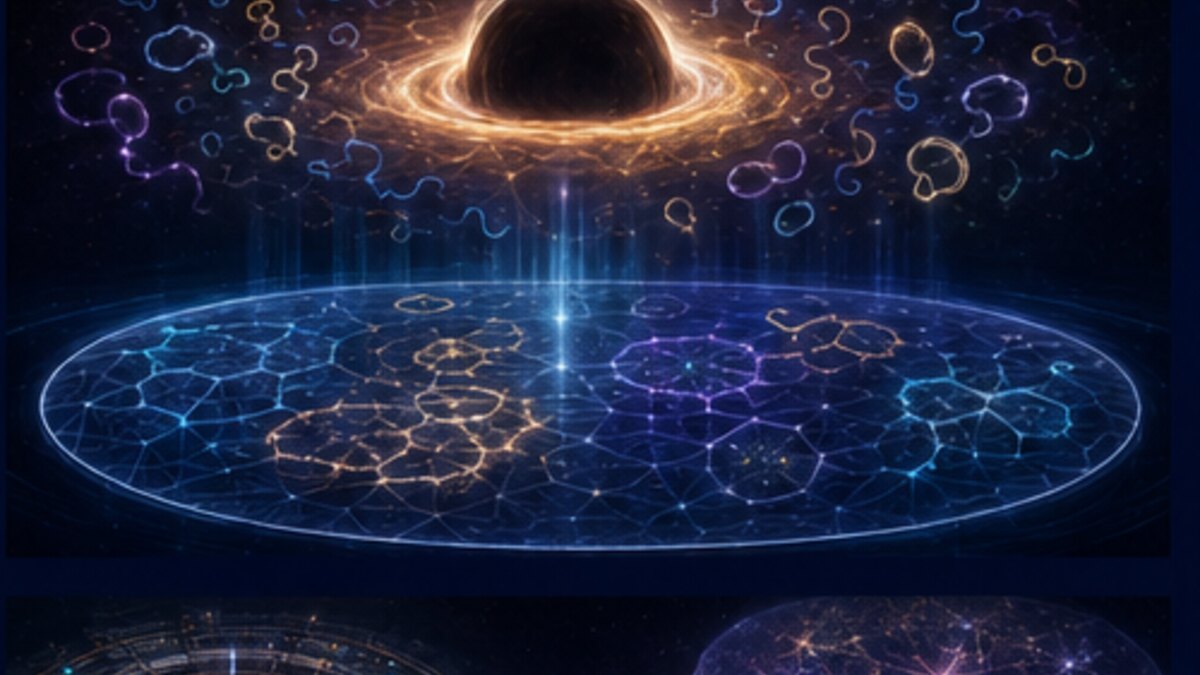
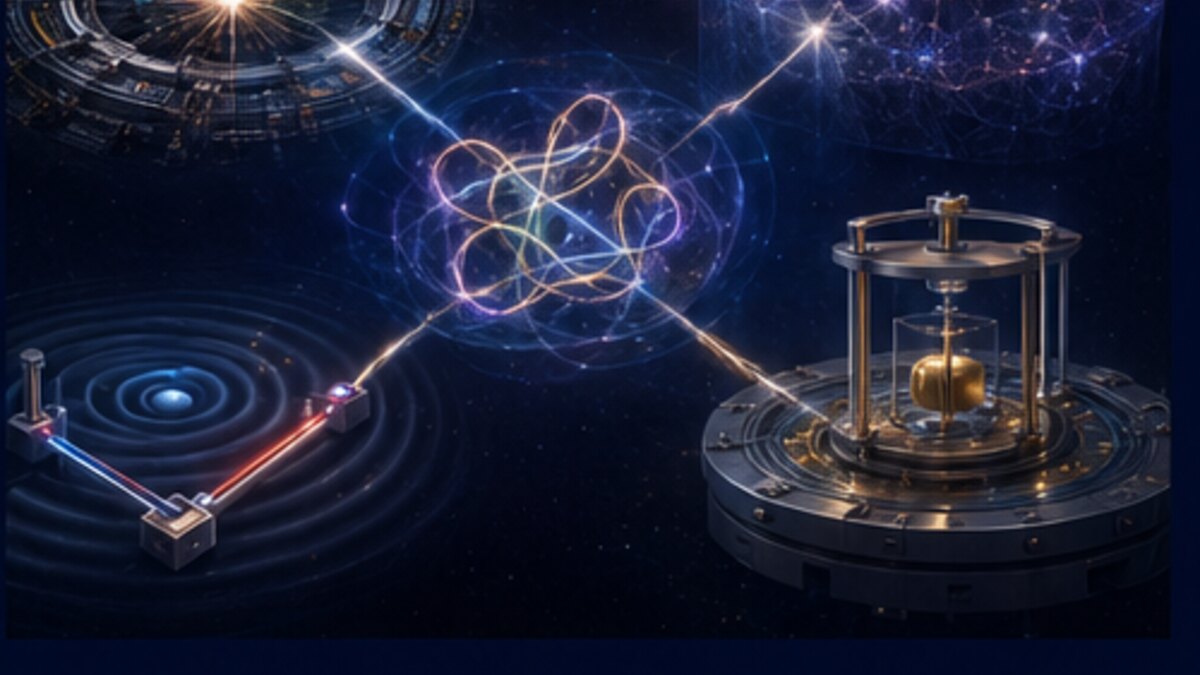
String theory asks whether the smallest building blocks of nature might be tiny vibrating strings rather than point-like particles. Different vibrations could appear as different particles, and the mathematics naturally includes gravity and extra dimensions. The idea is powerful, but no experiment has yet shown that strings or extra dimensions truly exist.
Start with the short explanation in each chapter. Open “Go a little deeper” only when you want more detail. The final line shows how the next chapter follows from the one you just read.
01CHAPTER
Extended objects soften the shortest-distance problem.
Why replace points with strings?
IN PLAIN LANGUAGE
Here is the big picture: Extended objects soften the shortest-distance problem. The main point to remember is this: Strings replace pointlike interaction vertices with smooth worldsheets.
See the fuller scientific explanation +
The Standard Model treats electrons, quarks, and other elementary particles as points. Quantum field theory describes their nongravitational interactions with extraordinary precision, but direct attempts to quantize general relativity generate uncontrollable short-distance divergences. String theory changes the fundamental ingredient: a particle-like event is produced by a one-dimensional object tracing a two-dimensional worldsheet through the connected fabric of space and time.
Because an interaction is spread over the string length rather than concentrated at a mathematical point, high-energy behavior can be better controlled. One vibration mode behaves like a massless spin-two particle—the properties expected of a graviton—so quantum gravity is not added by hand. This is the framework’s central achievement, not evidence that physical strings have been observed.
THE POINTS TO REMEMBER
✦Strings replace pointlike interaction vertices with smooth worldsheets
✦A graviton-like mode appears automatically
✦Mathematical consistency does not by itself establish physical reality
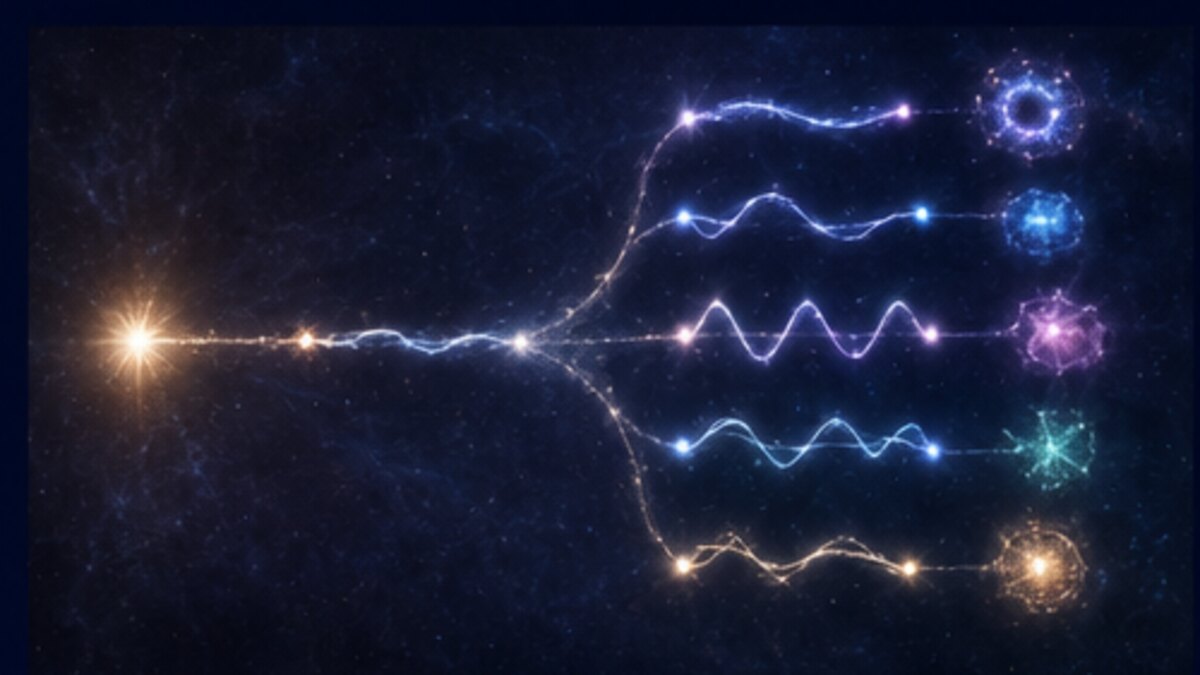
A string’s permitted vibrations can appear at accessible scales as different particle species.
02CHAPTER
Topology determines interactions and particle roles.
Open and closed strings
IN PLAIN LANGUAGE
Here is the big picture: Topology determines interactions and particle roles. The main point to remember is this: Joining and splitting replace pointlike collision vertices.
See the fuller scientific explanation +
An open string has two endpoints, while a closed string forms a loop. Strings split and join; the same basic process generates what a point-particle description would represent as many separate interaction rules. The strength of those interactions is controlled by the string coupling.
Closed-string spectra contain the graviton-like mode and therefore carry gravity. Open-string endpoints can support gauge interactions associated with forces such as electromagnetism and the nuclear interactions. Consistent theories may contain both types because an open-string quantum loop can be reinterpreted as a closed string moving between parts of the interaction.
THE POINTS TO REMEMBER
✦Joining and splitting replace pointlike collision vertices
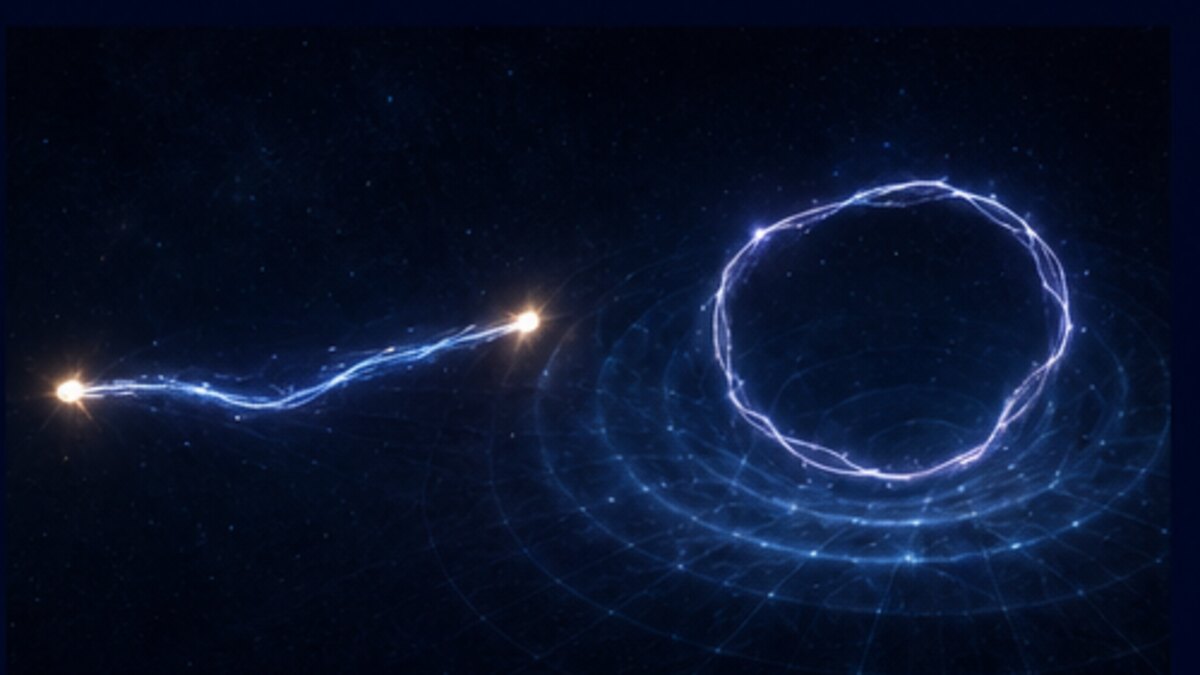
Open segments and closed loops support different spectra yet belong to one interacting framework.
03CHAPTER
Consistency links matter-like and force-like states.
Supersymmetry and superstrings
IN PLAIN LANGUAGE
Here is the big picture: Consistency links matter-like and force-like states. The main point to remember is this: Superstrings include fermions and require ten-dimensional the connected fabric of space and time.
See the fuller scientific explanation +
The earliest bosonic string theory requires 26 the connected fabric of space and time dimensions and contains an unstable tachyonic state. Adding supersymmetry to the worldsheet relates bosonic and fermionic degrees of freedom, removes that particular instability, and yields superstring theories in ten the connected fabric of space and time dimensions.
Supersymmetry predicts a structural partnership between fermions and bosons, but no superpartner of a known particle has been confirmed. Supersymmetry could be broken at energies beyond current accelerators, realized in a more complicated form, or absent from nature. In string theory it remains a powerful mathematical ingredient rather than an experimental discovery.
THE POINTS TO REMEMBER
✦Superstrings include fermions and require ten-dimensional the connected fabric of space and time
✦Supersymmetry improves theoretical consistency
✦No supersymmetric partner particle has been observed
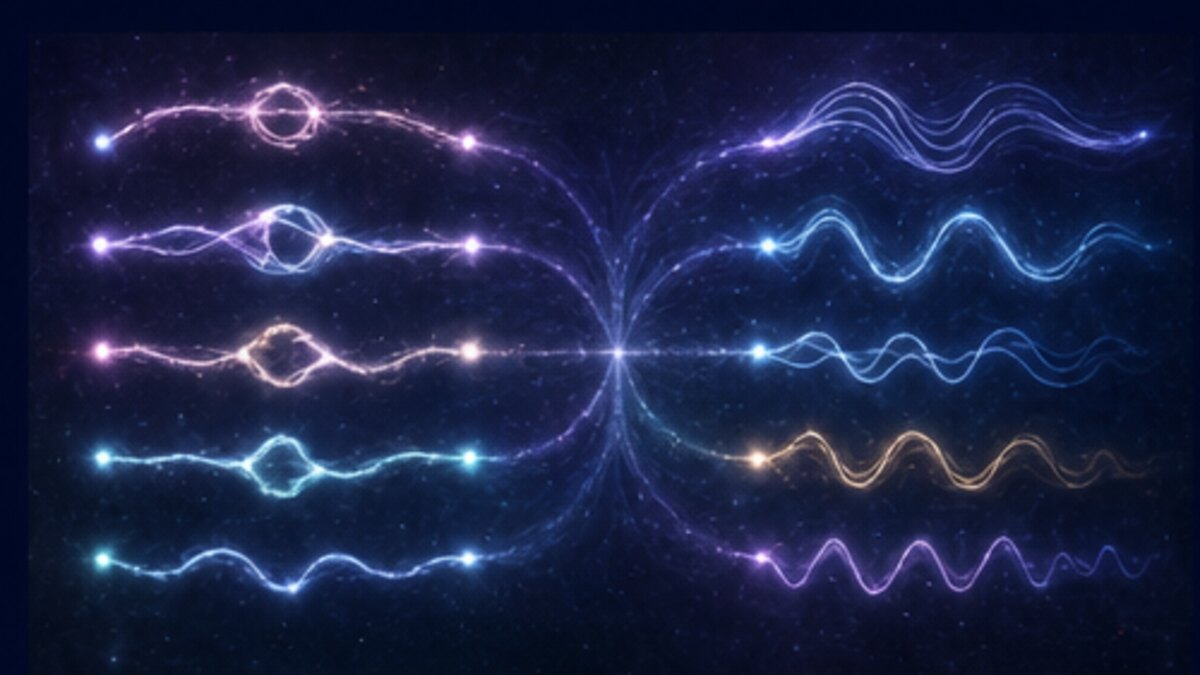
Supersymmetry organizes quantum states into paired bosonic and fermionic families.
04CHAPTER
Extra directions can be real yet difficult to access.
Higher dimensions and compactification
IN PLAIN LANGUAGE
Here is the big picture: Extra directions can be real yet difficult to access. The main point to remember is this: Compact dimensions can hide below current resolution.
See the fuller scientific explanation +
A theory formulated in ten dimensions must explain why everyday physics exposes only three large spatial dimensions and one time dimension. the idea that extra dimensions are curled up too small to see proposes that the remaining spatial directions are curled into extremely small geometries. A garden hose viewed from far away appears one-dimensional, while an ant can also move around its narrow circumference.
Motion and fields in compact directions appear in four dimensions as particle properties and towers of increasingly massive Kaluza–Klein states. Their absence in experiments constrains the size and geometry of extra dimensions. Other scenarios allow some dimensions to be larger while ordinary matter remains confined to a lower-dimensional brane.
THE POINTS TO REMEMBER
✦Compact dimensions can hide below current resolution
✦Geometry in extra dimensions becomes particle physics in four dimensions
✦Searches for Kaluza–Klein states constrain higher-dimensional models
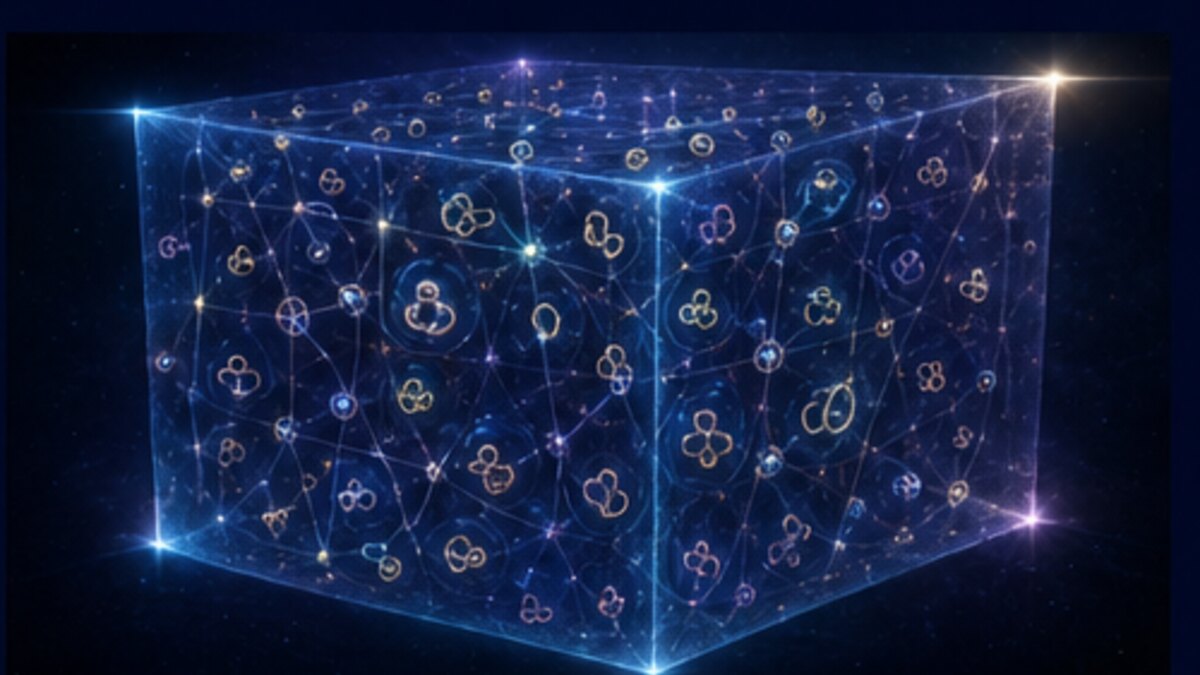
Small curled directions may accompany every point of familiar extended space.
05CHAPTER
The shape of hidden space helps determine visible physics.
Calabi–Yau geometry
IN PLAIN LANGUAGE
Here is the big picture: The shape of hidden space helps determine visible physics. The main point to remember is this: Compact geometry controls the low-energy spectrum.
See the fuller scientific explanation +
A common the idea that extra dimensions are curled up too small to see uses a six-dimensional Calabi–Yau manifold whose geometric properties preserve part of the original supersymmetry. The manifold is not an object sitting somewhere inside ordinary space; it describes the compact directions associated with each point in the large dimensions.
Allowed string vibrations depend on cycles, curvature, topology, fluxes, and other geometric data. Those features influence the number and behavior of low-energy fields, couplings, and particle families. Many possible manifolds and stabilization choices exist, creating both explanatory flexibility and a difficult selection problem.
THE POINTS TO REMEMBER
✦Compact geometry controls the low-energy spectrum
✦Topology can influence particle families and interactions
✦Many viable geometries make unique predictions difficult
A Calabi–Yau space is a mathematical model for compact dimensions, not a directly imaged structure.
06CHAPTER
Strings can end on higher-dimensional surfaces.
D-branes and the bulk
IN PLAIN LANGUAGE
Here is the big picture: Strings can end on higher-dimensional surfaces. The main point to remember is this: Open strings can terminate on D-branes.
See the fuller scientific explanation +
D-branes are dynamical extended objects on which open-string endpoints are confined. A Dp-brane has p spatial dimensions: a D0-brane is pointlike, a D1-brane resembles a string, and higher values describe extended volumes. Gauge fields and matter can live on branes, while closed strings—including gravitational modes—move through the higher-dimensional bulk.
This separation inspired braneworld models in which the observable universe behaves like a brane embedded in a larger space. D-branes also carry charges, contribute to black-hole microstate counting, and make nonperturbative physics accessible. They are essential mathematical objects in modern string theory, not confirmed cosmic membranes.
THE POINTS TO REMEMBER
✦Open strings can terminate on D-branes
✦Closed strings can propagate through the bulk
✦Branes connect gauge theory, gravity, and nonperturbative physics
A brane can localize open-string physics while gravity explores a larger-dimensional arena.
07CHAPTER
Different theories can describe the same underlying physics.
Dualities and M-theory
IN PLAIN LANGUAGE
Here is the big picture: Different theories can describe the same underlying physics. The main point to remember is this: T-duality exchanges small and large compact scales.
See the fuller scientific explanation +
Five consistent ten-dimensional superstring theories were once treated as separate candidates. Dualities later showed that they are connected. T-duality relates a theory compactified on a small circle to another on a large circle, exchanging momentum and winding modes. S-duality can relate strong coupling in one description to weak coupling in another.
At strong coupling, one superstring theory develops an additional dimension and connects to an eleven-dimensional framework called M-theory. Its complete fundamental formulation is not known, but its low-energy limit and network of branes and dualities suggest that strings are part of a broader structure whose different descriptions apply in different regimes.
THE POINTS TO REMEMBER
✦T-duality exchanges small and large compact scales
✦S-duality links strong and weak coupling
✦M-theory unifies string descriptions in an eleven-dimensional framework
Dualities reveal that apparently different theories may be complementary coordinate systems on one deeper structure.
08CHAPTER
Quantum gravity turns horizons into information systems.
Black holes and holography
IN PLAIN LANGUAGE
Here is the big picture: Quantum gravity turns horizons into information systems. The main point to remember is this: Black-hole a measure related to disorder and hidden information can be reproduced by counting string-theory microstates.
See the fuller scientific explanation +
String theory achieved a major conceptual success by counting microscopic configurations of certain idealized supersymmetric black holes and reproducing the Bekenstein–Hawking a measure related to disorder and hidden information proportional to horizon area. This does not yet provide a complete microscopic description of every astrophysical black hole, but it shows that horizon a measure related to disorder and hidden information can arise from identifiable quantum states.
The AdS/CFT correspondence gives an exact duality in well-defined examples: a gravitational string theory in a higher-dimensional anti-de Sitter the connected fabric of space and time is equivalent to a nongravitational quantum field theory on its lower-dimensional boundary. It is the clearest realization of holography and a powerful tool for quantum gravity, nuclear physics, and strongly coupled systems, although our accelerating universe is not anti-de Sitter space.
THE POINTS TO REMEMBER
✦Black-hole a measure related to disorder and hidden information can be reproduced by counting string-theory microstates
✦Holography maps a gravitational bulk to a lower-dimensional quantum theory
✦Established AdS/CFT examples do not yet directly describe our universe
Holography suggests that information about a gravitational volume may be encoded on a lower-dimensional boundary.
09CHAPTER
Compact dimensions create many possible low-energy universes.
String cosmology and the landscape
IN PLAIN LANGUAGE
Here is the big picture: Compact dimensions create many possible low-energy universes. The main point to remember is this: String ingredients support several early-universe scenarios.
See the fuller scientific explanation +
Strings, branes, and additional fields can participate in early-universe models, including versions of inflation, cosmic superstrings, pre–Big Bang scenarios, and mechanisms for producing dark matter. These proposals must eventually reproduce the observed nearly uniform universe, its fluctuation spectrum, ordinary particle physics, and late-time expansion.
Stabilizing compact dimensions with fields and fluxes produces a vast landscape of possible vacuum states with different effective constants and particles. Some physicists use environmental or anthropic selection within this landscape; others view the lack of unique low-energy predictions as a warning. The swampland program instead seeks principles separating effective theories that can arise from quantum gravity from those that cannot.
THE POINTS TO REMEMBER
✦String ingredients support several early-universe scenarios
✦Vacuum choices can change four-dimensional physics
✦Landscape and swampland research address predictivity
The string landscape represents a space of theoretical solutions, not a directly observed collection of universes.
10CHAPTER
A compelling framework still needs contact with nature.
Evidence, tests, and open questions
IN PLAIN LANGUAGE
Here is the big picture: A compelling framework still needs contact with nature. The main point to remember is this: Direct evidence for strings or extra dimensions is absent.
See the fuller scientific explanation +
No experiment has directly detected a fundamental string, extra dimension, supersymmetric particle, or Kaluza–Klein excitation. The natural string scale may be close to the Planck length, far beyond current accelerator energies. Researchers therefore test model-dependent consequences: missing-energy signatures, deviations from inverse-square gravity, cosmic strings, altered primordial signals, dark-matter candidates, and consistency relations in black-hole and quantum-gravity physics.
Null results already exclude portions of parameter space, but the framework’s flexibility makes decisive tests difficult. String theory should be judged with two truths held together: it has produced deep mathematical insights and the most developed examples of quantum gravity, while it has not yet supplied a unique experimentally verified description of our universe.
THE POINTS TO REMEMBER
✦Direct evidence for strings or extra dimensions is absent
✦Observable predictions depend strongly on the idea that extra dimensions are curled up too small to see and symmetry breaking
✦The central challenge is turning mathematical consistency into discriminating tests
The experimental frontier asks which observable, if any, can distinguish string theory from other quantum-gravity ideas.
THE ESSENTIAL THREAD
Three ideas worth keeping.
01Different particle types can arise as different string vibration modes.
02Extra dimensions must be hidden, compactified, or otherwise inaccessible at ordinary energies.
03String theory has transformed quantum-gravity research but has no decisive experimental confirmation.