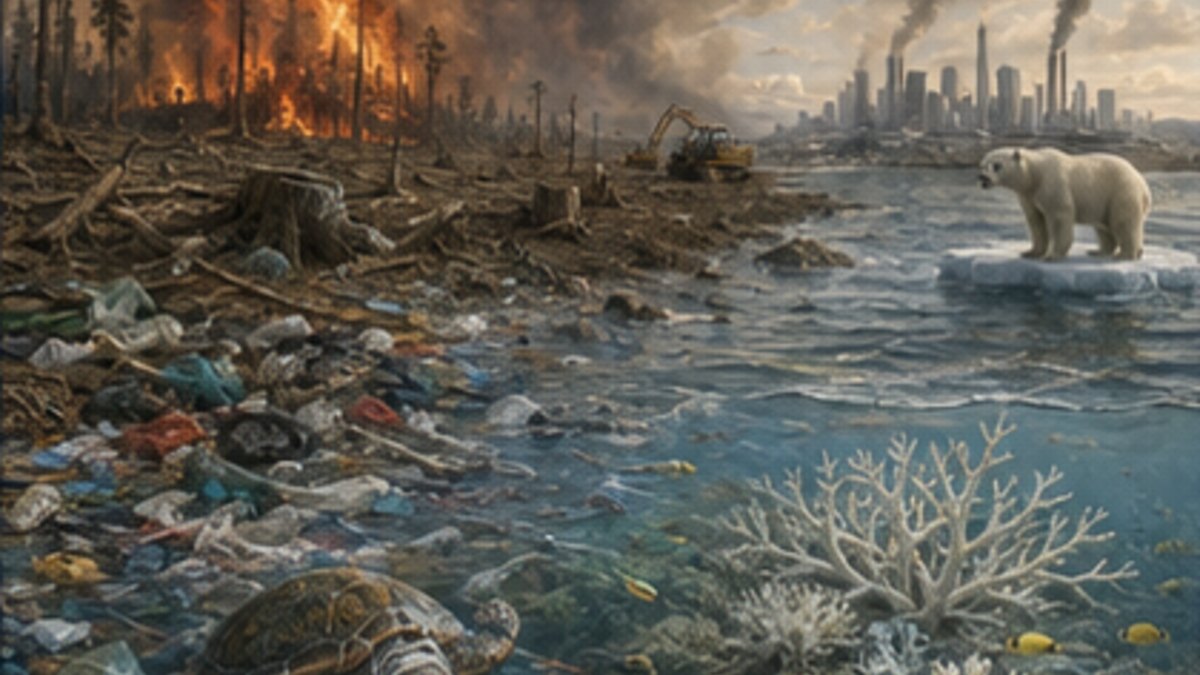
Five times in Earth’s history, a large share of the planet’s species disappeared within a relatively short geological period. These disasters shattered ecosystems, but they did not end life. The survivors eventually spread into newly available habitats and changed the direction of evolution.
Start with the short explanation in each chapter. Open “Go a little deeper” only when you want more detail. The final line shows how the next chapter follows from the one you just read.
01CHAPTER
How paleontologists recognize a global biological crisis.
Reading extinction in rocks
IN PLAIN LANGUAGE
Here is the big picture: How paleontologists recognize a global biological crisis. The main point to remember is this: Extinction must be global and taxonomically broad.
See the fuller scientific explanation +
The fossil record is incomplete, so mass extinction is not simply a count of missing species. Researchers compare disappearance rates across many regions, environments, and groups while accounting for rock availability, dating uncertainty, and sampling bias.
A mass extinction is distinguished by unusually rapid, widespread loss across the tree of life. Geochemical anomalies, impact debris, volcanic layers, climate proxies, and ecological changes help identify causes and sequence events.
THE POINTS TO REMEMBER
✦Extinction must be global and taxonomically broad
Sedimentary layers preserve biological turnover and environmental disruption.
02CHAPTER
Glaciation transforms an ocean-dominated world.
End-Ordovician extinction
IN PLAIN LANGUAGE
Here is the big picture: Glaciation transforms an ocean-dominated world. The main point to remember is this: Marine families suffered heavily.
See the fuller scientific explanation +
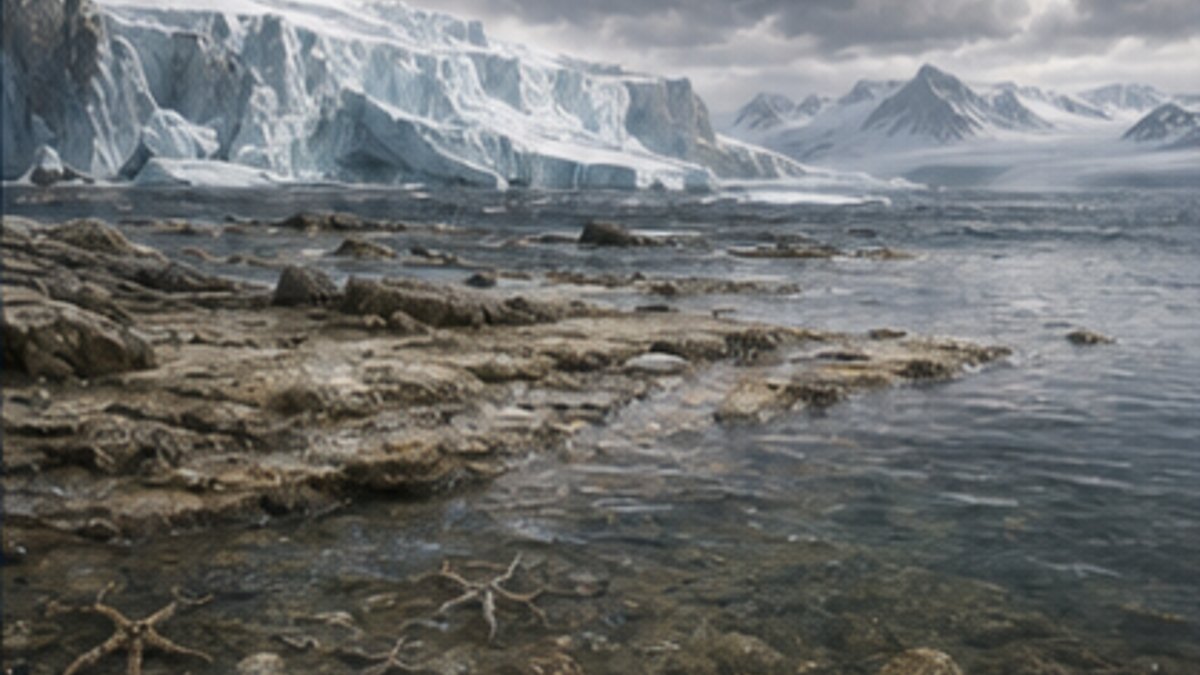
Around 444 million years ago, major extinction pulses struck marine communities. Rapid cooling, growth of ice sheets, and falling sea level removed shallow-water habitats; subsequent warming and ocean oxygen stress added further disruption.
The event shows that both cooling and warming can be dangerous when change is rapid. Because most complex life then lived in the sea, ocean chemistry and habitat area controlled the biological outcome.
Changing ice volume and sea level can reorganize global marine ecosystems.
03CHAPTER
A prolonged series of blows rather than one instant.
Late Devonian crisis
IN PLAIN LANGUAGE
Here is the big picture: A prolonged series of blows rather than one instant. The main point to remember is this: The crisis unfolded over millions of years.
See the fuller scientific explanation +
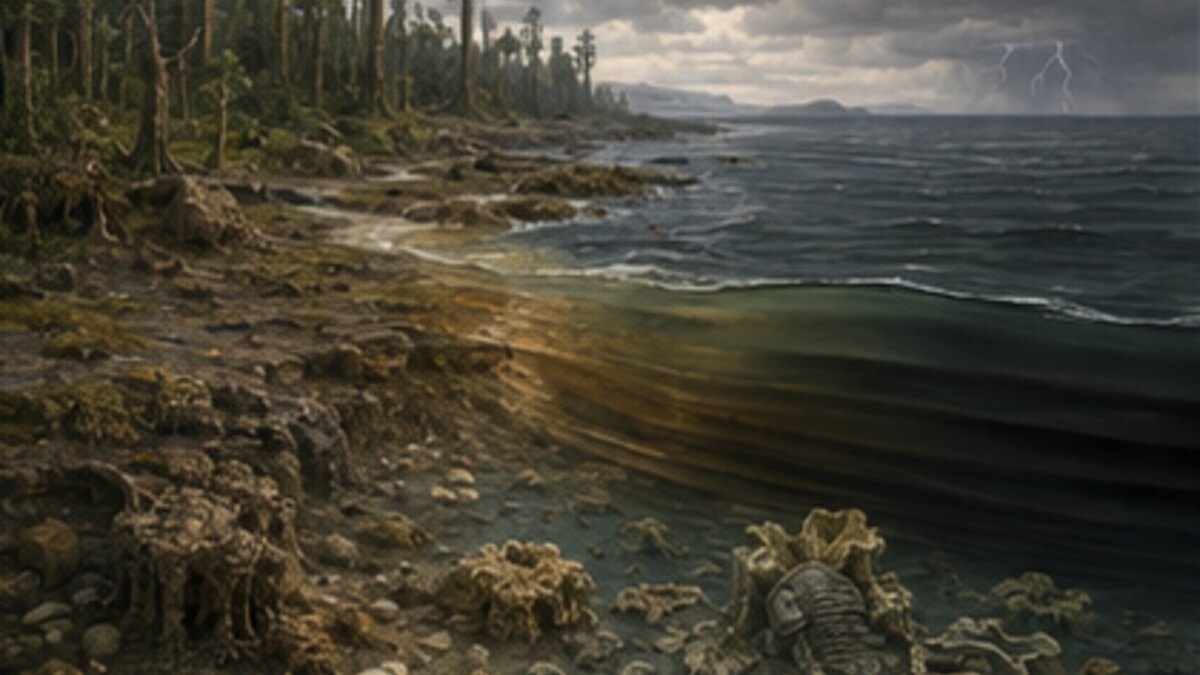
Between roughly 372 and 359 million years ago, extinction occurred in several pulses. Reef builders and many marine organisms declined severely. Evidence points toward widespread ocean anoxia, climate change, volcanism, nutrient runoff, and changing land ecosystems.
The expansion of forests may have increased weathering and nutrient delivery to seas, promoting algal growth and oxygen loss. This remains an active hypothesis, illustrating how evolutionary innovation on land can reshape oceans.
THE POINTS TO REMEMBER
✦The crisis unfolded over millions of years
✦Reef ecosystems were devastated
✦Land plants may have altered marine nutrient cycles
Ocean oxygen loss is a recurring mechanism in extinction intervals.
04CHAPTER
The most severe known mass extinction.
End-Permian: the Great Dying
IN PLAIN LANGUAGE
Here is the big picture: The most severe known mass extinction. The main point to remember is this: Large igneous volcanism was the primary driver.
See the fuller scientific explanation +
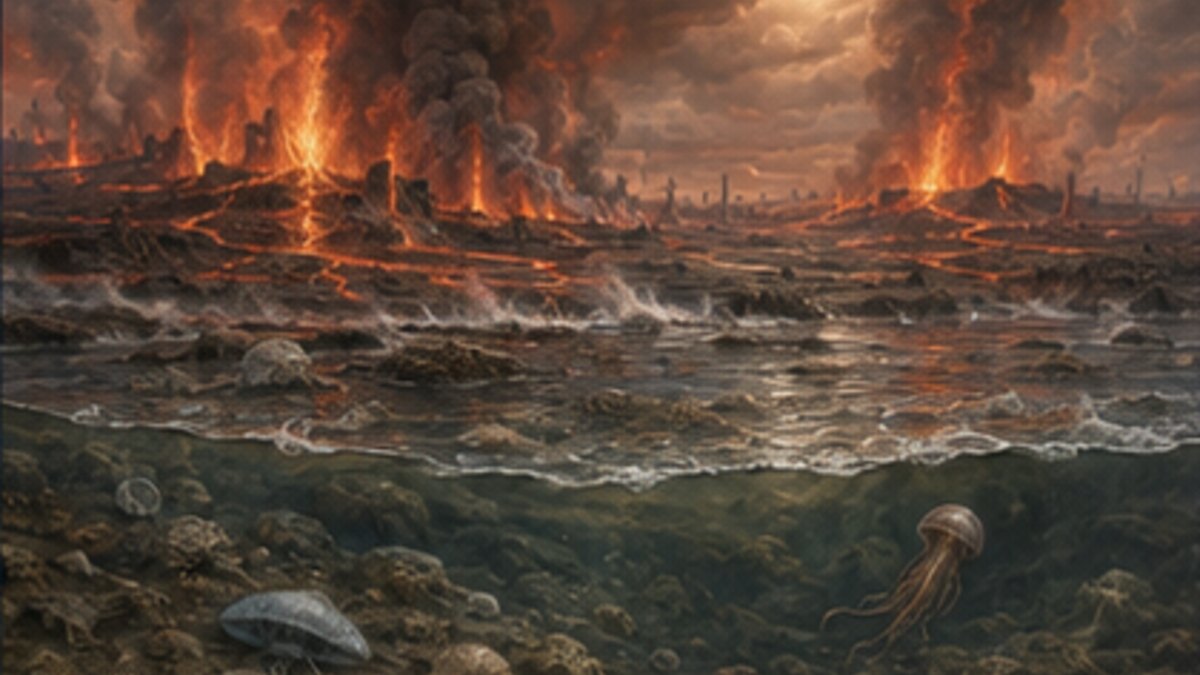
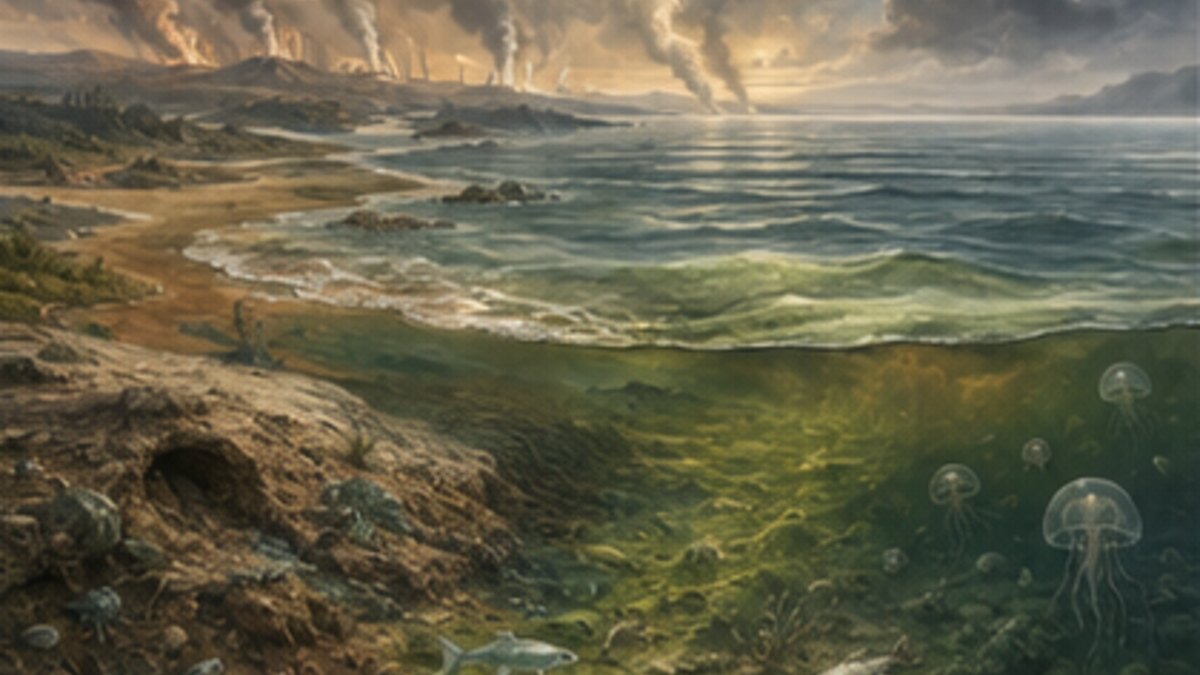
About 252 million years ago, extinction eliminated most marine species and many terrestrial vertebrate lineages. Vast Siberian Traps eruptions released carbon dioxide and other gases, driving rapid warming and destabilizing the carbon cycle.
Oceans warmed, acidified, and lost oxygen. Toxic conditions expanded, ecosystems simplified, and recovery took millions of years. The catastrophe was a cascade: volcanism initiated interacting physical and biological stresses rather than acting as a single isolated killer.
Enormous volcanic provinces can perturb climate and oceans on a planetary scale.
05CHAPTER
Volcanism clears ecological space for dinosaurs.
End-Triassic extinction
IN PLAIN LANGUAGE
Here is the big picture: Volcanism clears ecological space for dinosaurs. The main point to remember is this: Continental rifting triggered massive volcanism.
See the fuller scientific explanation +
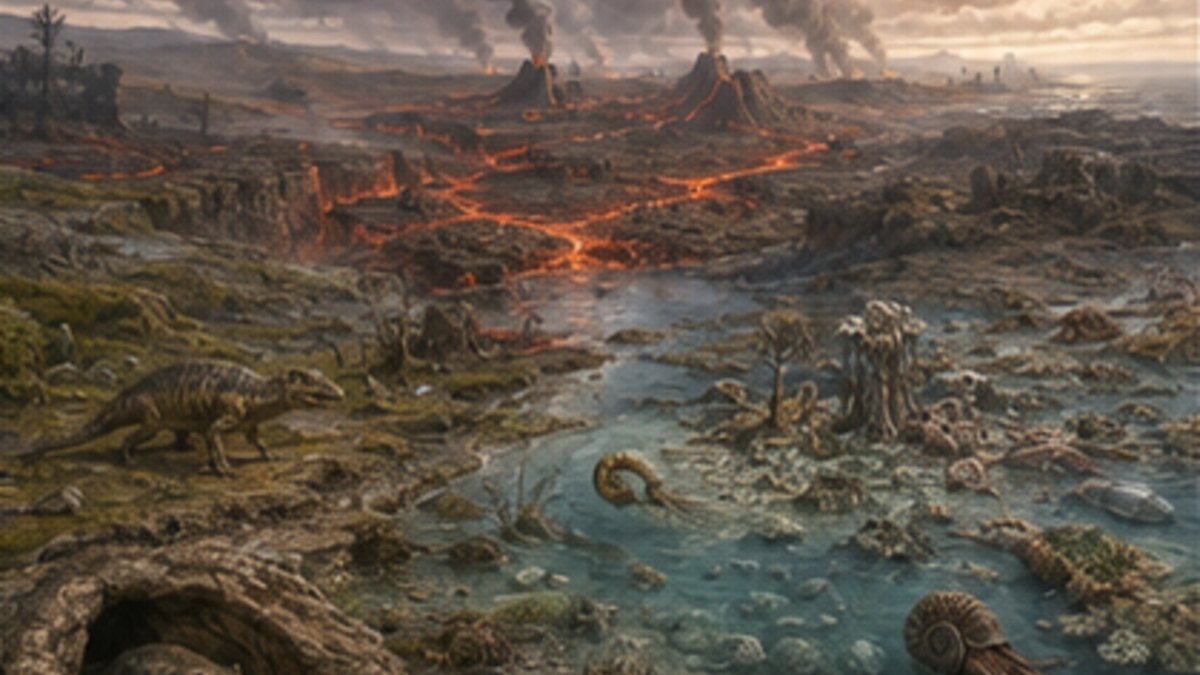
Around 201 million years ago, eruptions of the Central Atlantic Magmatic Province accompanied the breakup of Pangaea. Rapid greenhouse-gas release, warming, ocean acidification, and environmental instability eliminated many competitors of dinosaurs.
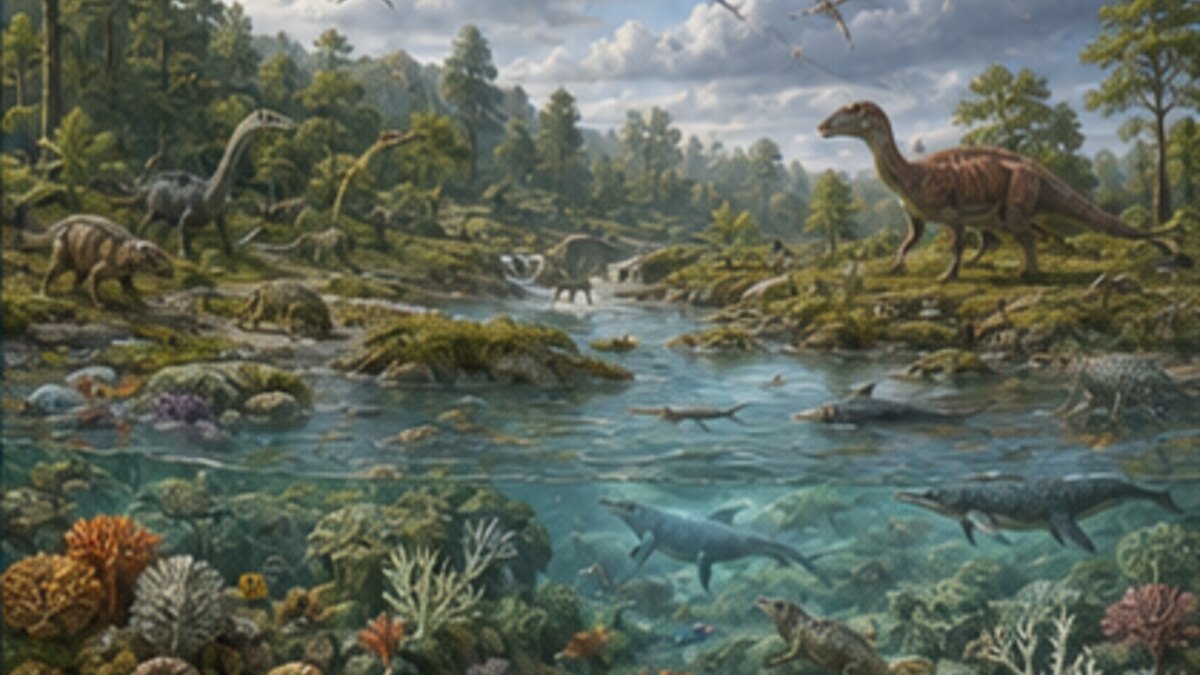
Dinosaurs already existed; the extinction did not create them. It changed ecological opportunity, after which surviving dinosaur groups diversified. This distinction separates the origin of a lineage from its later dominance.
THE POINTS TO REMEMBER
✦Continental rifting triggered massive volcanism
✦Carbon-cycle disruption affected land and sea
✦Survival reshaped later ecological dominance
NEXT Now that this piece is in place, we can turn to Chicxulub impact.
The breakup of a supercontinent coincided with atmosphere-changing eruptions.
06CHAPTER
A ten-kilometer asteroid ends the Cretaceous.
Chicxulub impact
IN PLAIN LANGUAGE
Here is the big picture: A ten-kilometer asteroid ends the Cretaceous. The main point to remember is this: Impact effects operated from minutes to years.
See the fuller scientific explanation +
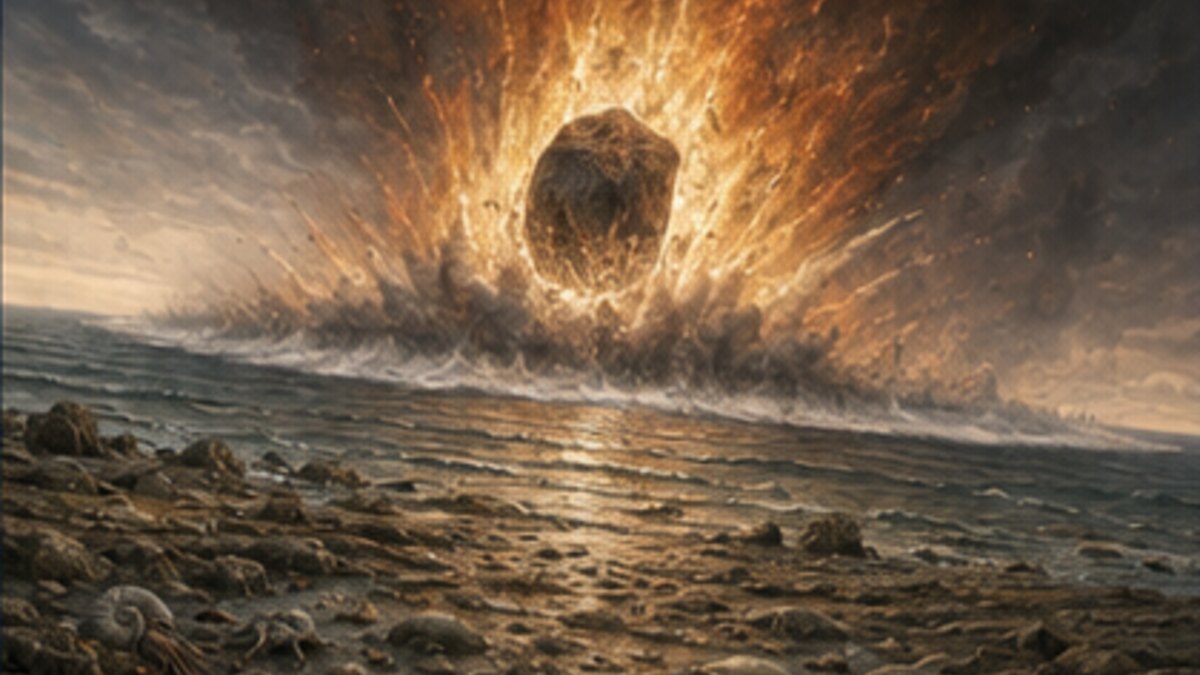
Sixty-six million years ago, an asteroid struck near the Yucatán Peninsula. Shock waves, earthquakes, ejecta, regional fires, and tsunamis caused immediate devastation. Dust, sulfate aerosols, and soot then reduced sunlight and cooled the surface.
Photosynthesis collapsed, food webs failed, and non-avian dinosaurs disappeared along with many marine groups. The crater, global iridium-rich layer, shocked minerals, and precisely dated deposits form an unusually strong causal case.
THE POINTS TO REMEMBER
✦Impact effects operated from minutes to years
✦Darkness crippled primary production
✦Independent geological evidence converges on one event
The Chicxulub impact combined instant destruction with a prolonged global winter.
07CHAPTER
Extinction filters traits, habitats, and chance.
Why some organisms survive
IN PLAIN LANGUAGE
Here is the big picture: Extinction filters traits, habitats, and chance. The main point to remember is this: Useful traits depend on the specific disaster.
See the fuller scientific explanation +
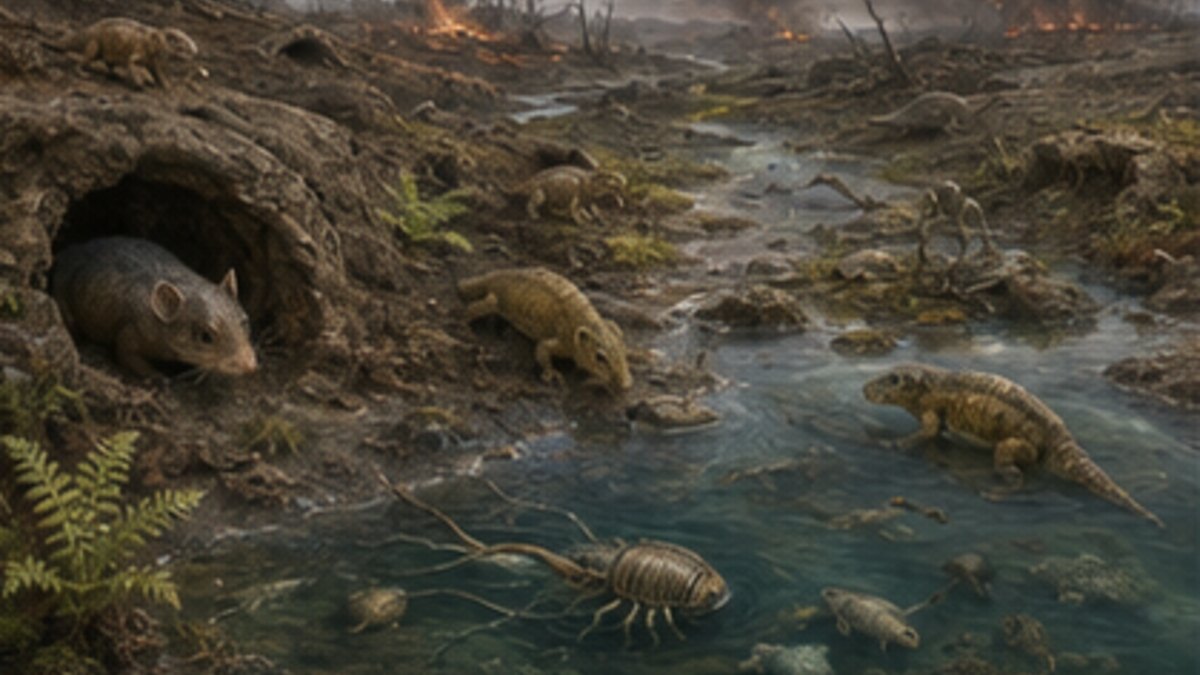
Survival is not simply a contest won by the most advanced organisms. Small body size, low energy demands, broad diets, dormancy, burrowing, freshwater habitats, geographic range, and flexible reproduction can help—but advantages vary by crisis.
Chance also matters. A lineage must occur in the right place, retain enough population, and pass through successive bottlenecks. Survivors inherit ecological opportunity, yet post-crisis ecosystems may remain unstable for long periods.
Survival depends on ecology and circumstance, not an evolutionary ranking.
08CHAPTER
Empty niches do not refill overnight.
Recovery and adaptive radiation
IN PLAIN LANGUAGE
Here is the big picture: Empty niches do not refill overnight. The main point to remember is this: Diversity recovery and ecosystem recovery differ.
See the fuller scientific explanation +
After a mass extinction, surviving populations expand and diversify, but recovery has stages. Opportunistic species may dominate first; food webs remain short; reef construction and specialized interactions can take millions of years to return.
Adaptive radiation produces new forms as lineages explore vacant roles. Mammalian diversification after the end-Cretaceous and dinosaur expansion after the end-Triassic are famous examples, though both began from histories already underway.
Biological recovery creates novel ecosystems rather than restoring an exact past.
09CHAPTER
The recurring planetary chain reactions.
Extinction mechanisms
IN PLAIN LANGUAGE
Here is the big picture: The recurring planetary chain reactions. The main point to remember is this: Rate of change matters alongside magnitude.
See the fuller scientific explanation +
Major crises repeatedly involve rapid climate shifts, ocean oxygen loss, acidification, habitat destruction, food-web collapse, and disruption of nutrient cycles. Impacts and volcanism are triggers; their global consequences operate through atmosphere, ocean, and ecology.
Scientists compare rates and magnitudes rather than merely naming a mechanism. A slow change that ecosystems track may be survivable, while a smaller but abrupt change can outpace migration and adaptation.
Atmosphere–ocean feedbacks can turn an initial disturbance into a global crisis.
10CHAPTER
What the Big Five teach—and what they do not.
The present biodiversity crisis
IN PLAIN LANGUAGE
Here is the big picture: What the Big Five teach—and what they do not. The main point to remember is this: Modern drivers act simultaneously.
See the fuller scientific explanation +
Current extinction rates are elevated by habitat conversion, exploitation, invasive species, pollution, and climate change. The phrase “sixth mass extinction” emphasizes risk, but comparisons require care because the Big Five are measured across incomplete fossil records and immense intervals.
Deep time shows that biodiversity can eventually recover, but not on human timescales and not by recreating lost species or ecosystems. Prevention preserves evolutionary history and ecological function that recovery cannot quickly replace.
THE POINTS TO REMEMBER
✦Modern drivers act simultaneously
✦Fossil and modern rates require careful comparison
✦Geological recovery is not a human-scale remedy
Deep-time recovery does not diminish the permanence of loss for civilization.
THE ESSENTIAL THREAD
Three ideas worth keeping.
01Mass extinctions usually involve several interacting stresses.
02The end-Permian was the most severe; the end-Cretaceous is the most famous.
03Extinction changes evolution by removing lineages and opening niches.