COSMIC LEARNING LAB

PATH 06 · FROM BIG BANG TO NOW

Cosmic Evolution

Cosmology tells the story of the universe as a whole. Evidence shows that the universe began in an extremely hot, dense state, expanded and cooled, formed atoms, stars, and galaxies, and is still expanding today. Surprisingly, that expansion is now speeding up.

11 CHAPTERSDEEP-DIVE GUIDEILLUSTRATED
11-PAGE FIELD GUIDE0102030405060708091011

A LIGHTER FIELD GUIDE

One idea.
Then the next.

Start with the short explanation in each chapter. Open “Go a little deeper” only when you want more detail. The final line shows how the next chapter follows from the one you just read.

01CHAPTER

What the Big Bang model actually says.

Expansion, not an explosion

IN PLAIN LANGUAGE

Here is the big picture: What the Big Bang model actually says. The main point to remember is this: Expansion occurs throughout space.

See the fuller scientific explanation +

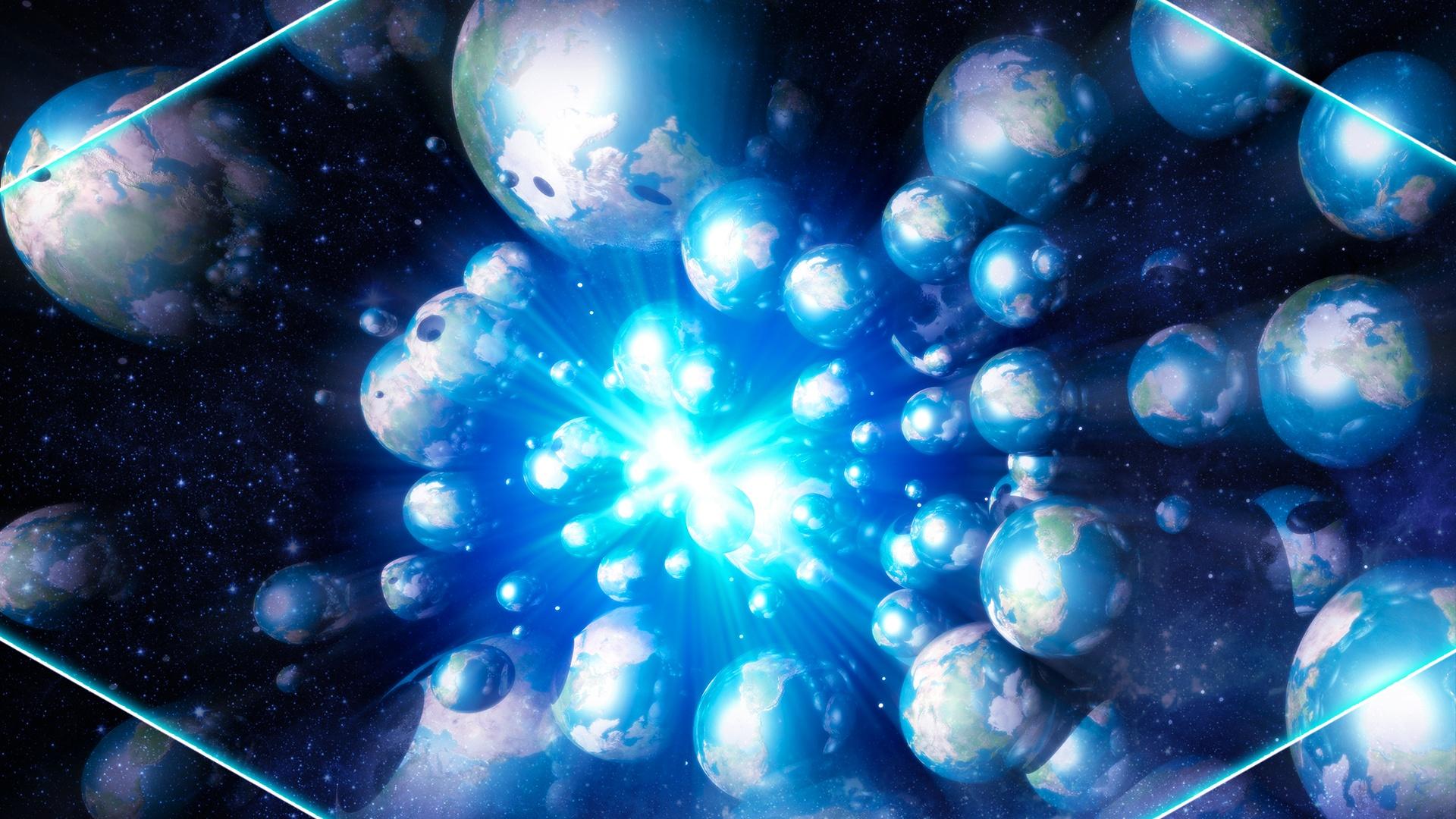
The Big Bang model describes an early hot, dense phase followed by expansion and cooling. It was not matter exploding from one location into surrounding empty space. On large scales, distances between unbound regions grow because the geometry of space evolves.

Every observer in a sufficiently uniform expanding universe sees distant galaxies recede in proportion to distance. There is no unique central galaxy or observable edge implied by the model.

THE POINTS TO REMEMBER
Expansion occurs throughout space
The model does not specify an external space
A hot beginning is supported by several independent observations

NEXT Now that this piece is in place, we can turn to The earliest accessible moments.

Expansion, not an explosion
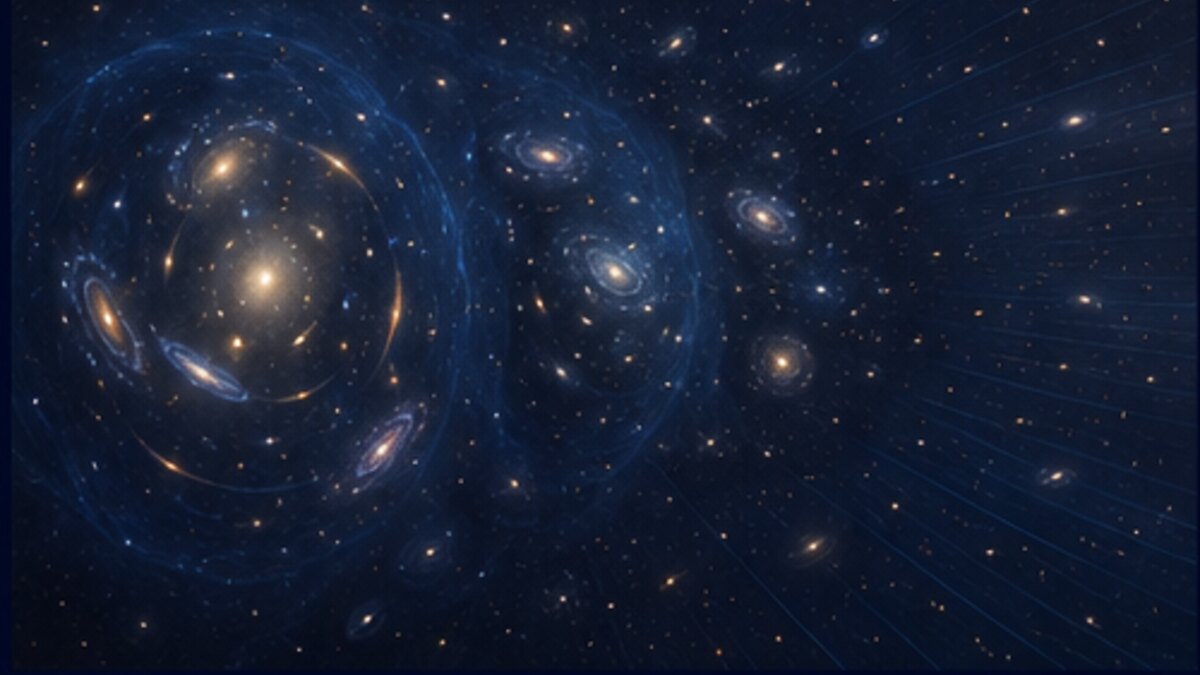
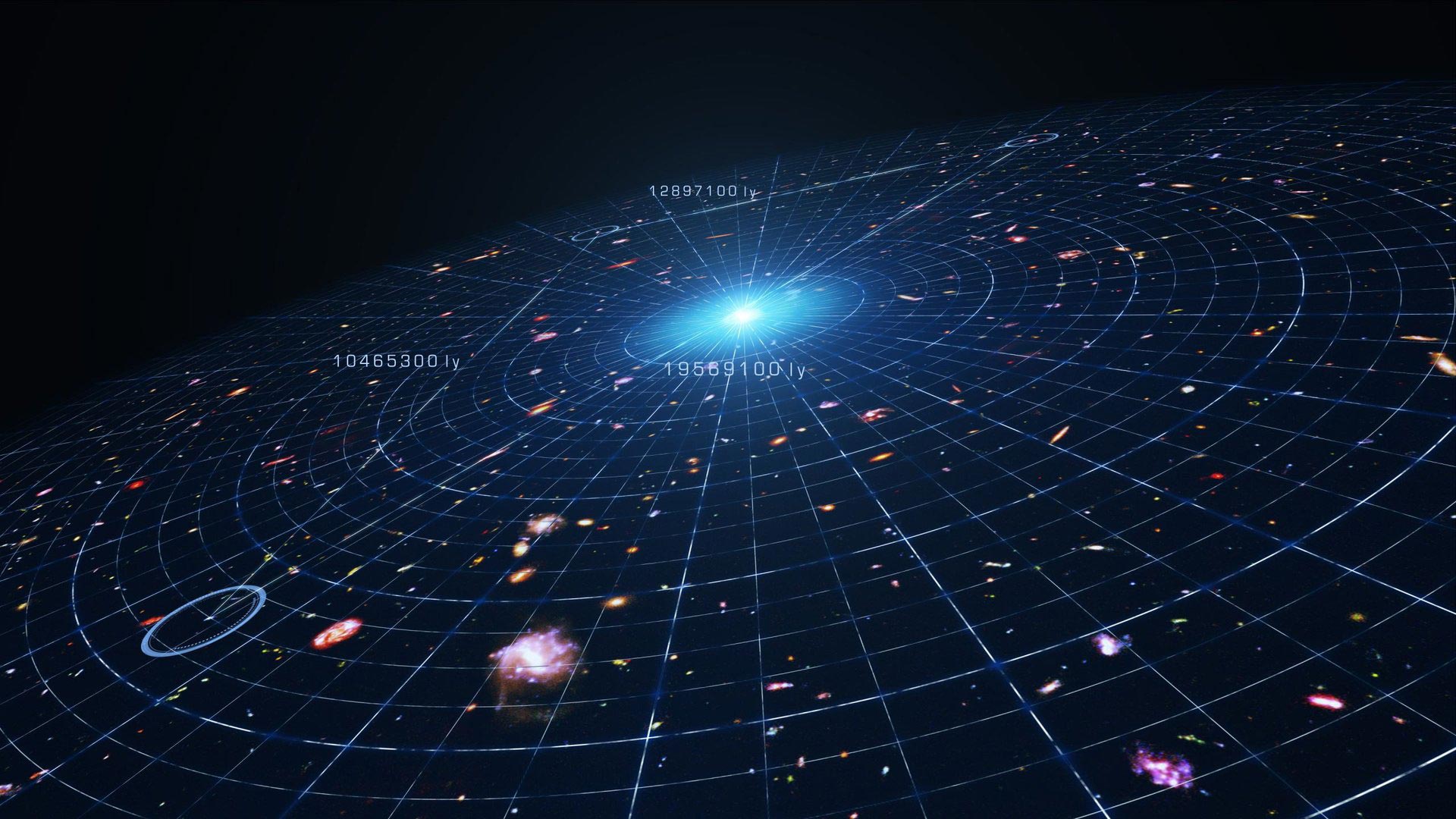
Cosmic expansion stretches distances and the wavelengths of traveling light.
02CHAPTER

Physics approaches its limits.

The earliest accessible moments

IN PLAIN LANGUAGE

Here is the big picture: Physics approaches its limits. The main point to remember is this: The Planck era lies beyond confirmed theory.

See the fuller scientific explanation +

At extremely early times, energies were so high that known interactions may have behaved differently. Current particle physics can model much of the thermal history, but the Planck era requires a quantum theory of gravity that has not been experimentally established.

Cosmologists distinguish well-tested extrapolations from speculative ideas. Terms such as singularity, multiverse, or quantum creation should not be treated as observations merely because they appear in mathematical models.

THE POINTS TO REMEMBER
The Planck era lies beyond confirmed theory
Earlier does not automatically mean physically understood
Models must be separated from evidence

NEXT Now that this piece is in place, we can turn to Inflation.

The earliest accessible moments
The earliest universe connects cosmology with unresolved fundamental physics.
03CHAPTER

A proposed burst of accelerated expansion.

Inflation

IN PLAIN LANGUAGE

Here is the big picture: A proposed burst of accelerated expansion. The main point to remember is this: Inflation addresses horizon and flatness puzzles.

See the fuller scientific explanation +

Inflation proposes that the very early universe underwent a brief period of rapid accelerated expansion. It can explain why distant regions share nearly the same temperature, why spatial curvature is small, and why unwanted relics are diluted.

Quantum fluctuations stretched during inflation can seed the density variations that later grow into galaxies. The broad framework fits observations well, but the identity of the inflating field and the detailed model remain unsettled.

THE POINTS TO REMEMBER
Inflation addresses horizon and flatness puzzles
Quantum fluctuations become structure seeds
No unique inflation model has been confirmed

NEXT Now that this piece is in place, we can turn to Primordial nucleosynthesis.

Inflation
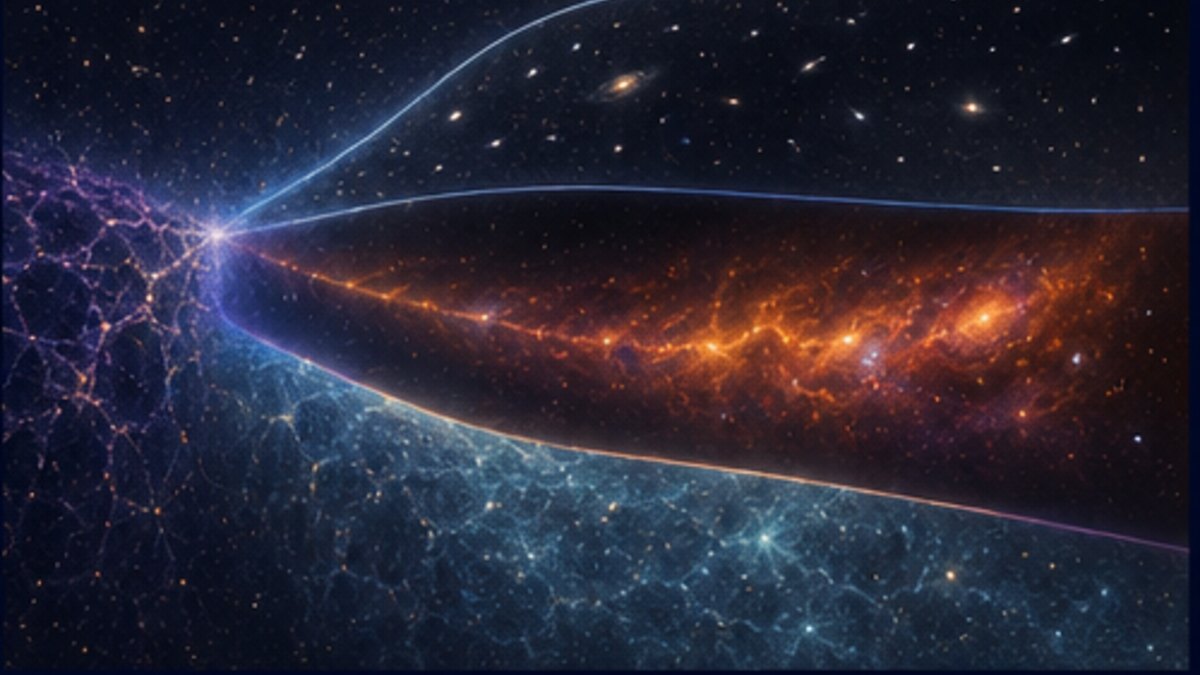
Microscopic fluctuations may have been stretched to astronomical scales.
04CHAPTER

The first three minutes establish cosmic chemistry.

Primordial nucleosynthesis

IN PLAIN LANGUAGE

Here is the big picture: The first three minutes establish cosmic chemistry. The main point to remember is this: Heavy elements could not form efficiently yet.

See the fuller scientific explanation +

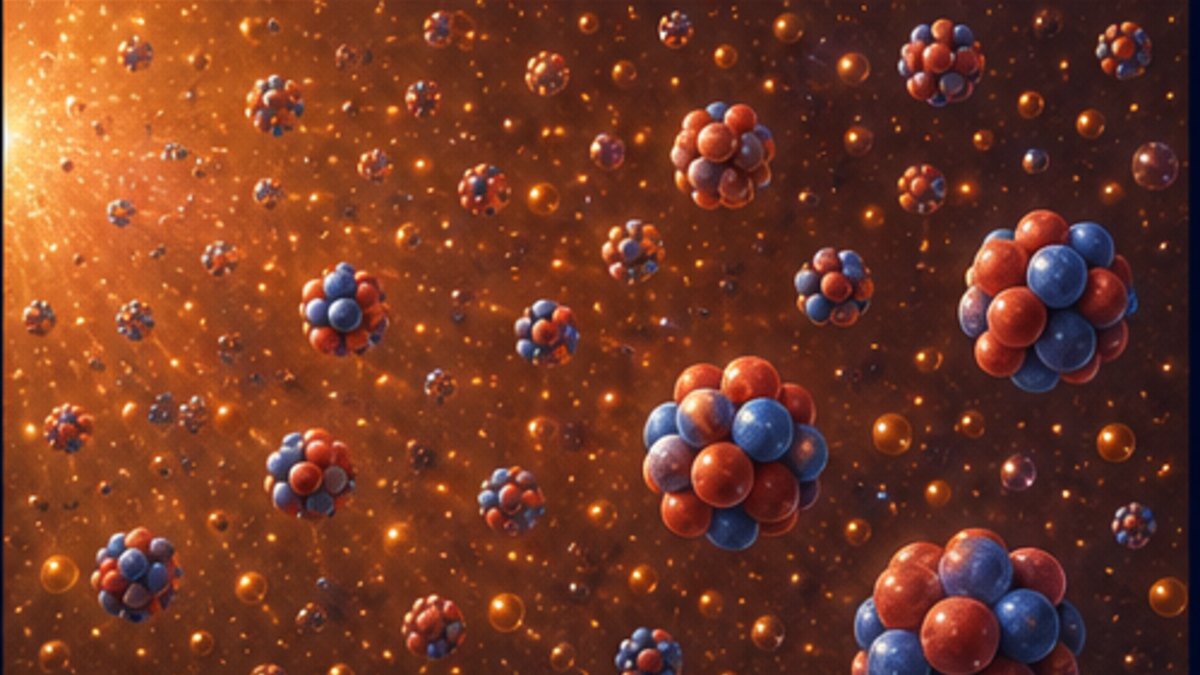
As expansion cooled the universe, protons and neutrons combined into light nuclei. Calculations predict mostly hydrogen, substantial helium-4, and trace deuterium, helium-3, and lithium-7. Observations broadly match this pattern.

The result depends on expansion rate, nuclear reactions, and the density of ordinary matter. It therefore tests both cosmology and particle physics. The persistent lithium discrepancy remains a notable open problem.

THE POINTS TO REMEMBER
Heavy elements could not form efficiently yet
Light-element abundances measure baryon density
Lithium does not fit as neatly as deuterium

NEXT Now that this piece is in place, we can turn to Recombination and last scattering.

Primordial nucleosynthesis
The universe’s first nuclear reactions produced a simple light-element mixture.
05CHAPTER

The cosmic fog clears and ancient light breaks free.

Recombination and last scattering

IN PLAIN LANGUAGE

Here is the big picture: The cosmic fog clears and ancient light breaks free. The main point to remember is this: Recombination means electrons binding to nuclei.

See the fuller scientific explanation +

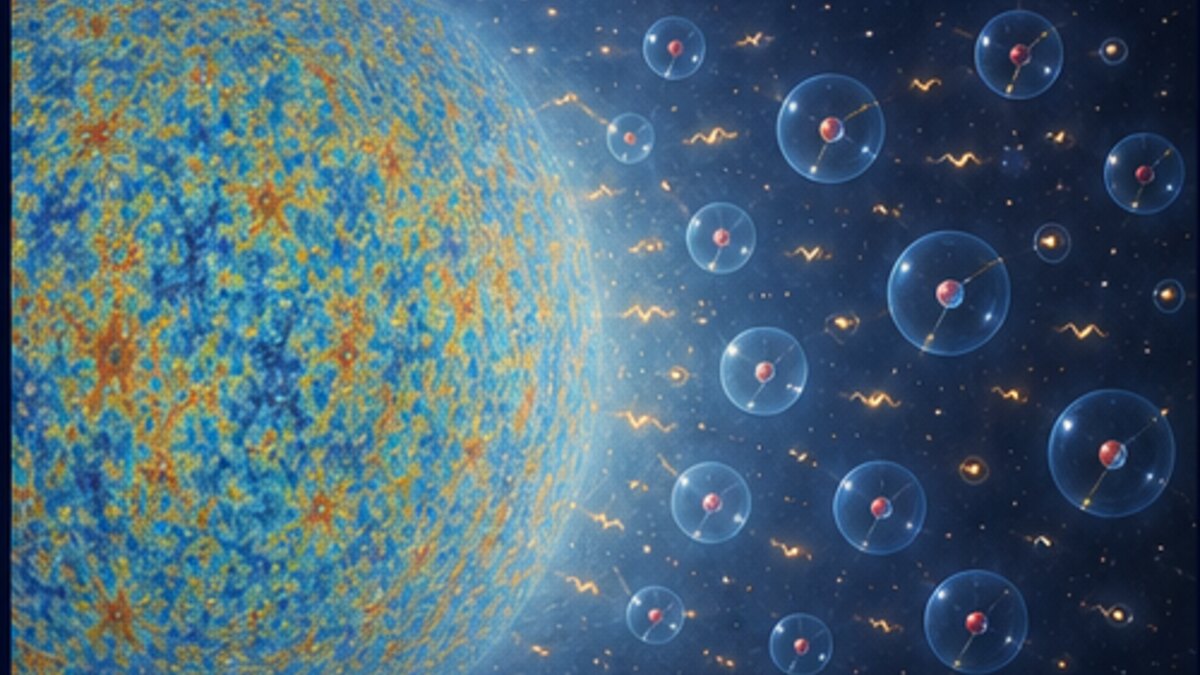
About 380,000 years after the hot beginning, the universe cooled enough for electrons to bind with nuclei. Before this transition, free electrons repeatedly scattered photons, making the cosmos opaque like the glowing interior of a star. Once neutral atoms formed, most photons could travel enormous distances without another collision.

This was not an instantaneous flash everywhere. The “surface of last scattering” is a finite period and, from our viewpoint, a spherical shell in every direction. Continued expansion stretched its once-visible and infrared photons into the microwave band we detect today.

THE POINTS TO REMEMBER
Recombination means electrons binding to nuclei
Last scattering marks the transition to transparency
Expansion stretched the released light into microwaves

NEXT Now that this piece is in place, we can turn to The CMB: the universe’s earliest portrait.

Recombination and last scattering
Recombination allowed ancient photons to stream freely through a newly transparent universe.
06CHAPTER

What the microwave background represents—and what it reveals.

The CMB: the universe’s earliest portrait

IN PLAIN LANGUAGE

Here is the big picture: What the microwave background represents—and what it reveals. The main point to remember is this: The CMB is the oldest directly observable light, not the first moment of time.

See the fuller scientific explanation +

The cosmic microwave background is relic thermal radiation arriving from every direction. It represents the oldest light that can reach us directly: a view of the universe when it was about 380,000 years old, long before stars or galaxies existed. It is not light from the Big Bang’s first instant, not an explosion photographed from outside, and not a physical edge of the universe.

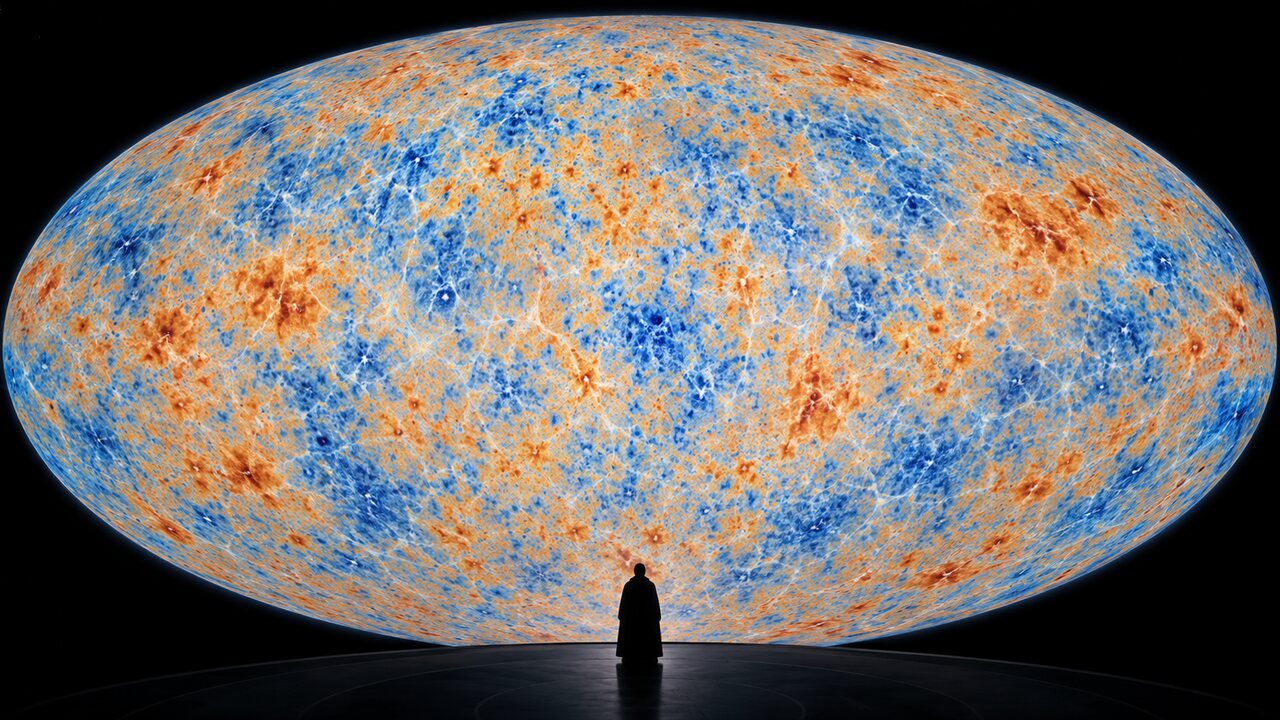
A familiar oval CMB map is a two-dimensional projection of the entire sky, much as a world map flattens Earth. Looking in different directions samples different regions on our last-scattering shell at nearly the same cosmic age. Because the universe has expanded while the photons traveled, their almost perfect blackbody spectrum has cooled to about 2.7 kelvin.

The map is remarkably uniform, but its hotter and cooler patches differ by only about one part in 100,000. These tiny variations trace slight variations in density, temperature, and gravitational potential. Gravity later amplified the denser regions into the cosmic web, galaxies, stars, and ultimately planets, so the pattern is a statistical blueprint for later structure—not a photograph of individual future galaxies.

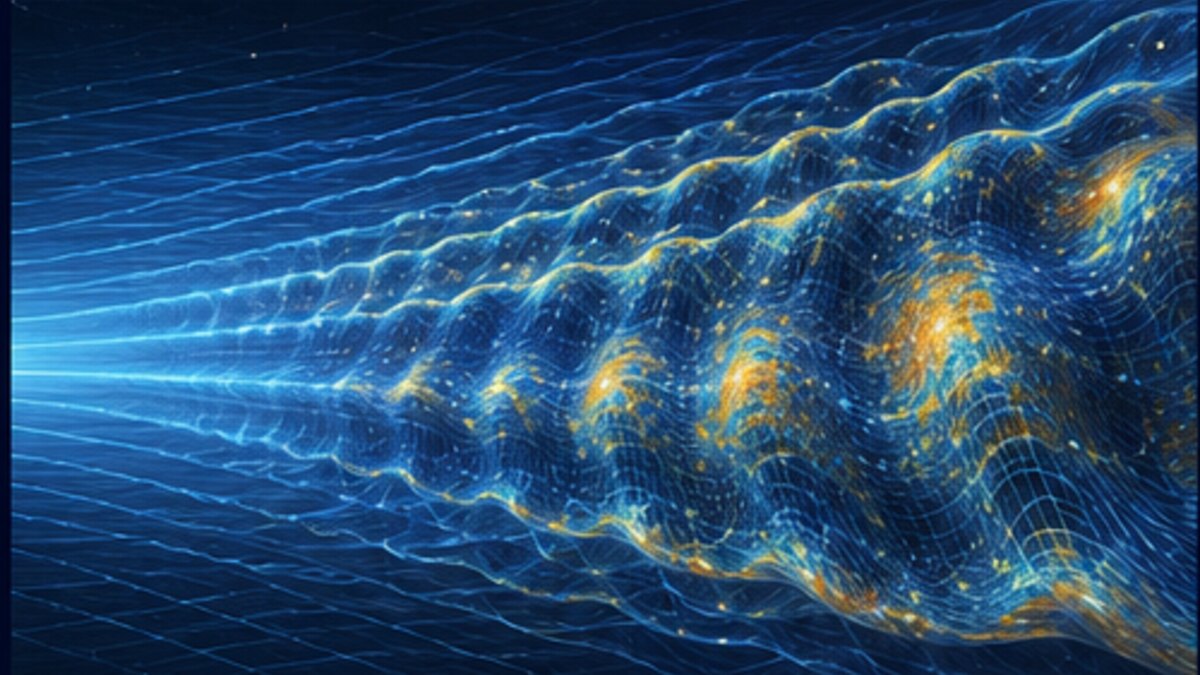
The sizes and strengths of the CMB’s acoustic patterns reveal how sound waves moved through the early photon–baryon plasma. Their angular power spectrum constrains the universe’s age, spatial geometry, ordinary-matter density, dark-matter density, and initial fluctuation spectrum. the orientation of light waves adds information about last scattering and later the era when early starlight electrically charged much of the gas between galaxies, while foreground radiation from the Milky Way must be carefully removed.

The CMB is therefore both a baby picture and a precision measuring instrument. It strongly supports a hot, expanding early universe, but interpreting it requires a cosmological model; it does not by itself identify dark matter, prove one unique model of inflation, or show what—if anything—preceded the hot early phase.
THE POINTS TO REMEMBER
The CMB is the oldest directly observable light, not the first moment of time
An all-sky map is a projection of a last-scattering shell around us
Tiny tiny variations seeded the later cosmic web
Acoustic patterns constrain geometry and cosmic composition
Foregrounds and model assumptions matter

NEXT Now that this piece is in place, we can turn to Dark ages and cosmic dawn.

The CMB: the universe’s earliest portrait
A full-sky microwave map reveals tiny early variations that gravity later developed into cosmic structure.
07CHAPTER

The first stars switch on the visible universe.

Dark ages and cosmic dawn

IN PLAIN LANGUAGE

Here is the big picture: The first stars switch on the visible universe. The main point to remember is this: Dark ages means no stars, not no radiation.

See the fuller scientific explanation +

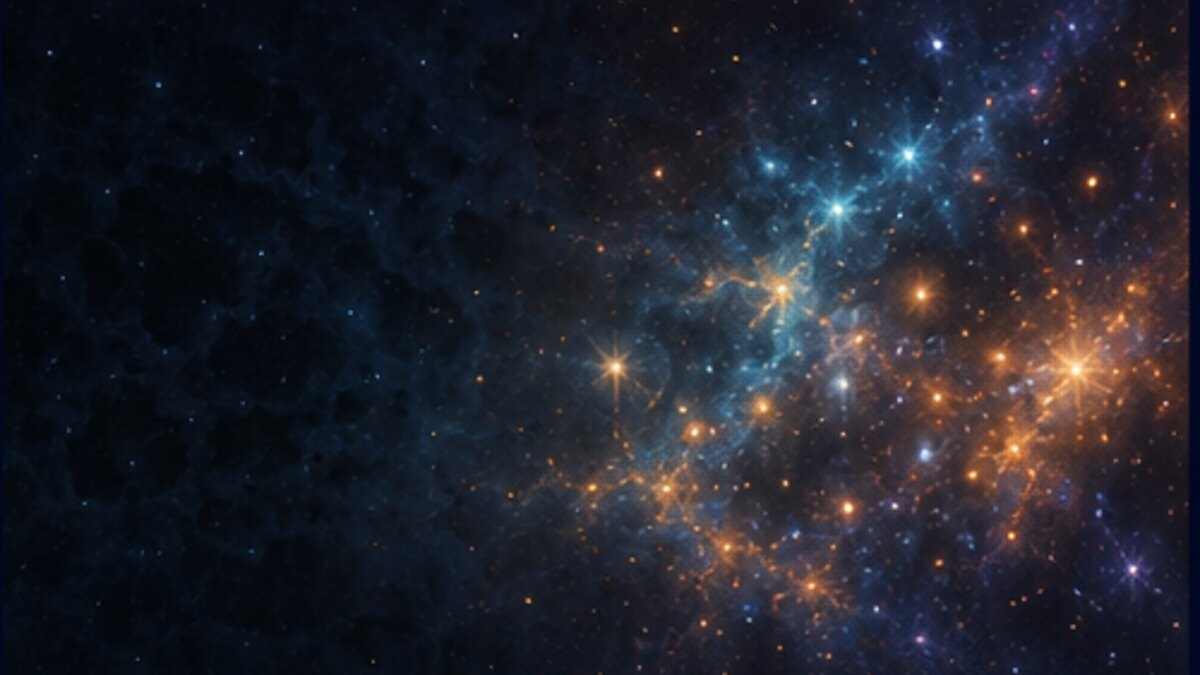
After recombination, neutral hydrogen filled a starless universe. Gravity drew gas into dark-matter structures until the first stars formed, probably from nearly pristine hydrogen and helium. These massive stars produced the first substantial heavy elements.

The transition called cosmic dawn is studied through very distant galaxies, gamma-ray bursts, background radiation, and the redshifted 21-centimeter signal of hydrogen. It remains one of observational astronomy’s major frontiers.

THE POINTS TO REMEMBER
Dark ages means no stars, not no radiation
First stars were chemically primitive
Several complementary probes target cosmic dawn

NEXT Now that this piece is in place, we can turn to Reionization.

Dark ages and cosmic dawn
The first stars ended hundreds of millions of years without stellar light.
08CHAPTER

Young galaxies transform intergalactic gas.

Reionization

IN PLAIN LANGUAGE

Here is the big picture: Young galaxies transform intergalactic gas. The main point to remember is this: Ionized bubbles formed around early sources.

See the fuller scientific explanation +

Ultraviolet photons from early stars and galaxies gradually stripped electrons from neutral hydrogen across intergalactic space. Ionized bubbles grew and overlapped until most diffuse hydrogen was reionized, probably within the first billion years.

CMB the orientation of light waves, quasar absorption spectra, galaxy observations, and future 21-centimeter maps constrain the timing. the era when early starlight electrically charged much of the gas between galaxies was extended and patchy, not one instantaneous flash.

THE POINTS TO REMEMBER
Ionized bubbles formed around early sources
The process was spatially uneven
Multiple observations probe different stages

NEXT Now that this piece is in place, we can turn to Galaxies and the cosmic web.

Reionization
Growing ionized regions reveal how the first luminous populations altered the cosmos.
09CHAPTER

Gravity amplifies a nearly smooth beginning.

Galaxies and the cosmic web

IN PLAIN LANGUAGE

Here is the big picture: Gravity amplifies a nearly smooth beginning. The main point to remember is this: Dark matter provides gravitational scaffolding.

See the fuller scientific explanation +

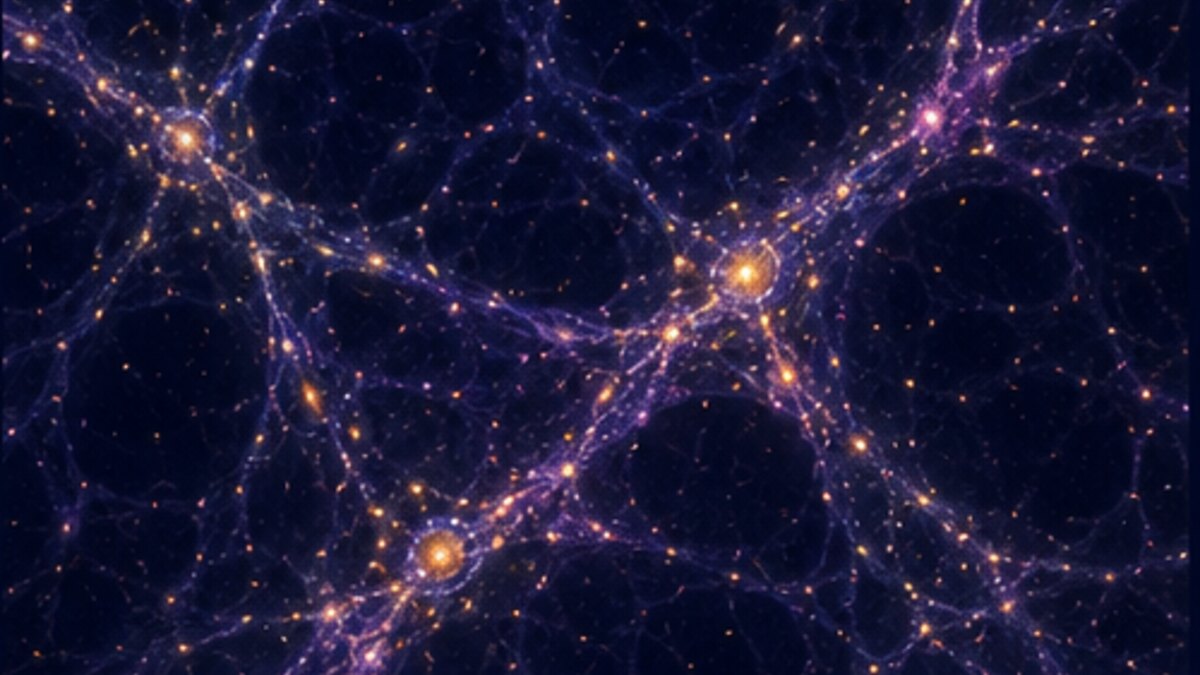
Dark matter began collecting into halos, filaments, sheets, and knots. Ordinary gas fell into these structures, cooled, formed stars, and built galaxies. Mergers, gas inflow, stellar feedback, and black-hole feedback continuously reshaped them.

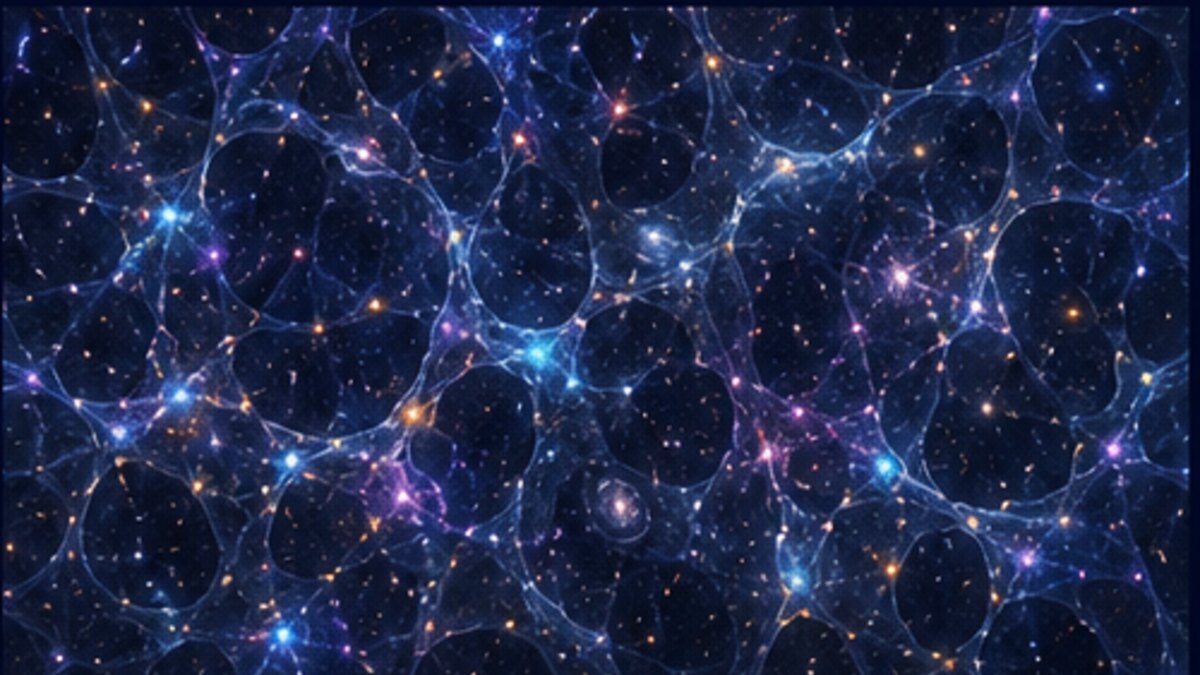
Large surveys show galaxies tracing a cosmic web surrounding underdense voids. Simulations reproduce this architecture from measured initial fluctuations when dark matter and cosmic expansion are included.

THE POINTS TO REMEMBER
Dark matter provides gravitational scaffolding
Galaxies grow through both inflow and mergers
Feedback regulates star formation

NEXT Now that this piece is in place, we can turn to Dark matter and dark energy.

Galaxies and the cosmic web
Matter forms a web of filaments and clusters separated by enormous voids.
10CHAPTER

Most cosmic content remains unidentified.

Dark matter and dark energy

IN PLAIN LANGUAGE

Here is the big picture: Most cosmic content remains unidentified. The main point to remember is this: Dark matter clusters and builds structure.

See the fuller scientific explanation +

Galaxy rotation, lensing, cluster dynamics, the CMB, and structure formation indicate more gravitating matter than luminous atoms supply. Dark matter is a label for this unseen component; its particle identity remains unknown.

Distant supernovae and other probes show that cosmic expansion is accelerating. Dark energy describes the responsible component or modification of gravity. A cosmological constant fits current data well, but explaining its physical value is a profound problem.

THE POINTS TO REMEMBER
Dark matter clusters and builds structure
Dark energy acts smoothly on large scales
Evidence is strong even though identities are unknown

NEXT Now that this piece is in place, we can turn to Cosmic fate and open questions.

Dark matter and dark energy
The visible universe represents only a small fraction of the inferred cosmic budget.
11CHAPTER

The future depends on physics we are still testing.

Cosmic fate and open questions

IN PLAIN LANGUAGE

Here is the big picture: The future depends on physics we are still testing. The main point to remember is this: Accelerated expansion produces future isolation.

See the fuller scientific explanation +

If dark energy remains close to a cosmological constant, expansion continues indefinitely. Distant unbound galaxies eventually cross our observable horizon, star formation declines, stellar remnants dominate, and black holes evaporate over unimaginable times.

Alternatives depend on whether dark energy changes. More immediate puzzles include the Hubble-constant tension, dark-matter identity, inflation’s mechanism, neutrino properties, and quantum gravity. Cosmology is mature enough for precision and unfinished enough for surprises.

THE POINTS TO REMEMBER
Accelerated expansion produces future isolation
Cosmic fate depends on dark-energy behavior
Precision disagreements may reveal new physics or hidden systematics
Cosmic fate and open questions
The universe’s ultimate history is linked to the nature of its least-understood components.

THE ESSENTIAL THREAD

Three ideas worth keeping.

  1. 01The Big Bang model describes expansion from a hot, dense early state.
  2. 02Gravity grew tiny variations into the cosmic web.
  3. 03Dark matter and dark energy dominate the cosmic budget but remain unidentified.

CONTINUE WITH PRIMARY SOURCES

Explore the evidence.

NASA Cosmic HistoryNASA WMAP OverviewNASA CMB Science
NEXT LEARNING PATH

The Life Cycle of a Star

Continue your journey →