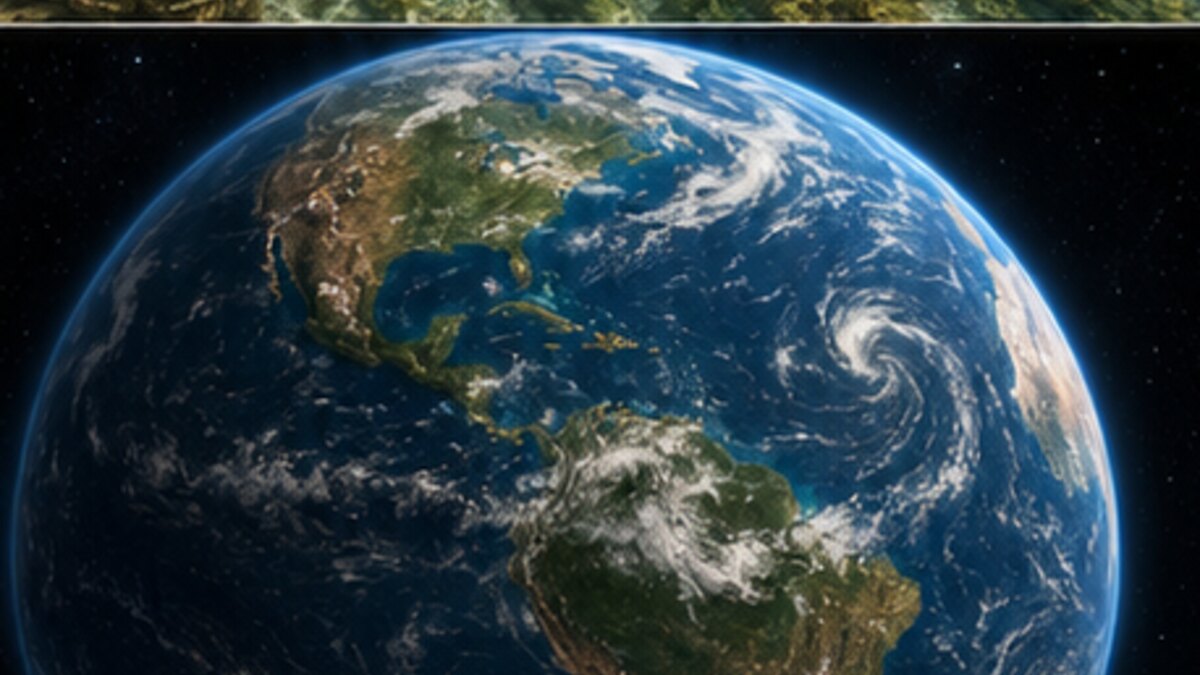
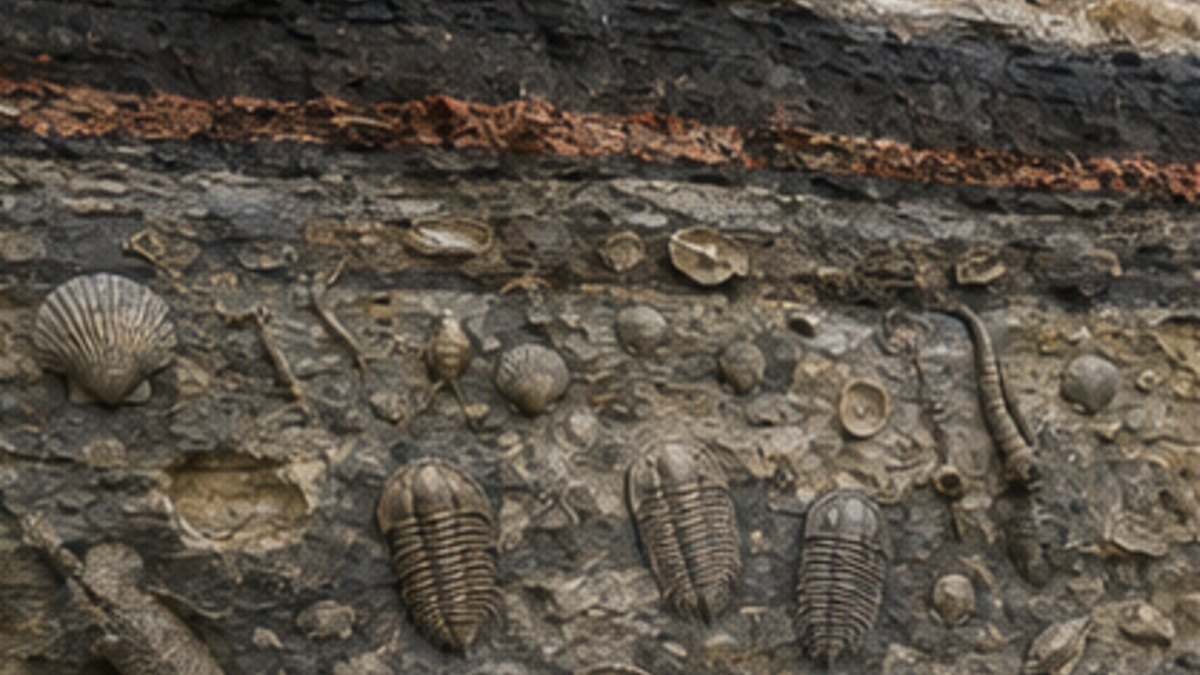
Earth was built gradually from pieces of rock and metal that collided in the young solar system. A giant impact helped form the Moon; heavy material sank to make Earth’s core; the surface cooled; oceans and an atmosphere developed; and moving plates kept reshaping the planet. Life later became part of that ongoing story.
Start with the short explanation in each chapter. Open “Go a little deeper” only when you want more detail. The final line shows how the next chapter follows from the one you just read.
01CHAPTER
A planet assembled through countless collisions.
Accretion of the proto-Earth
IN PLAIN LANGUAGE
Here is the big picture: A planet assembled through countless collisions. The main point to remember is this: Earth grew from many precursor bodies.
See the fuller scientific explanation +
Within the inner protoplanetary disk, rocky planetesimals and embryos repeatedly collided. Growth was energetic rather than gentle: impacts melted material, stripped atmospheres, exchanged rotational motion, and mixed bodies formed at different distances.
Radiometric dating of meteorites anchors solar-system formation near 4.567 billion years ago, while Earth reached most of its mass over tens of millions of years. The exact sequence is reconstructed through isotopes, dynamics, and comparison with other rocky planets.
THE POINTS TO REMEMBER
✦Earth grew from many precursor bodies
✦the gradual buildup of matter (accretion) redistributed heat and volatiles
The young Earth emerged from a prolonged era of violent the gradual buildup of matter (accretion).
02CHAPTER
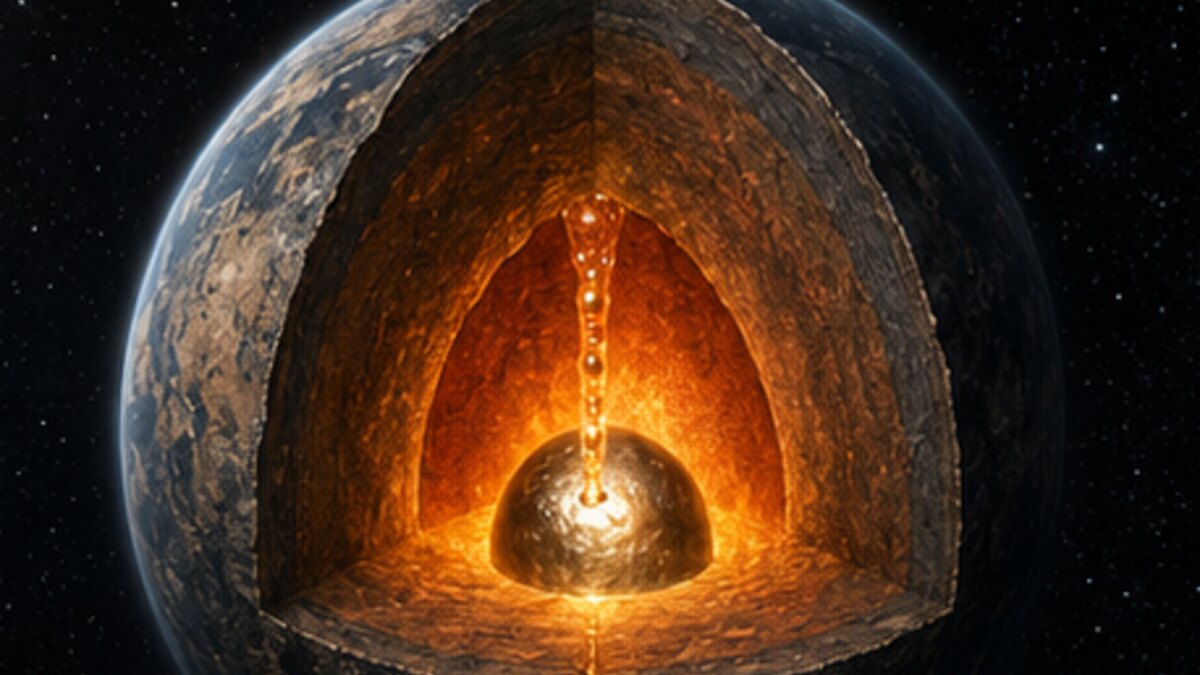
A molten world separated by density.
Differentiation into core and mantle
IN PLAIN LANGUAGE
Here is the big picture: A molten world separated by density. The main point to remember is this: Density drove large-scale separation.
See the fuller scientific explanation +
Impact energy, compression, and radioactive decay heated the young planet. Dense iron-rich metal sank toward the center while lighter silicates rose, producing a metallic core and rocky mantle. This chemical separation released additional gravitational energy.
Earth’s inner structure is inferred from seismic waves, gravity, magnetic behavior, high-pressure experiments, and meteorite analogues. The core later divided into a liquid outer region and solid inner core.
Earth’s familiar surface hides a layered interior produced early in its history.
03CHAPTER
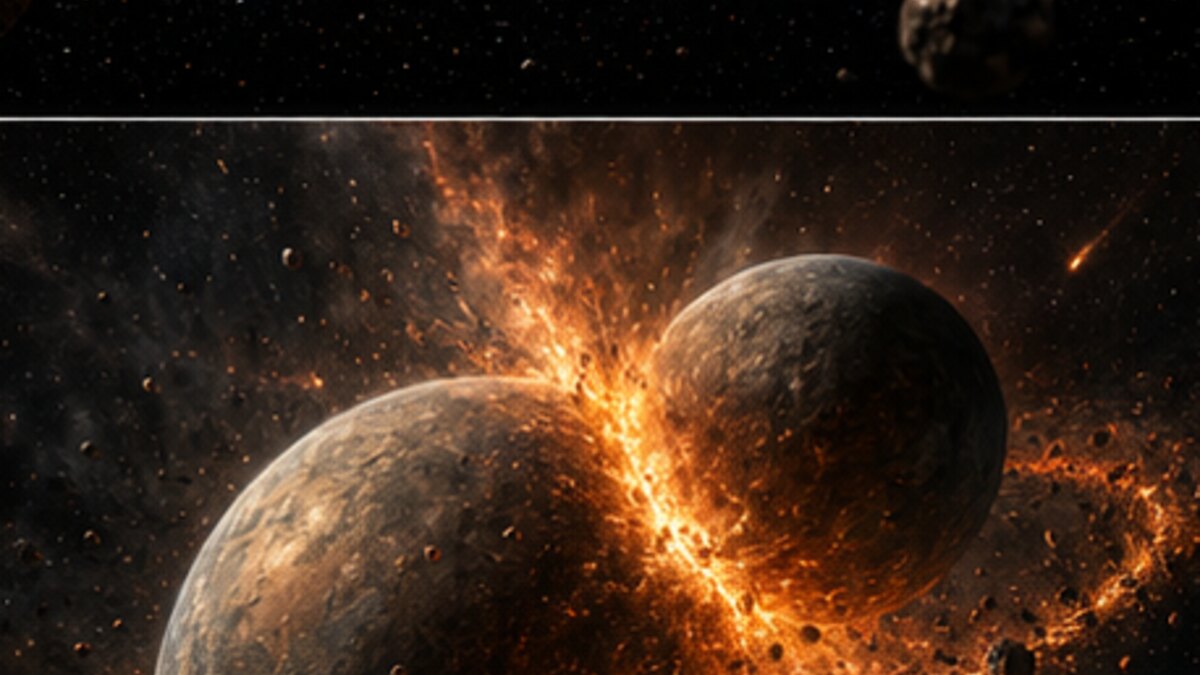
A giant impact reshaped two worlds.
The Moon-forming collision
IN PLAIN LANGUAGE
Here is the big picture: A giant impact reshaped two worlds. The main point to remember is this: The Moon formed from impact-generated debris.
See the fuller scientific explanation +
The leading hypothesis proposes that a large protoplanet struck the young Earth and placed hot debris into orbit. That material rapidly assembled into the Moon. Modern models explore a family of impacts rather than one settled scenario.
The Moon’s small iron core, depleted volatiles, rotational motion, and isotopic similarities with Earth constrain the collision. Lunar samples make the event one of the best-investigated giant impacts in planetary science.
THE POINTS TO REMEMBER
✦The Moon formed from impact-generated debris
✦Earth and Moon share striking isotope similarities
✦The impact altered Earth’s rotation and thermal state
A giant impact is the leading explanation for the origin of the Earth–Moon system.
04CHAPTER
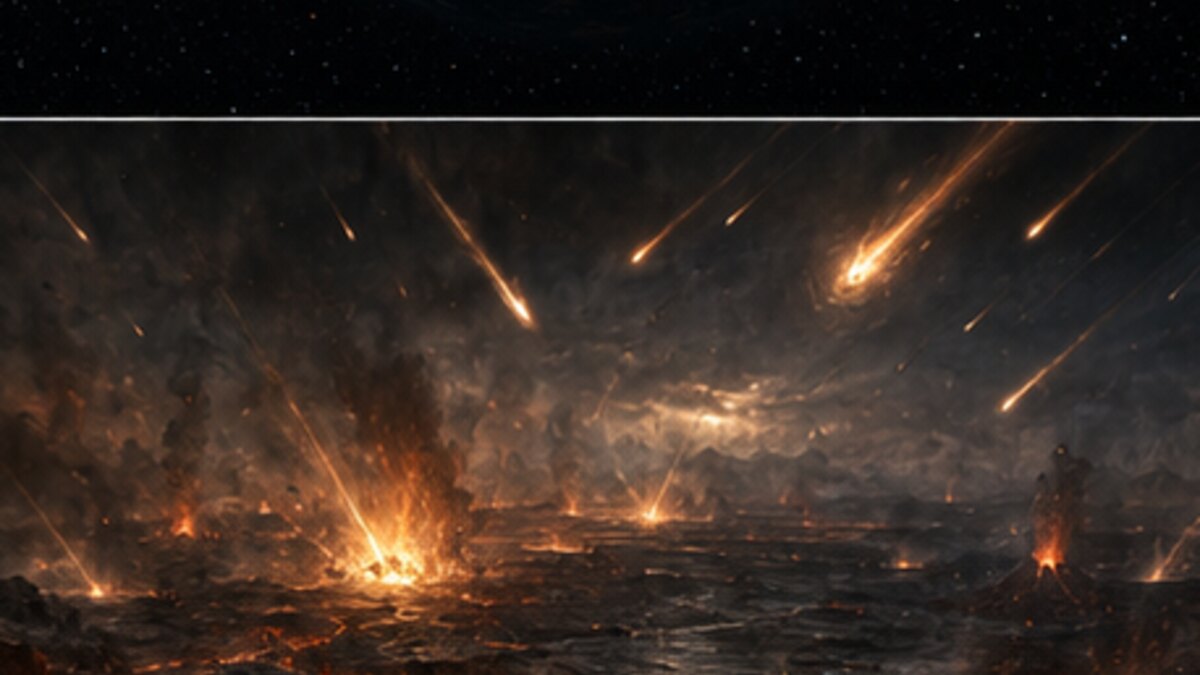
The surface repeatedly melted, broke, and reformed.
Cooling crust and early bombardment
IN PLAIN LANGUAGE
Here is the big picture: The surface repeatedly melted, broke, and reformed. The main point to remember is this: Most primordial crust was destroyed.
See the fuller scientific explanation +
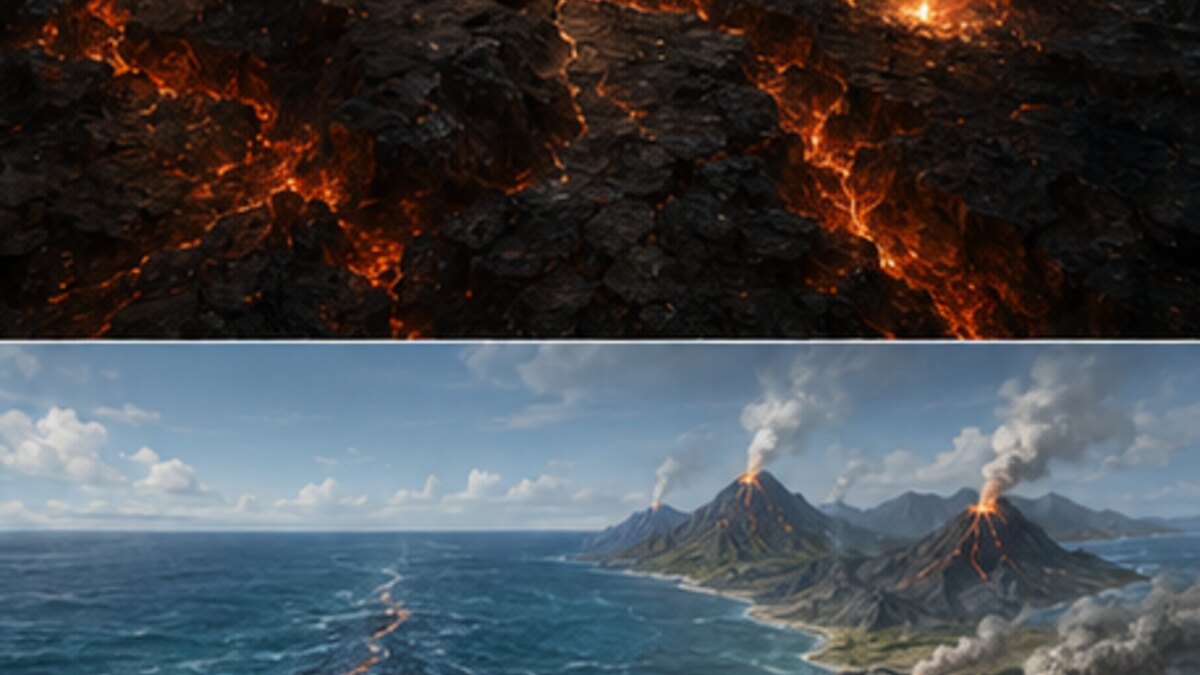
After the giant-impact era, magma oceans cooled and the earliest crust formed. Impacts remained frequent, while volcanism and mantle overturn recycled much of the first surface. Tiny ancient zircon crystals provide rare evidence of cool crust and liquid water very early.
The traditional Late Heavy Bombardment picture is still debated; lunar ages may reflect a spike, a long decline, or sampling bias. The uncertainty illustrates how planetary history changes as evidence improves.
Impacts and internal heat repeatedly renewed Earth’s earliest surface.
05CHAPTER
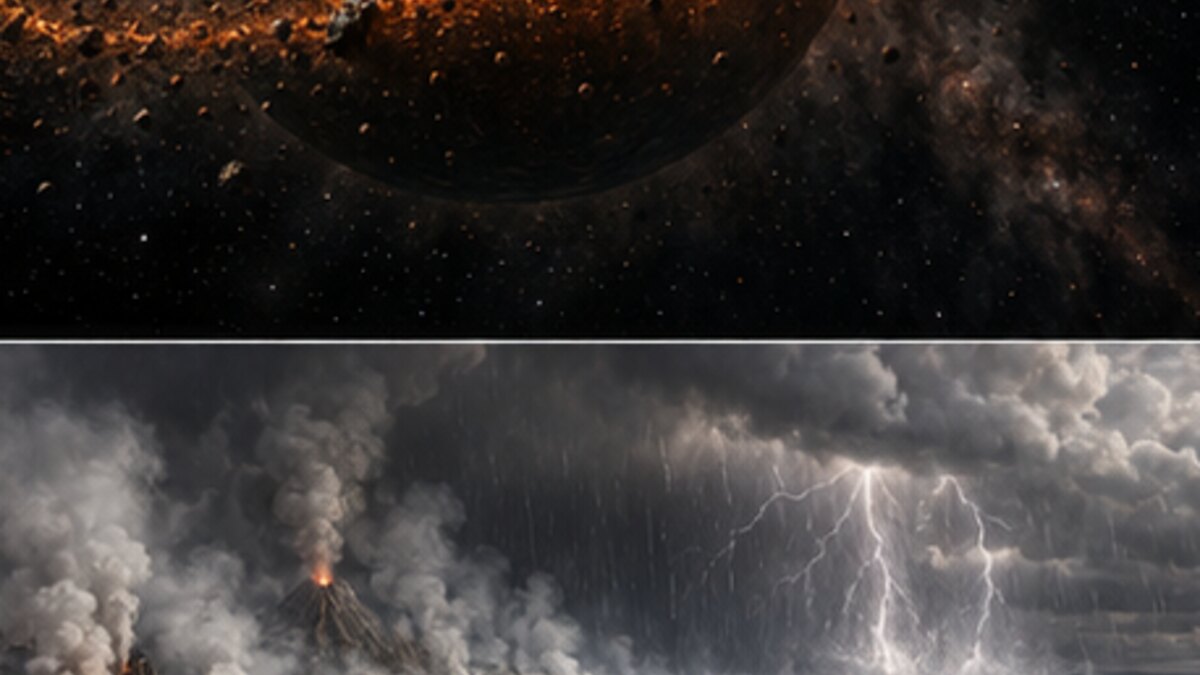
Volatiles arrived, escaped, condensed, and cycled.
Origin of oceans and atmosphere
IN PLAIN LANGUAGE
Here is the big picture: Volatiles arrived, escaped, condensed, and cycled. The main point to remember is this: Earth’s volatiles have mixed origins.
See the fuller scientific explanation +
Water and atmospheric gases came from multiple reservoirs. Outgassing released material from Earth’s interior, while water-bearing planetesimals contributed additional volatiles. The earliest light gases escaped readily; later atmospheres were dominated by nitrogen, carbon compounds, water vapor, and volcanic gases.
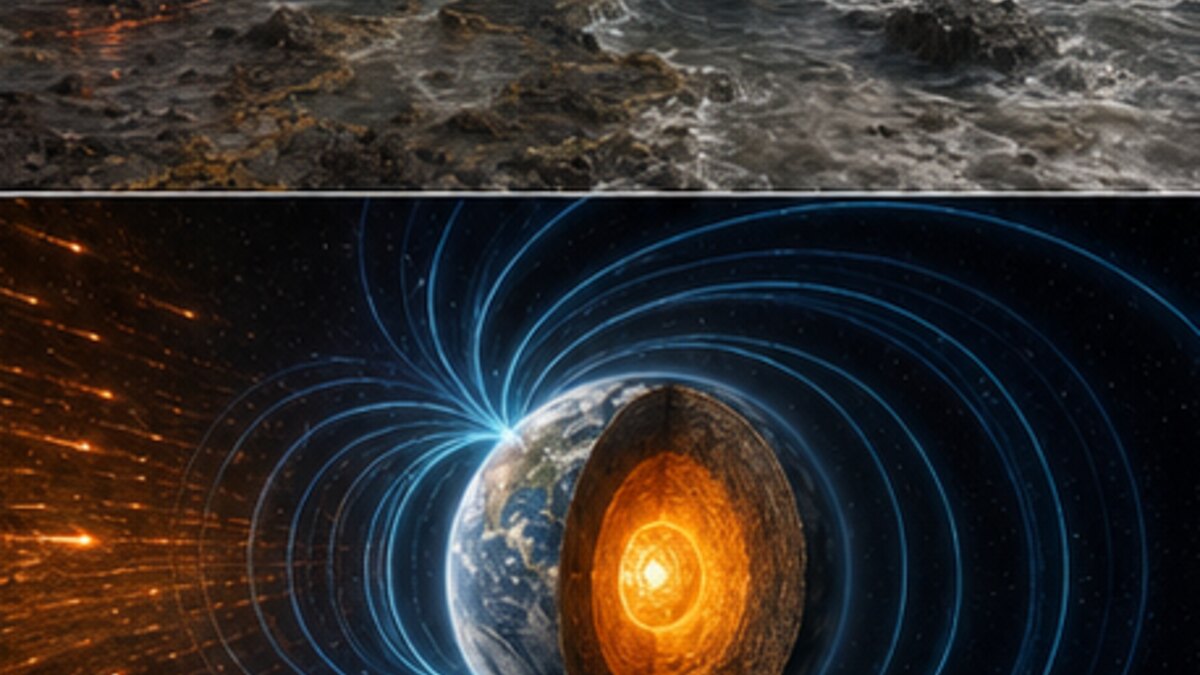
As the surface cooled, water condensed into oceans. Isotopic ratios help trace sources, but no single comet-delivery story explains the full inventory.
THE POINTS TO REMEMBER
✦Earth’s volatiles have mixed origins
✦The atmosphere evolved through escape and outgassing
Oceans and atmosphere are dynamic reservoirs exchanged with rock and life.
06CHAPTER
A mobile shell turns Earth into a recycling planet.
Plate tectonics begins
IN PLAIN LANGUAGE
Here is the big picture: A mobile shell turns Earth into a recycling planet. The main point to remember is this: Mantle heat drives large-scale motion.
See the fuller scientific explanation +
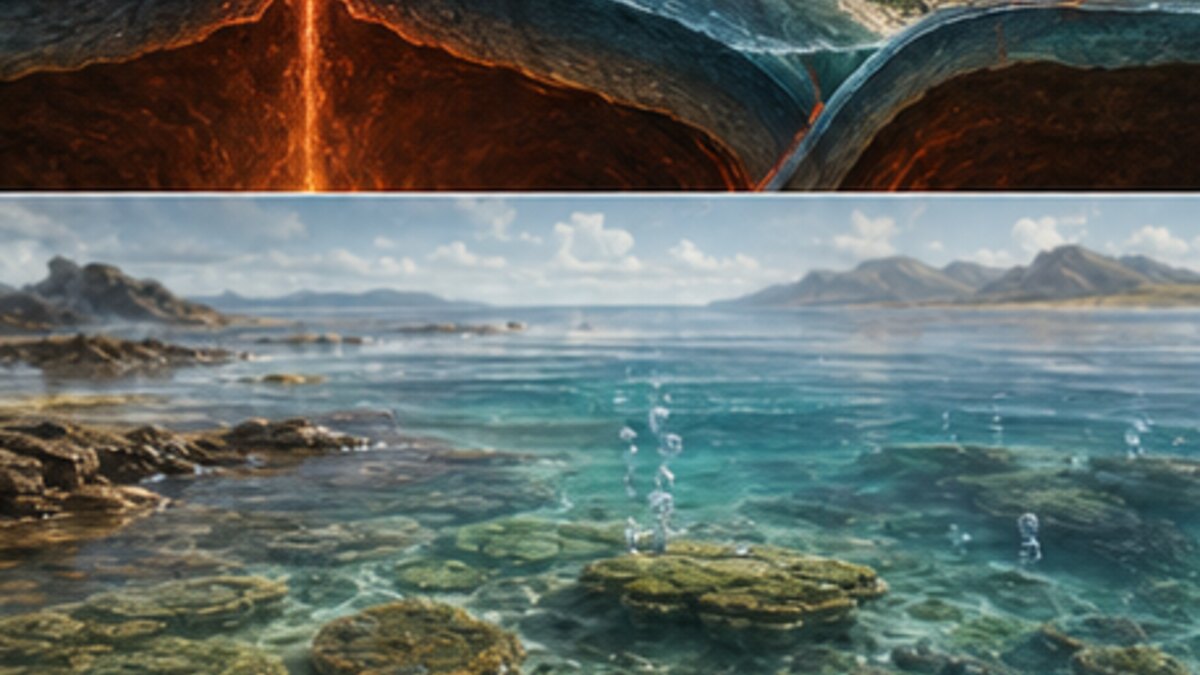
Earth’s rigid lithosphere is divided into plates moving over a deformable mantle. At boundaries, plates spread, collide, sink, slide, and build mountains. Subduction returns surface material to the interior, while volcanism creates new crust.
When plate tectonics began in its modern form remains debated. Whatever the timing, long-term recycling became central to continents, oceans, nutrient cycles, climate regulation, and biological habitats.
Moving plates continuously remake continents, ocean basins, and climate-regulating cycles.
07CHAPTER
A moving iron core generates a planetary field.
The magnetic shield
IN PLAIN LANGUAGE
Here is the big picture: A moving iron core generates a planetary field. The main point to remember is this: The field is generated, not permanently magnetized.
See the fuller scientific explanation +
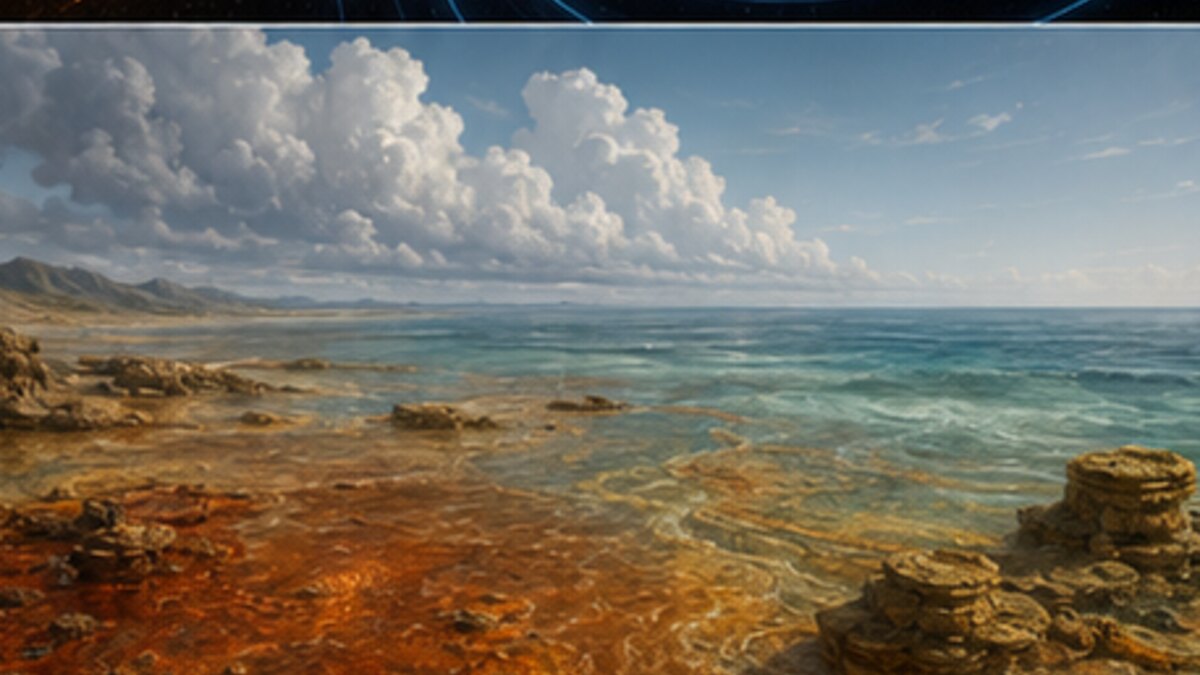
Convection in electrically conducting liquid iron, organized by Earth’s rotation, sustains the geodynamo. The magnetic field deflects much of the solar wind and creates a magnetosphere with dynamic belts, tails, and auroral regions.
Magnetic minerals record field direction when rocks form, revealing reversals and plate motion. A magnetic field is helpful for atmospheric protection, though planetary habitability depends on many interacting factors.
THE POINTS TO REMEMBER
✦The field is generated, not permanently magnetized
Earth’s field connects deep-core convection with the space environment.
08CHAPTER
Biology begins changing a planetary system.
Life enters the geological record
IN PLAIN LANGUAGE
Here is the big picture: Biology begins changing a planetary system. The main point to remember is this: The oldest evidence is difficult to interpret.
See the fuller scientific explanation +
Evidence for early life includes isotopic signatures, microbial structures, and ancient sedimentary environments. The exact origin and earliest date remain uncertain, but microbial life dominated most of Earth history.
Life altered mineral cycles, weathering, sediments, and eventually the atmosphere. Evolution is therefore not merely something that happened on Earth; it became part of how Earth works.
Life emerged early enough to become woven into Earth’s chemical cycles.
09CHAPTER
Photosynthesis transformed air and oceans.
The Great Oxidation
IN PLAIN LANGUAGE
Here is the big picture: Photosynthesis transformed air and oceans. The main point to remember is this: Oxygen sources preceded atmospheric accumulation.
See the fuller scientific explanation +
Oxygen-producing photosynthesis evolved before free oxygen accumulated in the atmosphere. Reduced minerals and volcanic gases initially consumed much of it. Around 2.4 billion years ago, atmospheric oxygen rose substantially in the Great Oxidation Event.
Oxygen enabled high-yield metabolism but was toxic to many organisms. It also changed minerals, ocean chemistry, methane abundance, and climate. Later oxygenation steps helped support complex multicellular life.
THE POINTS TO REMEMBER
✦Oxygen sources preceded atmospheric accumulation
✦Geochemical sinks controlled timing
✦Planetary transformation created both crisis and opportunity
A biological waste product permanently altered Earth’s surface environment.
10CHAPTER
Climate, rock, water, air, and life evolve together.
Earth as a coupled system
IN PLAIN LANGUAGE
Here is the big picture: Climate, rock, water, air, and life evolve together. The main point to remember is this: Habitability is a system property.
See the fuller scientific explanation +
The carbon cycle moves carbon among atmosphere, ocean, life, sediments, crust, and mantle. Weathering can act as a long-term temperature feedback, while tectonics and volcanism supply carbon over geological time. Shorter cycles operate through oceans and ecosystems.
Earth’s present habitability is not explained by distance from the Sun alone. It reflects a history of feedbacks, contingencies, interior activity, atmospheric evolution, and life. Understanding these connections is essential for interpreting both climate change and distant exoplanets.
THE POINTS TO REMEMBER
✦Habitability is a system property
✦Feedbacks operate on different timescales
✦Earth history guides exoplanet interpretation
The modern planet is the outcome of interacting physical, chemical, and biological cycles.
THE ESSENTIAL THREAD
Three ideas worth keeping.
01Earth grew through collisions and separated into layers.
02Water, atmosphere, and plate tectonics co-evolved.
03Life became a geological force that changed the planet.