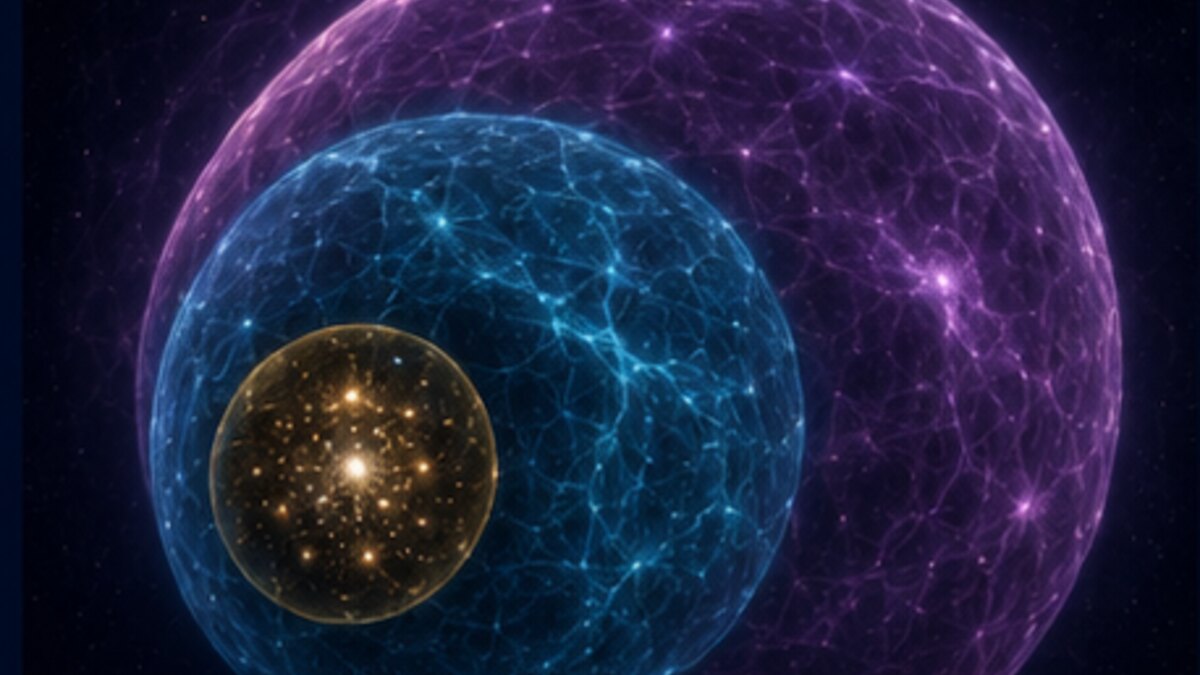
Everything we can see—stars, planets, gas, and people—makes up only a small part of the universe. Dark matter is the name given to unseen material whose gravity helps hold galaxies together. Dark energy is the name for whatever is causing the expansion of the universe to speed up. We can measure their effects, but we still do not know what they are.
Start with the short explanation in each chapter. Open “Go a little deeper” only when you want more detail. The final line shows how the next chapter follows from the one you just read.
01CHAPTER
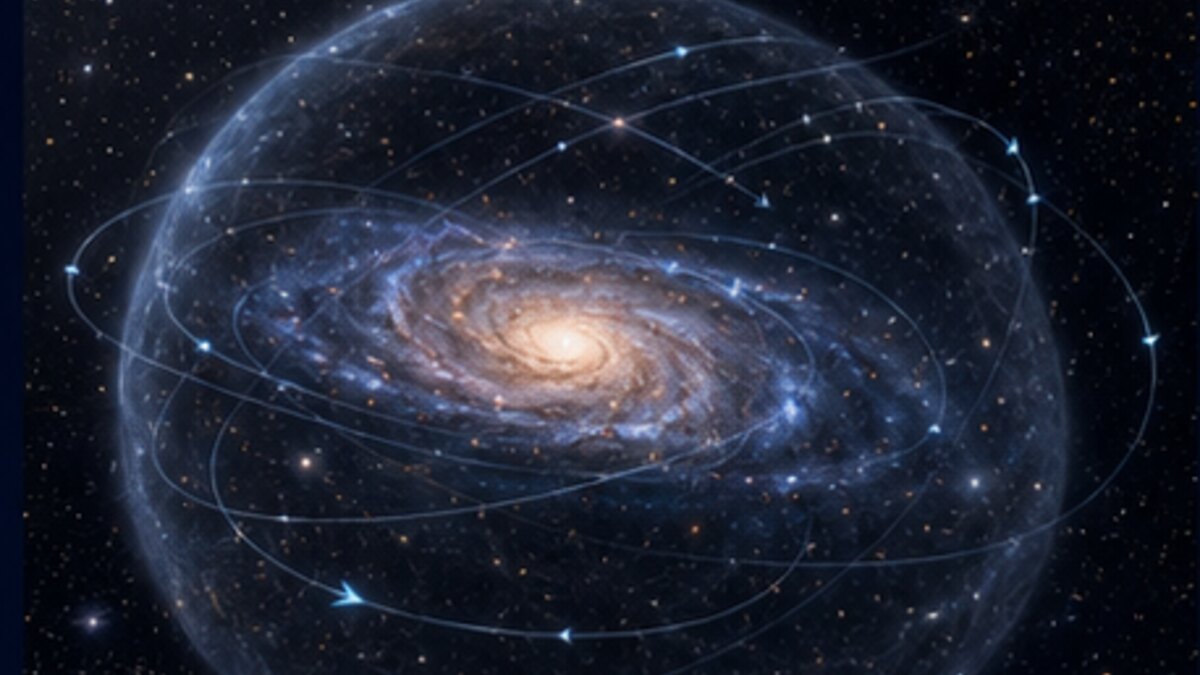
Visible matter cannot explain measured gravity.
The missing-mass problem
IN PLAIN LANGUAGE
Here is the big picture: Visible matter cannot explain measured gravity. The main point to remember is this: Rotation curves reveal extra gravity.
See the fuller scientific explanation +
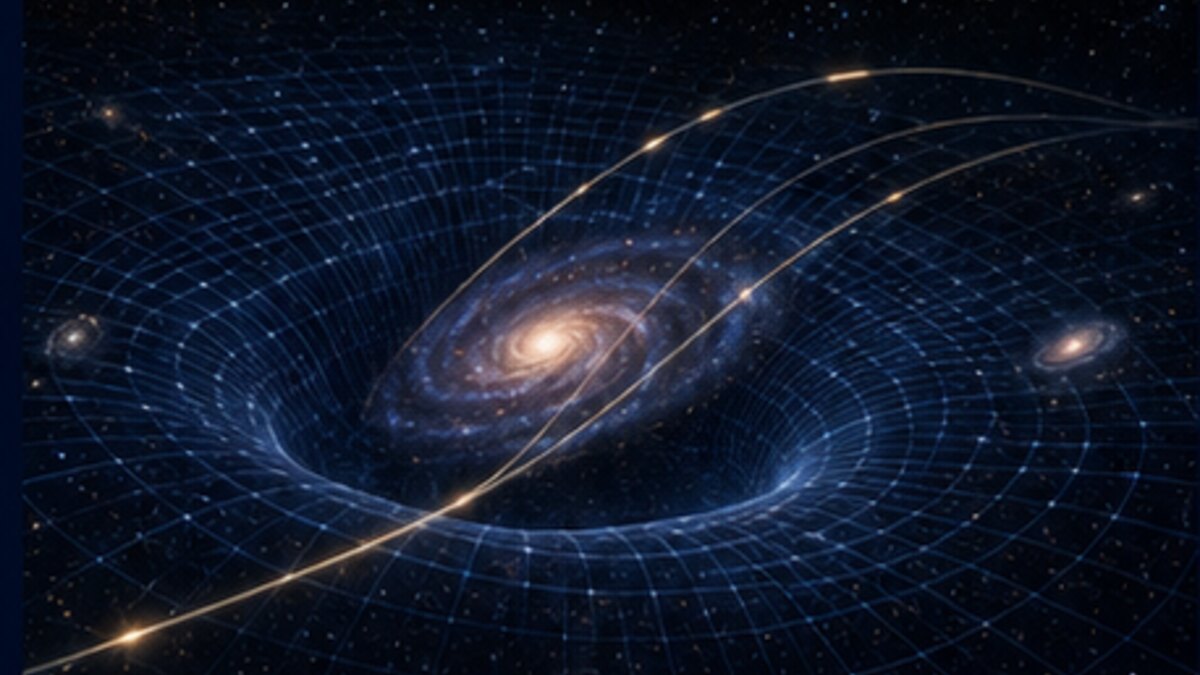
Stars orbit galaxies too rapidly for luminous mass alone, galaxy clusters bind more strongly than their galaxies and gas imply, and gravitational lensing maps unseen mass.
These observations span different scales and methods. Together they motivate dark matter: an additional gravitating component that interacts weakly or not at all with light.
Dark matter is inferred through its gravitational influence on visible systems.
02CHAPTER
Separating gas from gravitating mass.
Clusters and the Bullet Cluster
IN PLAIN LANGUAGE
Here is the big picture: Separating gas from gravitating mass. The main point to remember is this: Hot gas contains most visible cluster matter.
See the fuller scientific explanation +
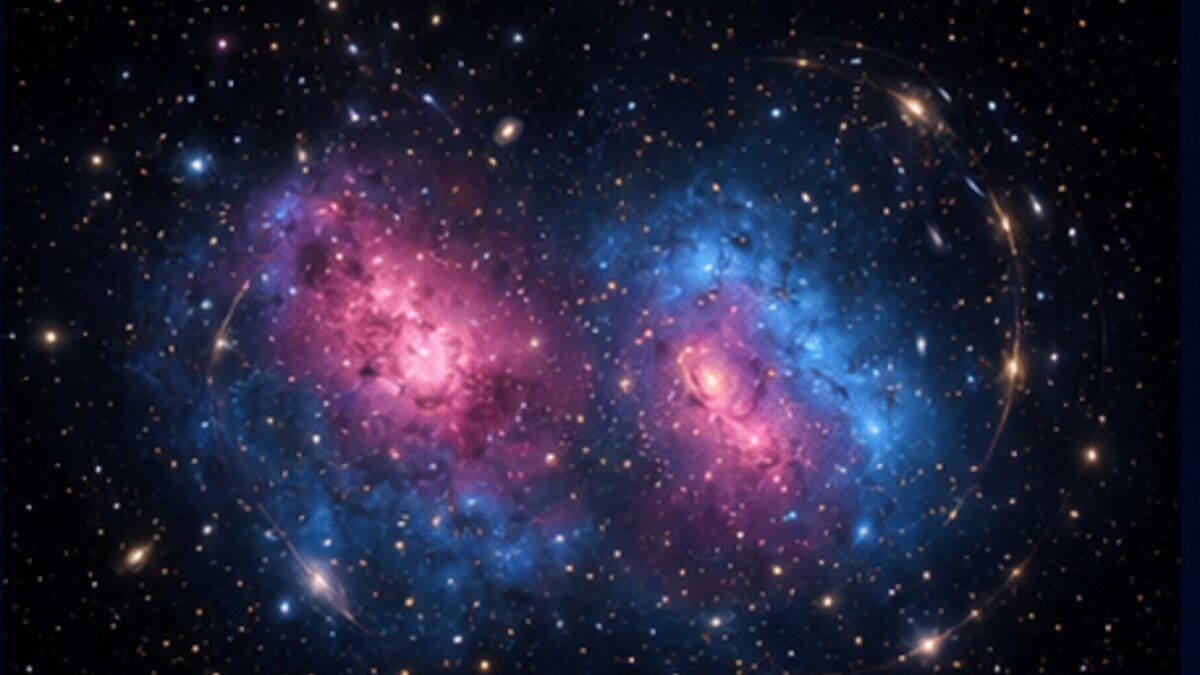
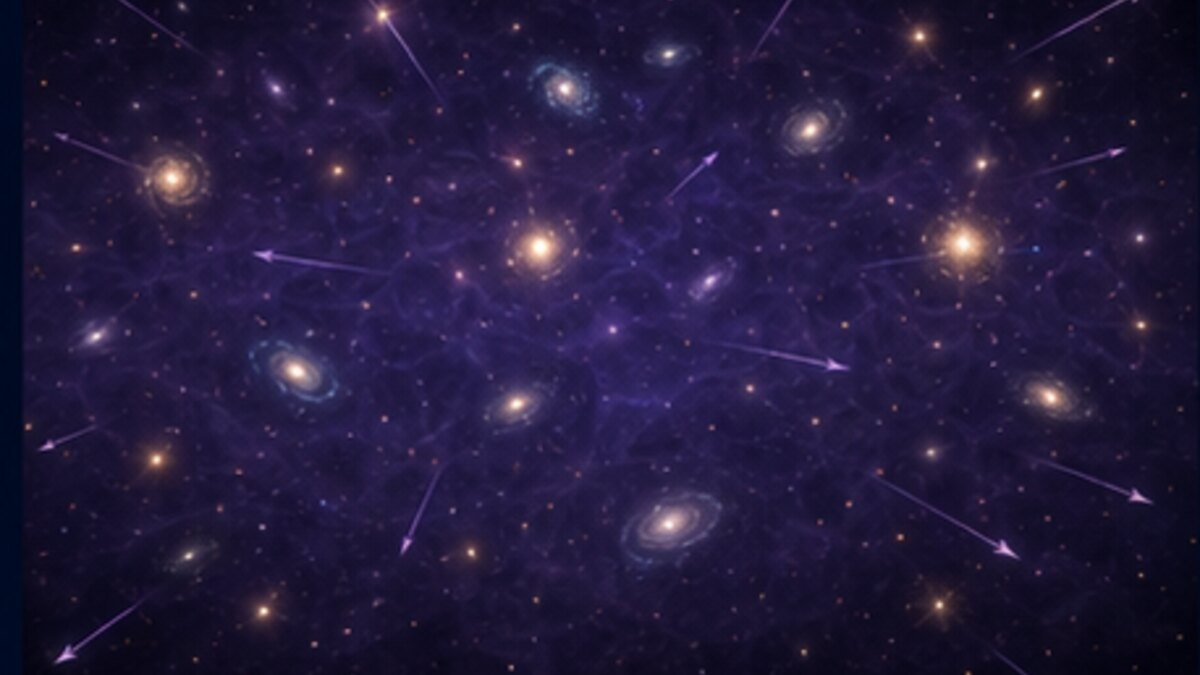
In colliding clusters, hot ordinary gas is slowed by interaction while galaxies pass more freely. Lensing maps can place much of the total mass away from the gas.
The Bullet Cluster is not a single proof of one dark-matter particle, but it is an important demonstration that most gravitating matter behaves differently from collisional baryonic gas.
THE POINTS TO REMEMBER
✦Hot gas contains most visible cluster matter
✦Lensing locates total mass
✦Collisions test how dark matter interacts
NEXT Now that this piece is in place, we can turn to The cosmic web.
Cluster collisions can spatially separate ordinary matter from dominant gravity.
03CHAPTER
Dark matter builds large-scale scaffolding.
The cosmic web
IN PLAIN LANGUAGE
Here is the big picture: Dark matter builds large-scale scaffolding. The main point to remember is this: Structure grows from tiny early fluctuations.
See the fuller scientific explanation +
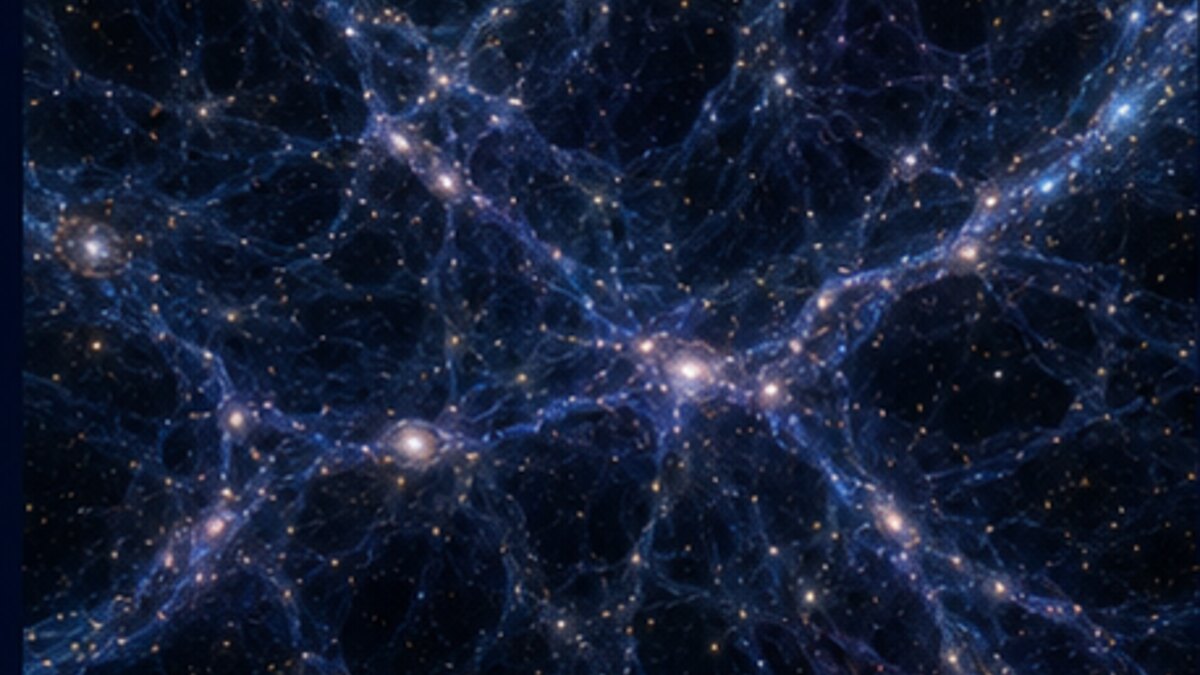
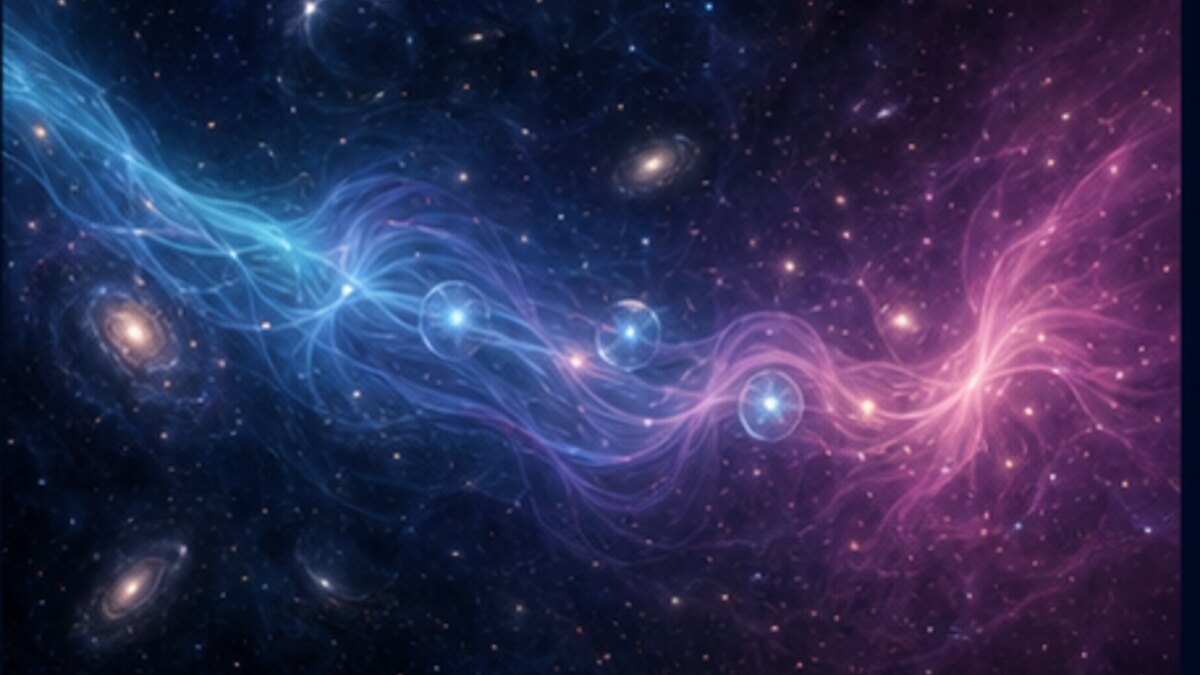
Early density fluctuations grew into halos, filaments, clusters, and voids. Simulations with cold dark matter reproduce the broad web-like distribution traced by galaxies.
Ordinary gas falls into this structure, then cooling and feedback create luminous galaxies. Dark matter does not merely add mass to existing galaxies; it shapes when and where galaxies form.
Galaxies illuminate only the densest portions of a much larger matter network.
04CHAPTER
A gravitational role without a confirmed identity.
What dark matter might be
IN PLAIN LANGUAGE
Here is the big picture: A gravitational role without a confirmed identity. The main point to remember is this: Dark matter is a category, not one established particle.
See the fuller scientific explanation +
Candidates include weakly interacting massive particles, axions, sterile-neutrino-like particles, and primordial black holes in limited mass ranges. Each predicts different signatures and formation behavior.
Direct-detection experiments, colliders, astronomical observations, and indirect searches have narrowed parameter space but have not confirmed a particle.
THE POINTS TO REMEMBER
✦Dark matter is a category, not one established particle
✦Candidates span enormous mass ranges
✦Null results guide future searches
NEXT Now that this piece is in place, we can turn to Modified gravity.
The microscopic identity of cosmic dark matter remains unknown.
05CHAPTER
Could the laws change instead of the matter content?
Modified gravity
IN PLAIN LANGUAGE
Here is the big picture: Could the laws change instead of the matter content? The main point to remember is this: Alternative gravity models are testable.
See the fuller scientific explanation +
Some theories modify gravity on galactic or cosmic scales and can reproduce selected phenomena without conventional dark matter. They provide useful challenges to assumptions.
Any successful alternative must also explain lensing, clusters, the CMB, structure growth, and cosmological expansion simultaneously. Matching one rotation curve is not enough.
THE POINTS TO REMEMBER
✦Alternative gravity models are testable
✦Multiple datasets must agree
✦Dark matter remains the leading integrated framework
Gravity theories are judged across galaxies, clusters, lensing, and the early universe.
06CHAPTER
Distant supernovae changed the cosmic story.
Discovery of acceleration
IN PLAIN LANGUAGE
Here is the big picture: Distant supernovae changed the cosmic story. The main point to remember is this: Supernovae act as standardized candles.
See the fuller scientific explanation +
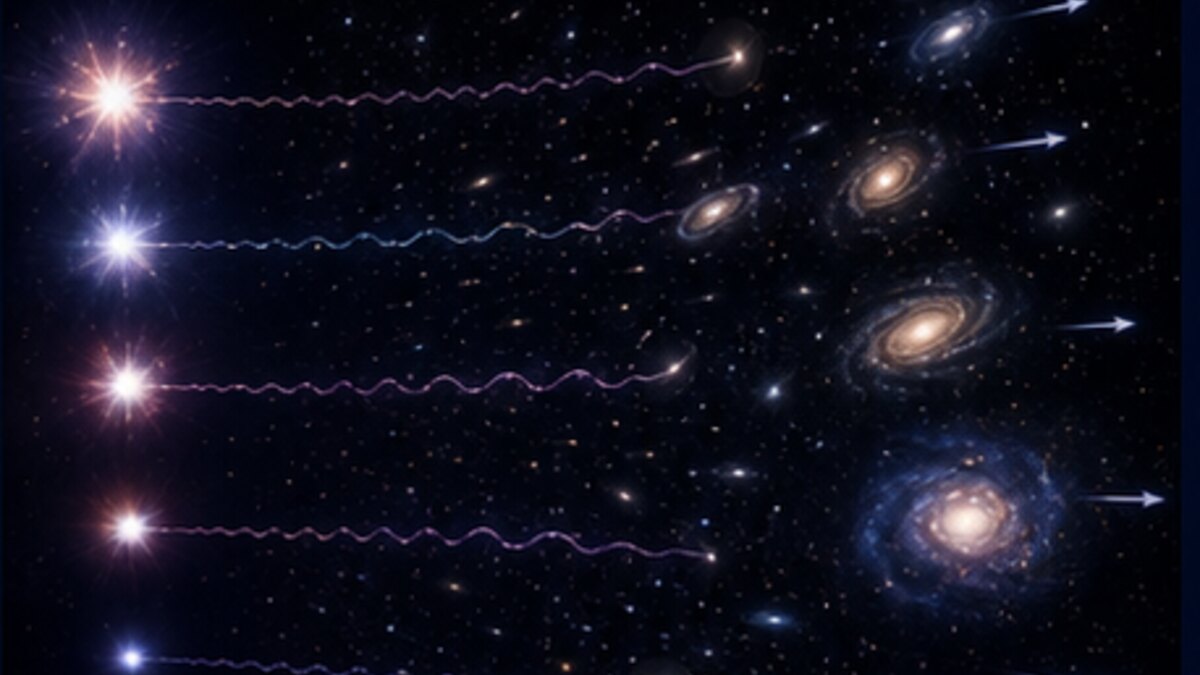
Type Ia supernova distance measurements showed that expansion has accelerated in recent cosmic history. Baryon acoustic oscillations, the CMB, and structure measurements provide complementary constraints.
Dark energy is the name for the component or gravitational behavior associated with this acceleration. It is distinct from dark matter, which clusters and adds attractive gravity.
Cosmic distances reveal that expansion is speeding up rather than slowing down.
07CHAPTER
The simplest fit creates a deep puzzle.
The cosmological constant
IN PLAIN LANGUAGE
Here is the big picture: The simplest fit creates a deep puzzle. The main point to remember is this: Λ has negative effective pressure.
See the fuller scientific explanation +
Einstein’s cosmological constant acts like a uniform energy density of empty space. In the standard ΛCDM model, it fits current observations well and remains constant as space expands.
Quantum field theory suggests vacuum contributions, but naive estimates differ enormously from the observed value. Explaining the small nonzero scale is the cosmological-constant problem.
Vacuum physics may connect the smallest scales with cosmic acceleration.
08CHAPTER
Could acceleration change over time?
Dynamic dark energy
IN PLAIN LANGUAGE
Here is the big picture: Could acceleration change over time? The main point to remember is this: Time variation would transform cosmic fate.
See the fuller scientific explanation +
Quintessence-like models introduce evolving fields whose energy density and pressure change. Modified-gravity theories can also mimic an evolving dark-energy signal.
Large surveys measure supernovae, galaxy clustering, weak lensing, and structure growth to test whether the equation-of-state parameter differs from a cosmological constant.
THE POINTS TO REMEMBER
✦Time variation would transform cosmic fate
✦Geometry and growth provide complementary tests
✦Precision control of systematics is essential
NEXT Now that this piece is in place, we can turn to The cosmic budget.
Future surveys seek tiny deviations from constant dark energy.
09CHAPTER
Only a small fraction is familiar matter.
The cosmic budget
IN PLAIN LANGUAGE
Here is the big picture: Only a small fraction is familiar matter. The main point to remember is this: Baryons are a cosmic minority.
See the fuller scientific explanation +
CMB and large-scale observations indicate a universe composed roughly of a few percent ordinary matter, about a quarter dark matter, and the remainder dark energy, with values refined by each dataset.
The percentages describe contributions to cosmic mass-energy density, not volumes occupied like ingredients in a container. Dark energy appears smooth; dark matter forms halos.
The visible universe is not the dominant component of the inferred cosmic budget.
10CHAPTER
Mapping gravity from laboratories to the sky.
The experiments ahead
IN PLAIN LANGUAGE
Here is the big picture: Mapping gravity from laboratories to the sky. The main point to remember is this: Complementary experiments cover different models.
See the fuller scientific explanation +
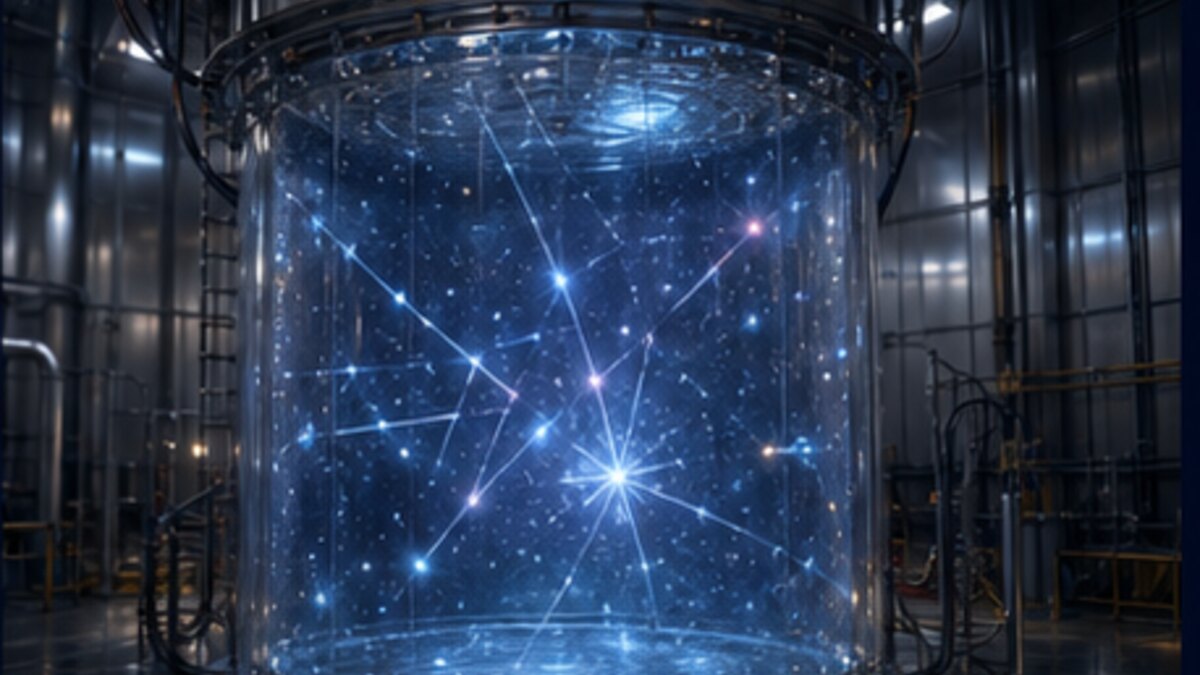
Underground detectors search for particle collisions, resonant instruments seek axions, colliders test new particles, and telescopes map lensing and galaxy growth. No single technique covers the full possibilities.
The goal is not merely to name two unknowns. It is to connect consistent gravitational evidence with a physical theory that makes new, falsifiable predictions.
THE POINTS TO REMEMBER
✦Complementary experiments cover different models
✦Astronomy and particle physics must connect
✦A discovery must predict more than existing data
The dark universe is attacked through many independent experimental windows.
THE ESSENTIAL THREAD
Three ideas worth keeping.
01Dark matter and dark energy are distinct problems.
02Their evidence is gravitational and cosmological.
03Neither component has a confirmed physical identity.