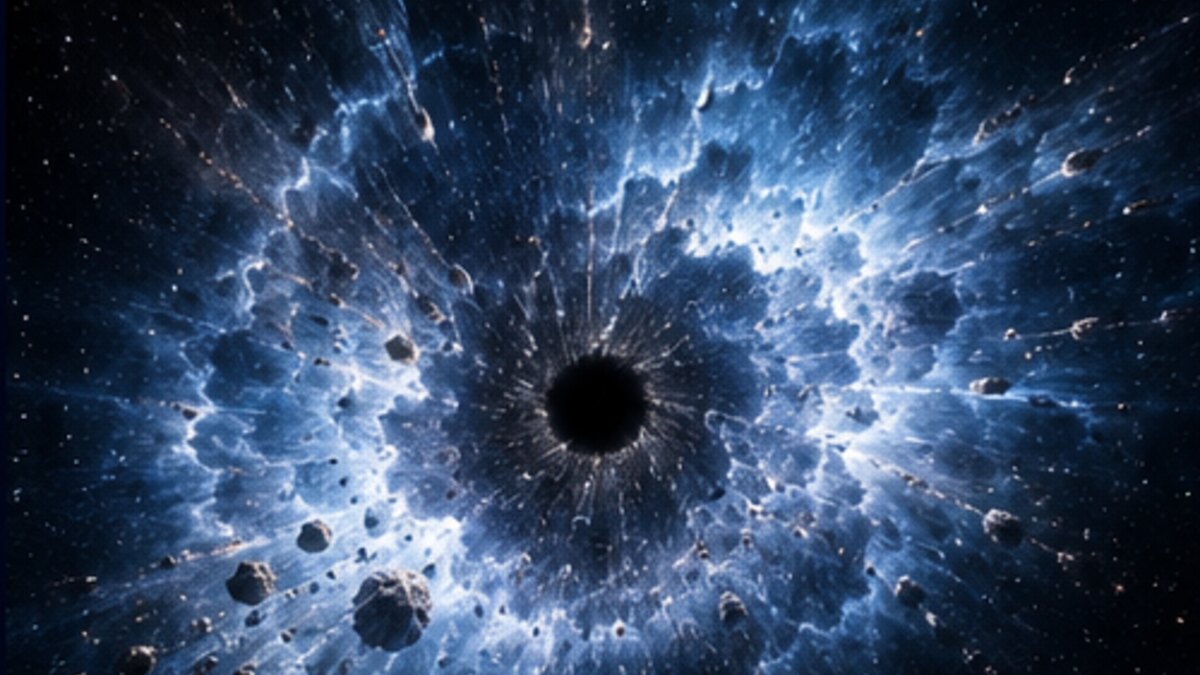
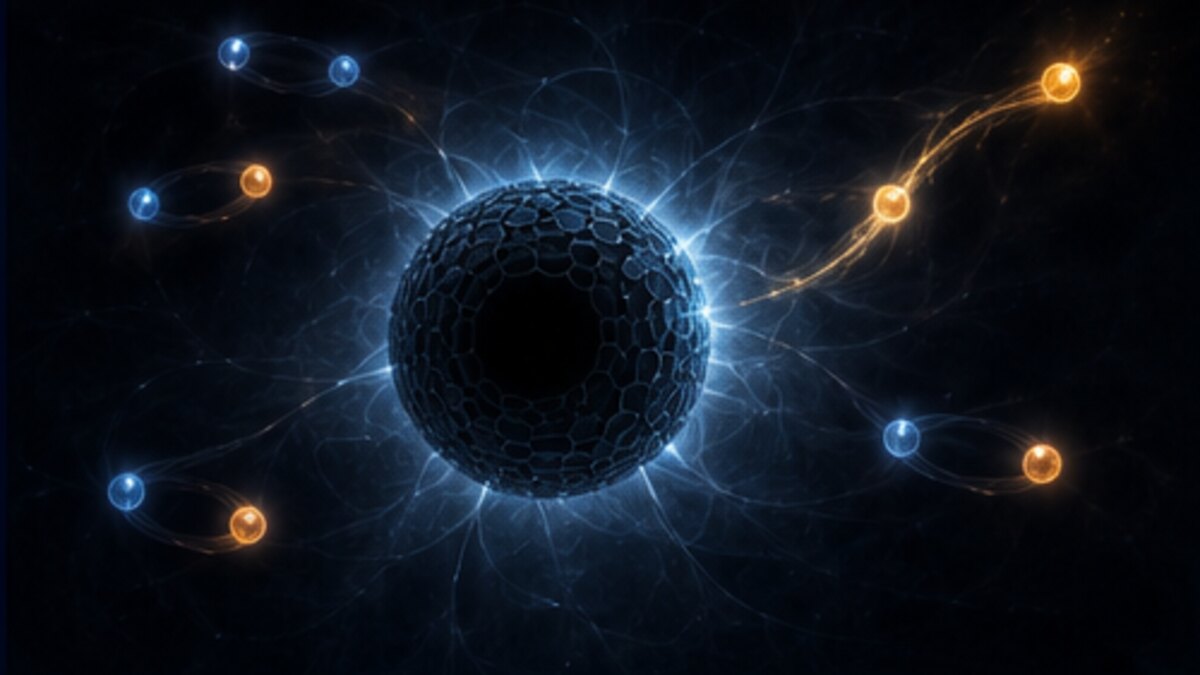
A black hole is a place where gravity has become so strong that, after crossing a boundary called the event horizon, nothing can return—not even light. We cannot see the black hole itself, but we can detect how it pulls on stars, heats nearby gas, bends light, and produces ripples in space and time.
Start with the short explanation in each chapter. Open “Go a little deeper” only when you want more detail. The final line shows how the next chapter follows from the one you just read.
01CHAPTER
How gravity can win permanently.
From massive star to collapsed core
IN PLAIN LANGUAGE
Here is the big picture: How gravity can win permanently. The main point to remember is this: Core collapse follows the loss of pressure support.
See the fuller scientific explanation +
A massive star supports itself by fusion-generated pressure. When usable core fuel is exhausted, the core collapses. If the remnant exceeds the maximum mass that neutron degeneracy and nuclear forces can support, no known pressure stops the collapse and an event horizon forms.
The outcome depends on initial mass, composition, rotation, mass loss, and binary interaction. Many stellar black holes are discovered in binaries because gas from a companion forms a luminous X-ray-emitting disk.
THE POINTS TO REMEMBER
✦Core collapse follows the loss of pressure support
A stellar black hole may reveal itself by stripping gas from a companion star.
02CHAPTER
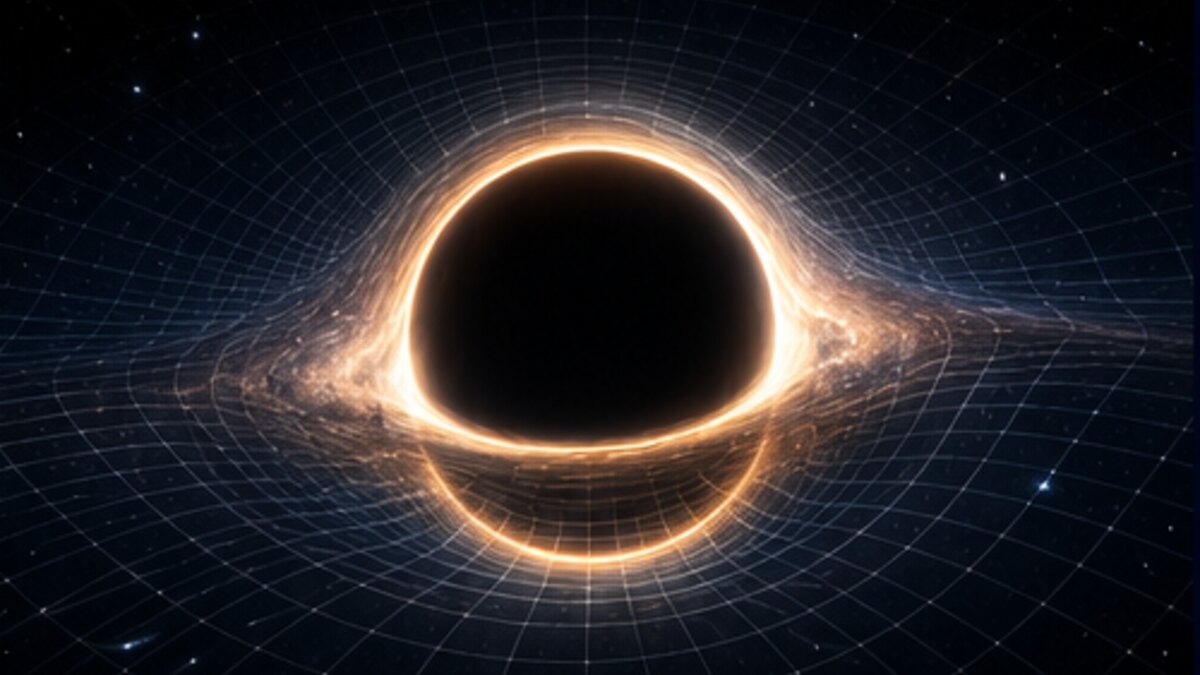
An event horizon is a boundary in the connected fabric of space and time.
The geometry of no return
IN PLAIN LANGUAGE
Here is the big picture: An event horizon is a boundary in the connected fabric of space and time. The main point to remember is this: The horizon is not a solid surface.
See the fuller scientific explanation +
In general relativity, gravity is not a force pulling objects through fixed space; mass-energy curves the connected fabric of space and time and free objects follow that geometry. Around a nonrotating black hole, the Schwarzschild radius marks the event horizon. Inside it, decreasing radius is as unavoidable as moving toward the future.
The horizon is locally unremarkable for a freely falling observer crossing a sufficiently large black hole. Distant observers receive increasingly redshifted, delayed light, so descriptions of the crossing depend on how the connected fabric of space and time is sliced into space and time.
THE POINTS TO REMEMBER
✦The horizon is not a solid surface
✦Escape speed language is only an analogy
✦Causal structure—not material strength—traps light
The dark center is surrounded by radiation from matter still outside the horizon.
03CHAPTER
Real black holes spin.
Rotation and frame dragging
IN PLAIN LANGUAGE
Here is the big picture: Real black holes spin. The main point to remember is this: A spinning hole drags local inertial frames.
See the fuller scientific explanation +
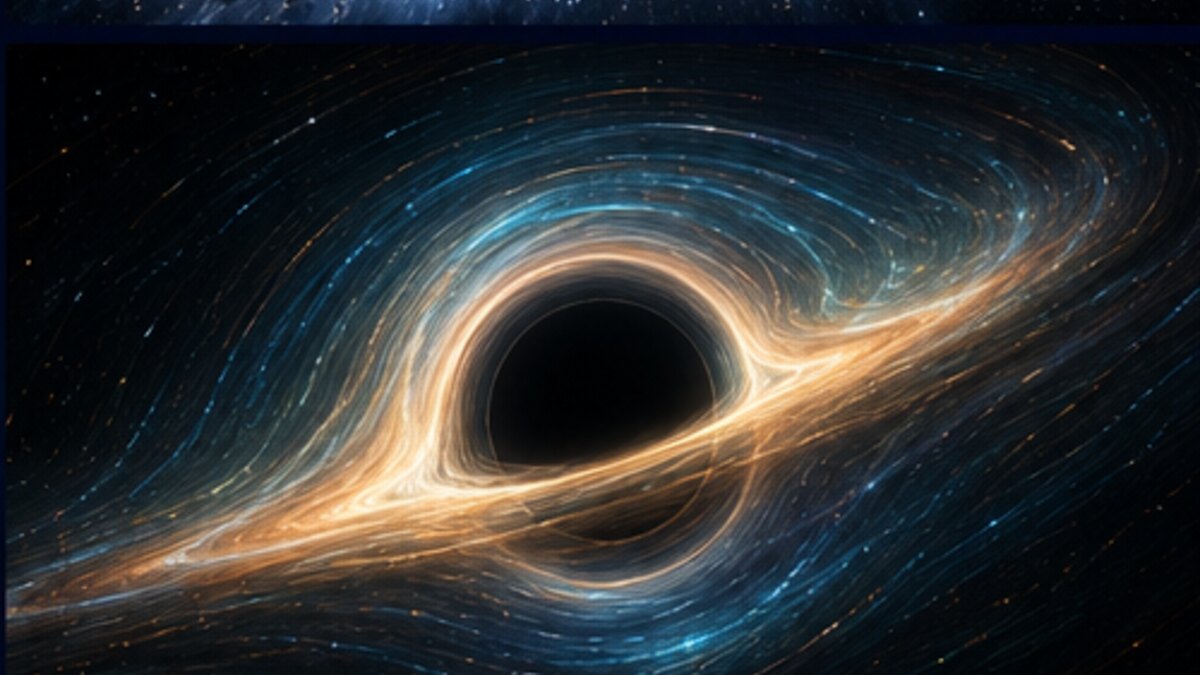
Collapsing stars and merging objects carry rotational motion, so astrophysical black holes are expected to rotate. The Kerr solution describes an ideal rotating black hole. Outside its horizon lies an ergosphere where frame dragging is so strong that remaining stationary relative to distant space is impossible.
Rotation changes the horizon, innermost stable orbit, disk efficiency, and possible jet production. In principle, rotational energy can be extracted through carefully arranged processes or electromagnetic fields.
Rotation twists nearby the connected fabric of space and time and alters the flow of accreting matter.
04CHAPTER
Most black-hole light comes from outside the hole.
Accretion disks and coronae
IN PLAIN LANGUAGE
Here is the big picture: Most black-hole light comes from outside the hole. The main point to remember is this: the gradual buildup of matter (accretion) converts gravity into radiation.
See the fuller scientific explanation +
Gas with rotational motion cannot fall straight inward. It forms a disk where magnetic turbulence transports rotational motion outward and allows matter to spiral in. Gravitational energy becomes heat and radiation, making the gradual buildup of matter (accretion) among the most efficient known energy sources.
A hot corona above the disk can scatter lower-energy photons into X-rays. Spectral lines, timing variations, and the orientation of light waves probe the disk’s motion, geometry, and inner edge.
THE POINTS TO REMEMBER
✦the gradual buildup of matter (accretion) converts gravity into radiation
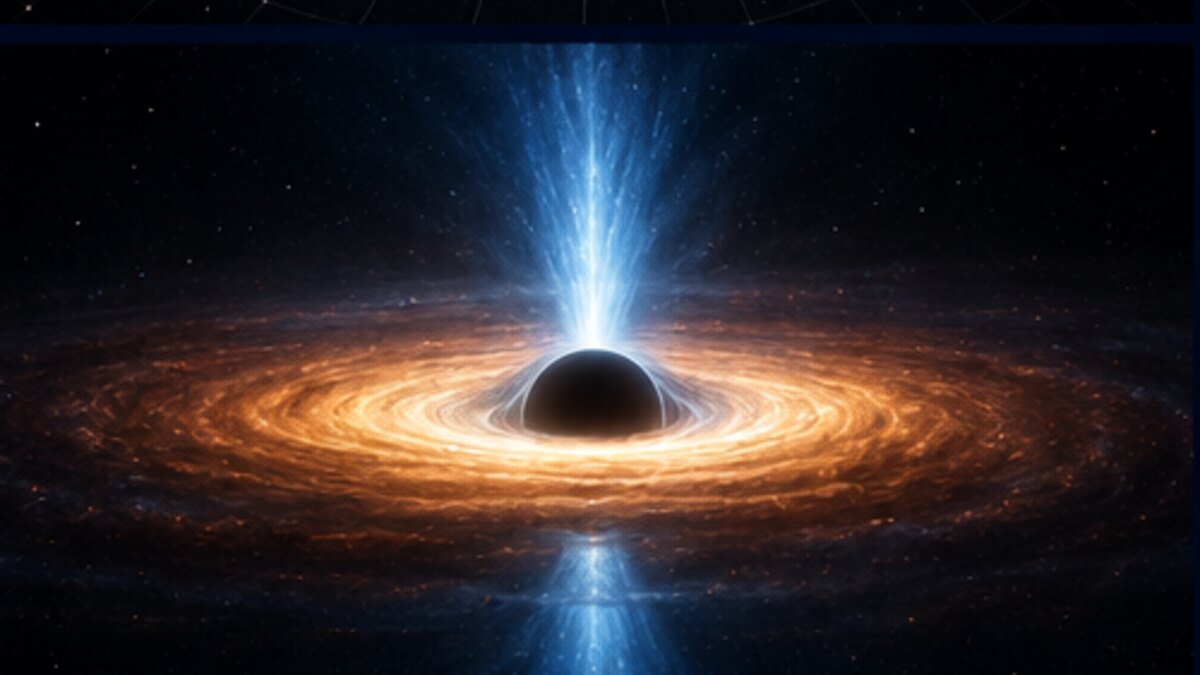
A bright disk and high-energy corona make an otherwise invisible black hole detectable.
05CHAPTER
Some feeding black holes launch beams across galaxies.
Jets and active galaxies
IN PLAIN LANGUAGE
Here is the big picture: Some feeding black holes launch beams across galaxies. The main point to remember is this: Jets emerge from the near-hole environment.
See the fuller scientific explanation +
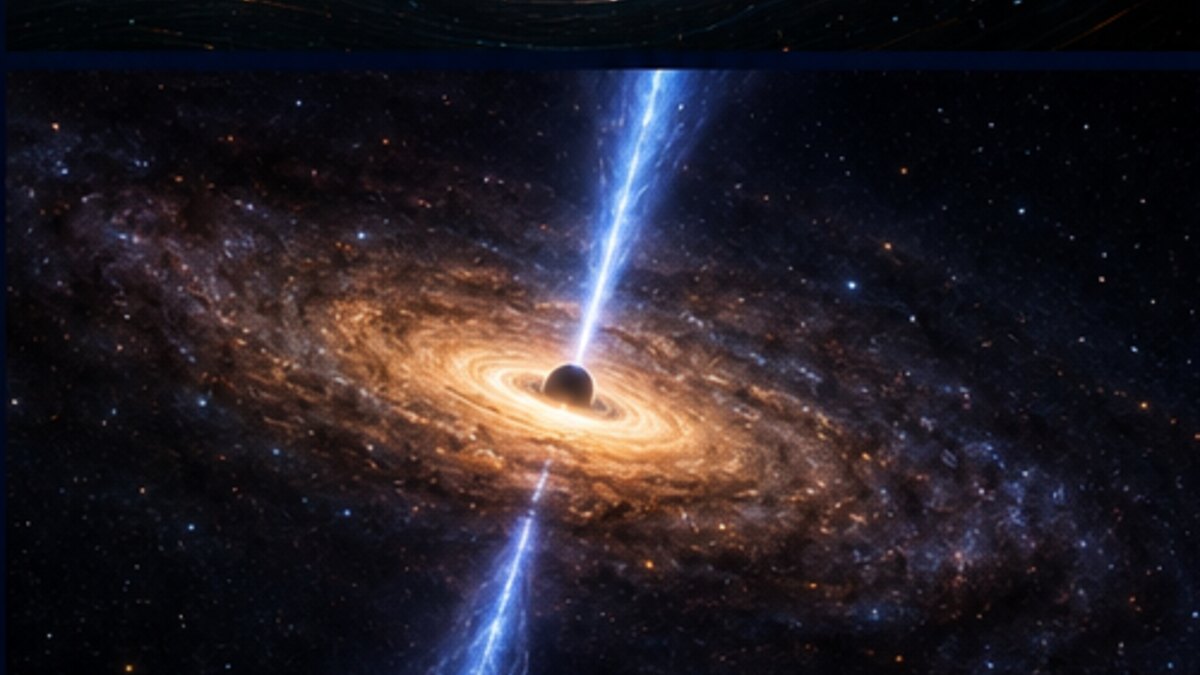
Supermassive black holes surrounded by magnetized the gradual buildup of matter (accretion) flows can power narrow relativistic jets. The jets likely tap disk energy and possibly black-hole spin, accelerating plasma to near light speed. When aimed toward Earth, the source may appear as a blazar.
Jets affect their host galaxies by heating or displacing gas. This feedback can suppress star formation or redistribute material, connecting the growth of a central black hole with the evolution of an entire galaxy.
THE POINTS TO REMEMBER
✦Jets emerge from the near-hole environment
✦Orientation changes how an active nucleus appears
Active galactic nuclei convert the gradual buildup of matter (accretion) energy into radiation and enormous outflows.
06CHAPTER
Gravity changes rapidly across nearby objects.
Tidal disruption and spaghettification
IN PLAIN LANGUAGE
Here is the big picture: Gravity changes rapidly across nearby objects. The main point to remember is this: Tidal strength depends on mass and distance.
See the fuller scientific explanation +
Tidal forces arise when gravity differs from one side of an object to the other. Near a stellar-mass black hole, the gradient can stretch an infalling body lengthwise and compress it sideways before horizon crossing. Around a very massive black hole, the horizon can be crossed before tidal forces become fatal.
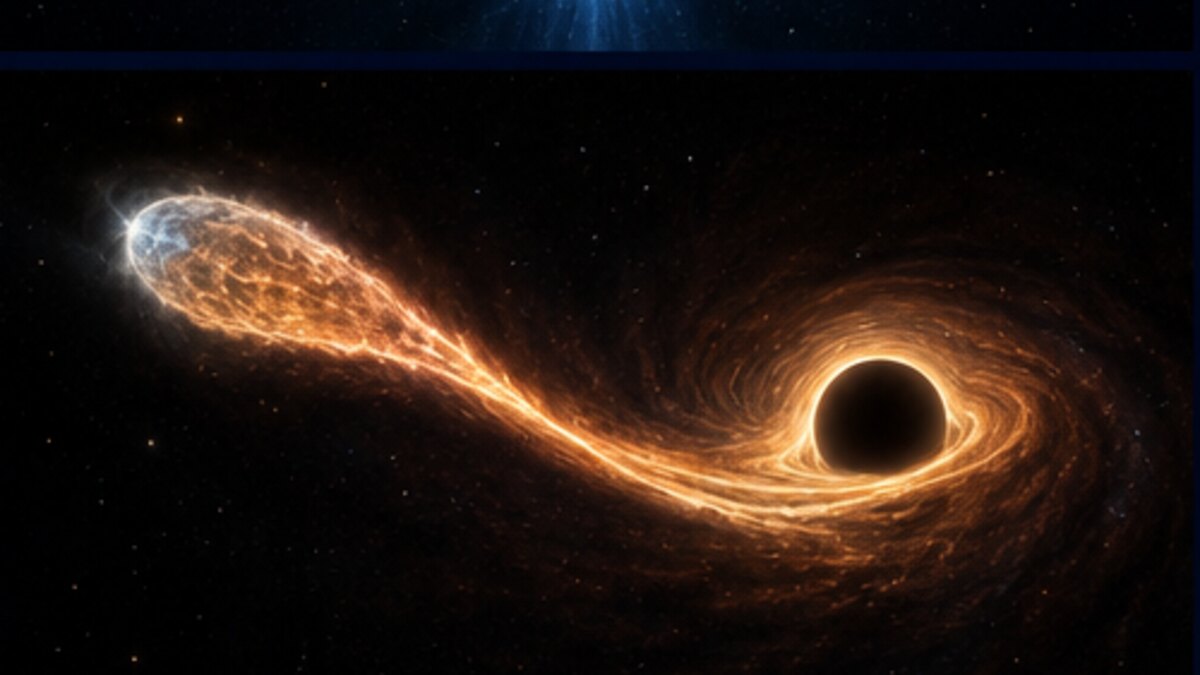
A star passing close to a supermassive black hole may be torn apart. Part of the debris escapes while part returns, producing a bright tidal-disruption flare that maps the feeding process.
A close stellar encounter can produce a luminous stream of torn material.
07CHAPTER
Astronomers infer black holes from their effects.
Finding invisible objects
IN PLAIN LANGUAGE
Here is the big picture: Astronomers infer black holes from their effects. The main point to remember is this: Orbits measure enclosed mass.
See the fuller scientific explanation +
Black holes are detected through stellar or gas orbits, the gradual buildup of matter (accretion) radiation, gravitational microlensing, gravitational waves, and horizon-scale imaging. Each method measures a different part of the system and carries different uncertainties.
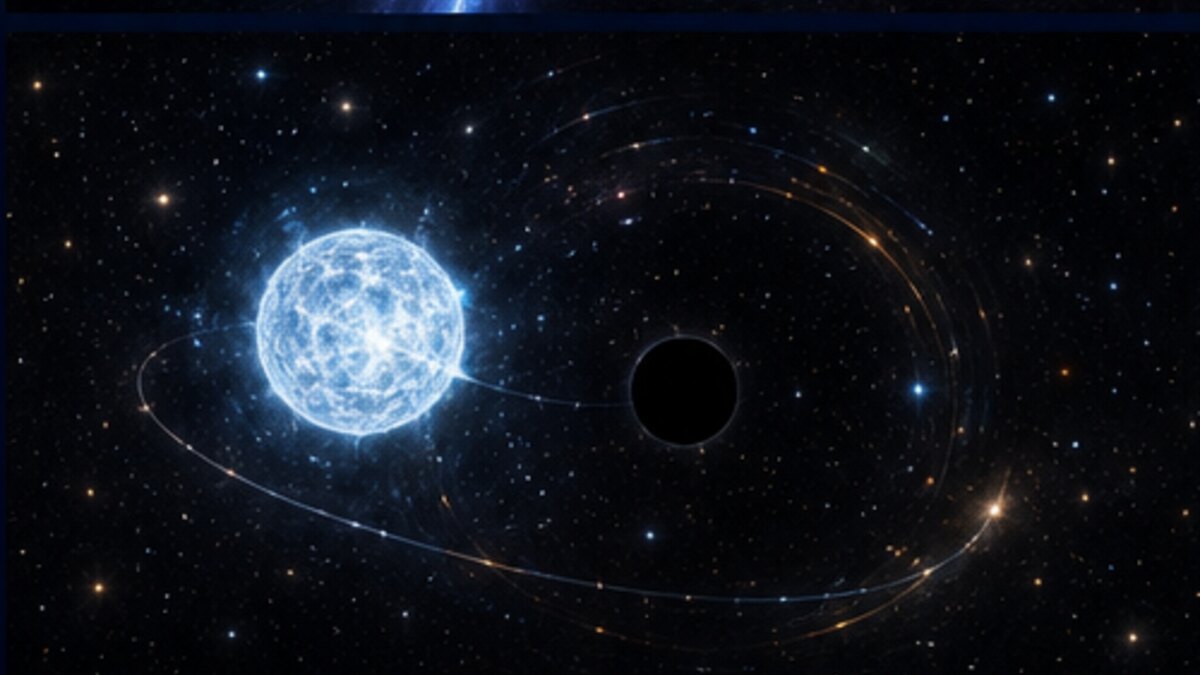
At the Milky Way’s center, decades of infrared observations track stars orbiting Sagittarius A*, revealing millions of solar masses inside a tiny region. Event Horizon Telescope observations add an image of the surrounding emission and shadow scale.
THE POINTS TO REMEMBER
✦Orbits measure enclosed mass
✦Lensing can find isolated dark objects
✦Multiple methods test the same relativistic picture
Motion and high-energy emission expose massive objects that emit no light of their own.
08CHAPTER
Colliding horizons make the connected fabric of space and time ring.
Mergers and gravitational waves
IN PLAIN LANGUAGE
Here is the big picture: Colliding horizons make the connected fabric of space and time ring. The main point to remember is this: Inspiral chirps rise in frequency and amplitude.
See the fuller scientific explanation +
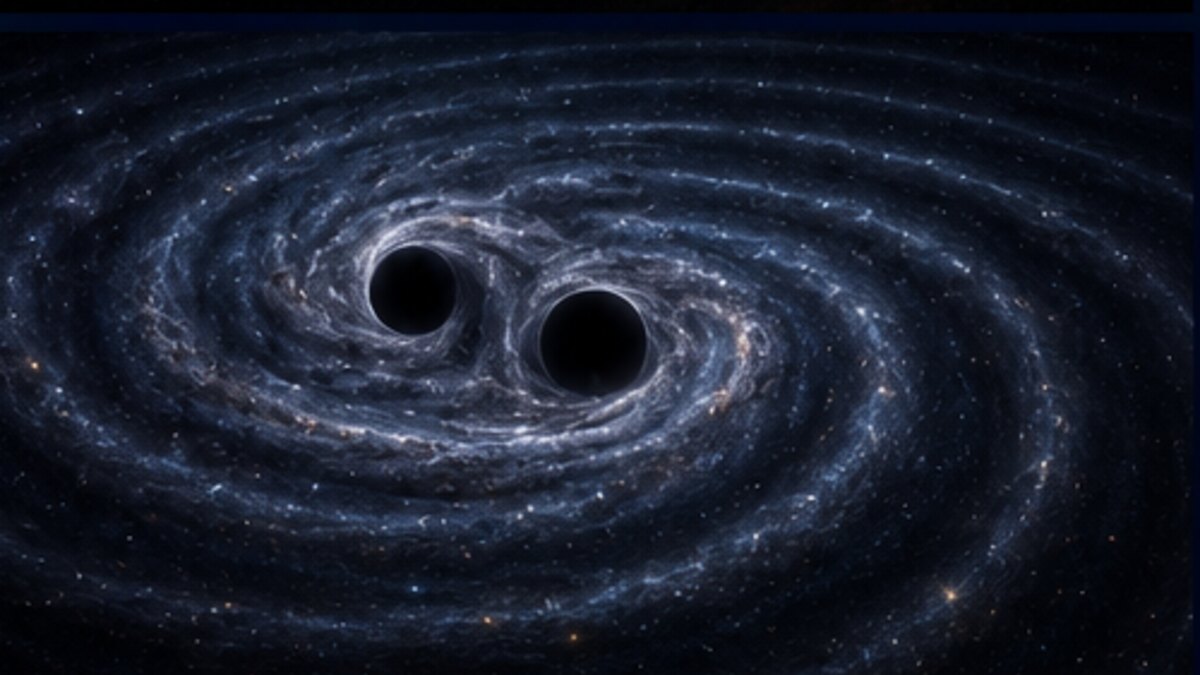
A compact binary loses orbital energy through gravitational radiation, spirals inward, merges, and settles into one distorted black hole. The waveform’s inspiral, merger, and ringdown encode the masses, spins, distance, and consistency with general relativity.
Ground-based detectors have transformed black holes from rare candidates into a population. Their measurements reveal unexpectedly heavy stellar black holes and let astronomers study formation channels that are difficult to distinguish electromagnetically.
Gravitational waves carry a direct record of accelerating compact masses.
09CHAPTER
Black holes behave like thermodynamic systems.
Hawking radiation and entropy
IN PLAIN LANGUAGE
Here is the big picture: Black holes behave like thermodynamic systems. The main point to remember is this: Larger holes are colder.
See the fuller scientific explanation +
Quantum field theory in curved the connected fabric of space and time predicts that a black hole emits nearly thermal radiation. Its temperature is inversely proportional to mass, so astrophysical black holes are extremely cold. As radiation carries energy away, an isolated black hole would eventually evaporate over an immense time.
Black-hole a measure related to disorder and hidden information scales with horizon area rather than volume. This surprising result connects gravity, information, quantum theory, and thermodynamics, inspiring the holographic principle.
THE POINTS TO REMEMBER
✦Larger holes are colder
✦a measure related to disorder and hidden information is proportional to horizon area
✦Evaporation is negligible on ordinary cosmic timescales
The horizon’s area acts like a measure of hidden microscopic information.
10CHAPTER
Where quantum theory and gravity collide.
The information paradox
IN PLAIN LANGUAGE
Here is the big picture: Where quantum theory and gravity collide. The main point to remember is this: Thermal radiation seems to erase distinctions.
See the fuller scientific explanation +
Hawking’s original calculation made the outgoing radiation appear thermal and uncorrelated with what formed the black hole. If the hole disappears completely, information about the initial quantum state seems lost, conflicting with ordinary unitary quantum evolution.
Modern work suggests information is preserved, but the mechanism remains a deep subject. Holography, quantum extremal surfaces, and calculations of the radiation a measure related to disorder and hidden information have sharpened the problem. The paradox is valuable because any successful quantum theory of gravity must explain it.
THE POINTS TO REMEMBER
✦Thermal radiation seems to erase distinctions
✦Quantum unitarity resists fundamental information loss
✦Holography offers a powerful framework
The information problem turns a dark object into a test of fundamental physics.
THE ESSENTIAL THREAD
Three ideas worth keeping.
01An event horizon is a causal boundary, not a solid surface.
02Black holes reveal themselves through gravity and energetic surroundings.
03Their information problem is a clue toward quantum gravity.