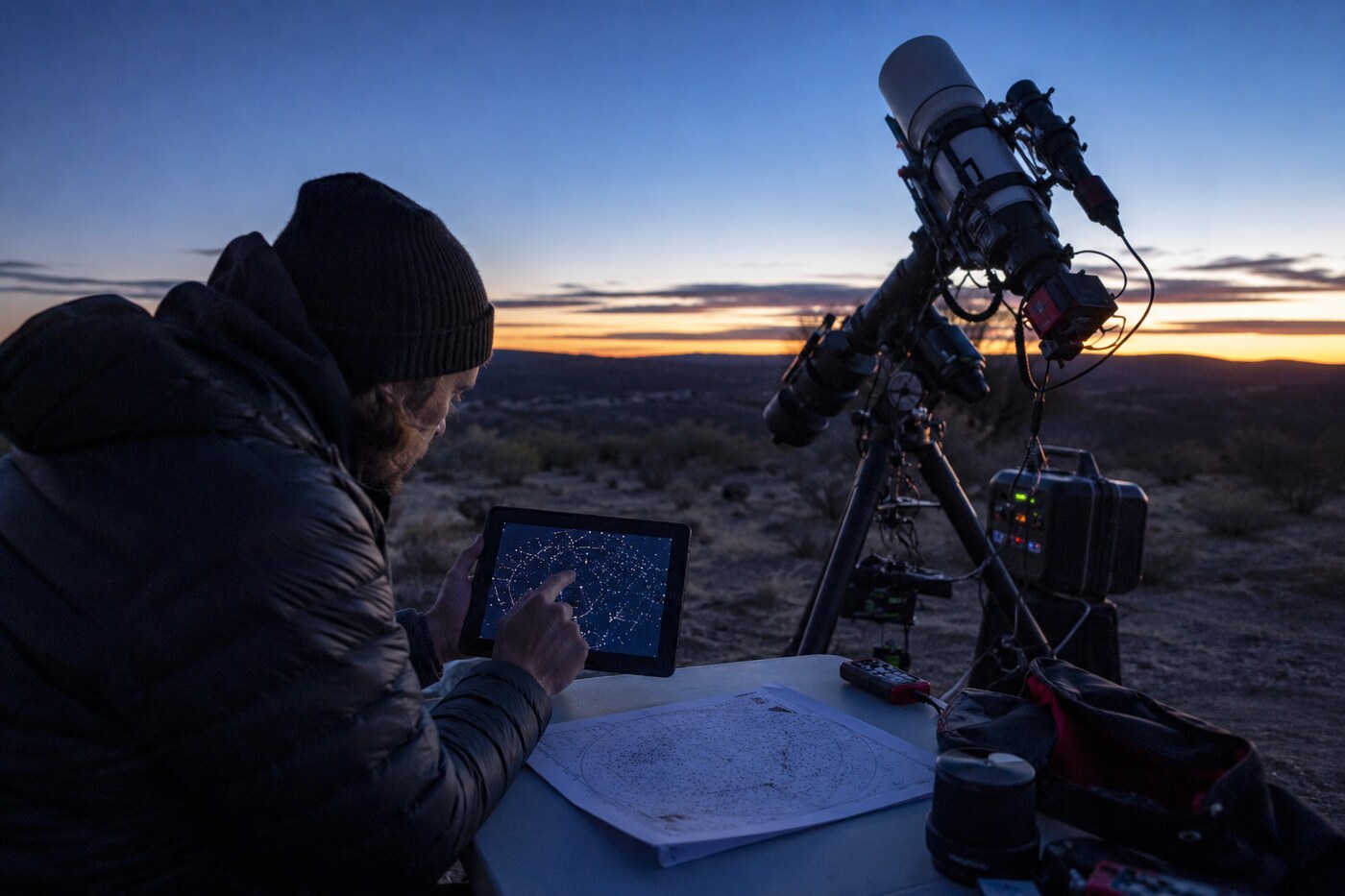
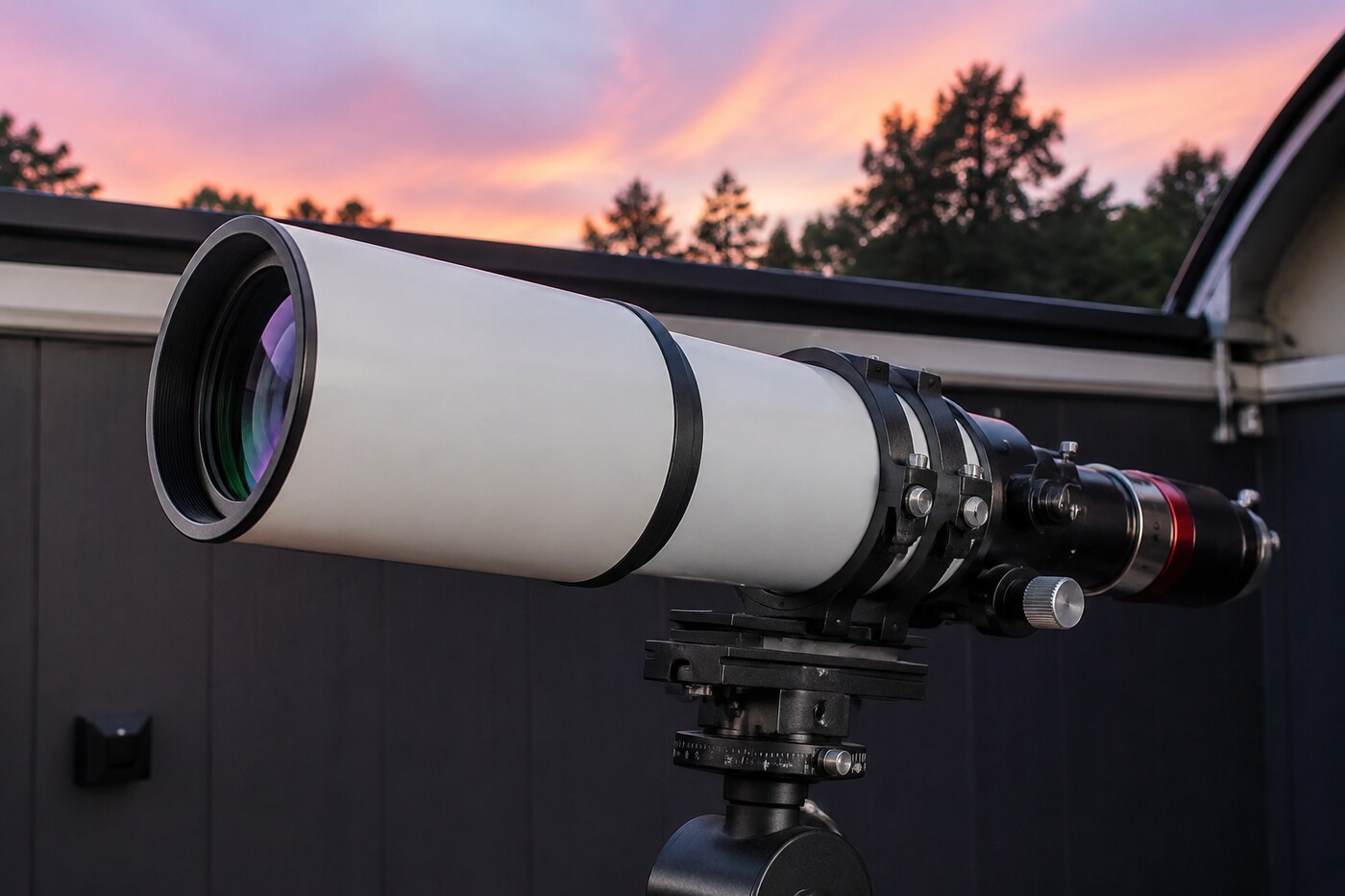
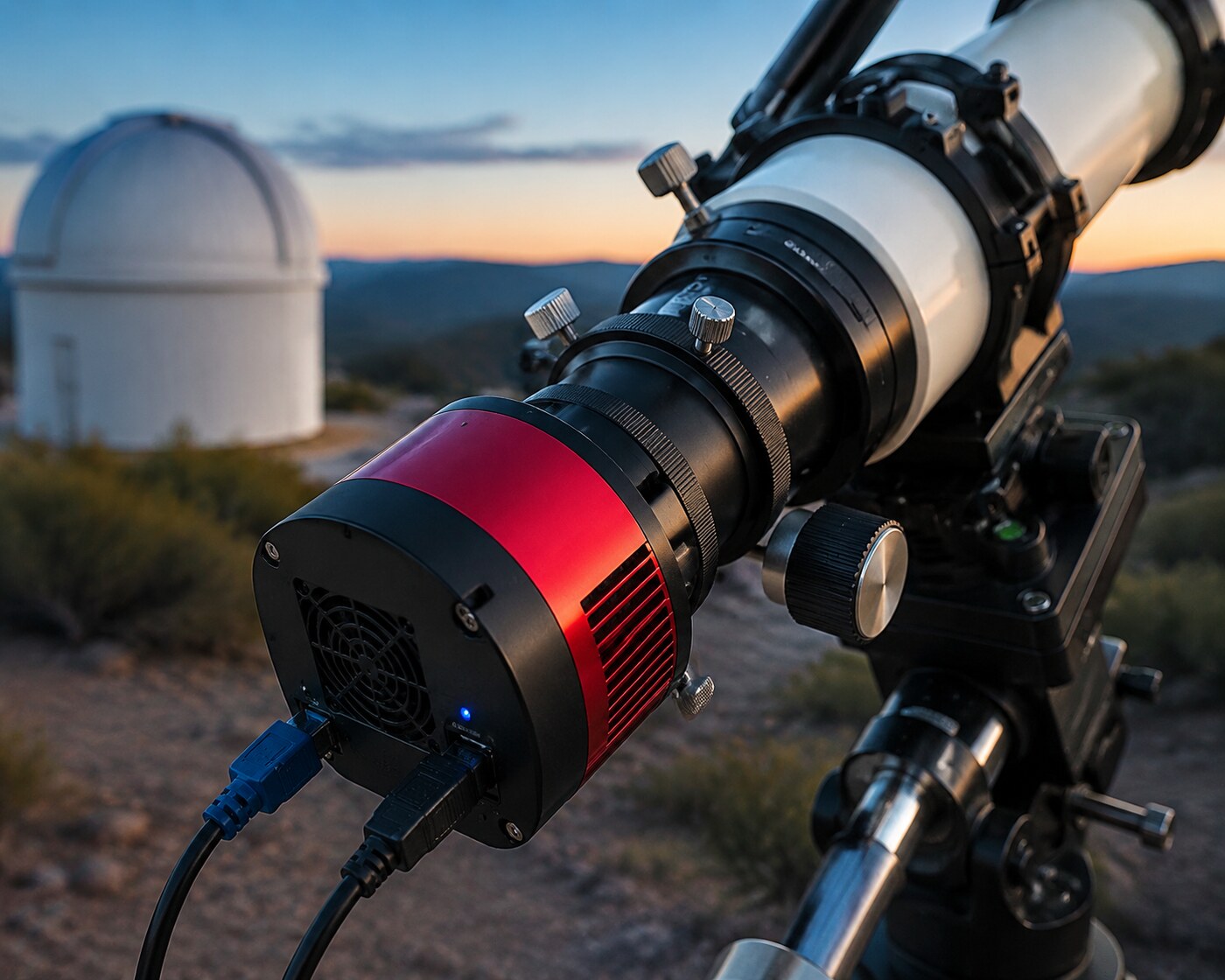
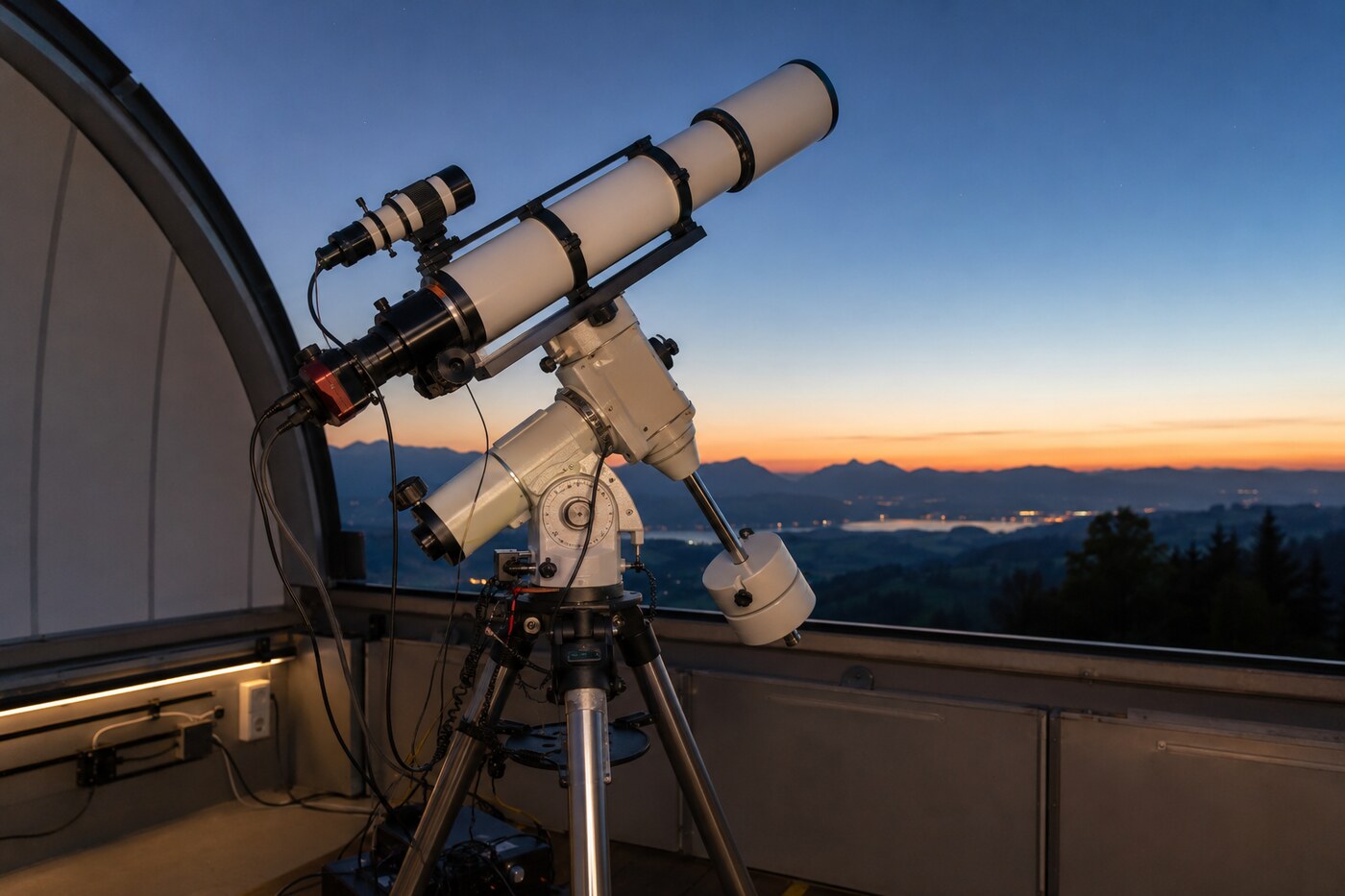
Astrophotography is the practice of collecting very faint light from the night sky and turning it into a useful, attractive image. Good results depend on steady tracking, many exposures, careful calibration, and restrained processing. The goal is to reveal real detail without allowing noise or editing to create a misleading picture.
Start with the short explanation in each chapter. Open “Go a little deeper” only when you want more detail. The final line shows how the next chapter follows from the one you just read.
01CHAPTER
The target should choose the equipment—not the other way around.
Begin with the picture you want
IN PLAIN LANGUAGE
Here is the big picture: The target should choose the equipment—not the other way around. The main point to remember is this: Field of view comes first.
See the fuller scientific explanation +
A wide nebula, a small galaxy, the Moon, and the Milky Way all ask for different fields of view and exposure strategies. Start by deciding what should fit in the frame.
Then check when the target is high, how bright the Moon will be, and how much clear sky you really have. A simple plan prevents most wasted nights.
Planning turns limited clear-sky time into useful exposure time.
02CHAPTER
Focal length frames the sky; aperture gathers light.
Telescopes and focal length
IN PLAIN LANGUAGE
Here is the big picture: Focal length frames the sky; aperture gathers light. The main point to remember is this: Focal length sets image scale.
See the fuller scientific explanation +
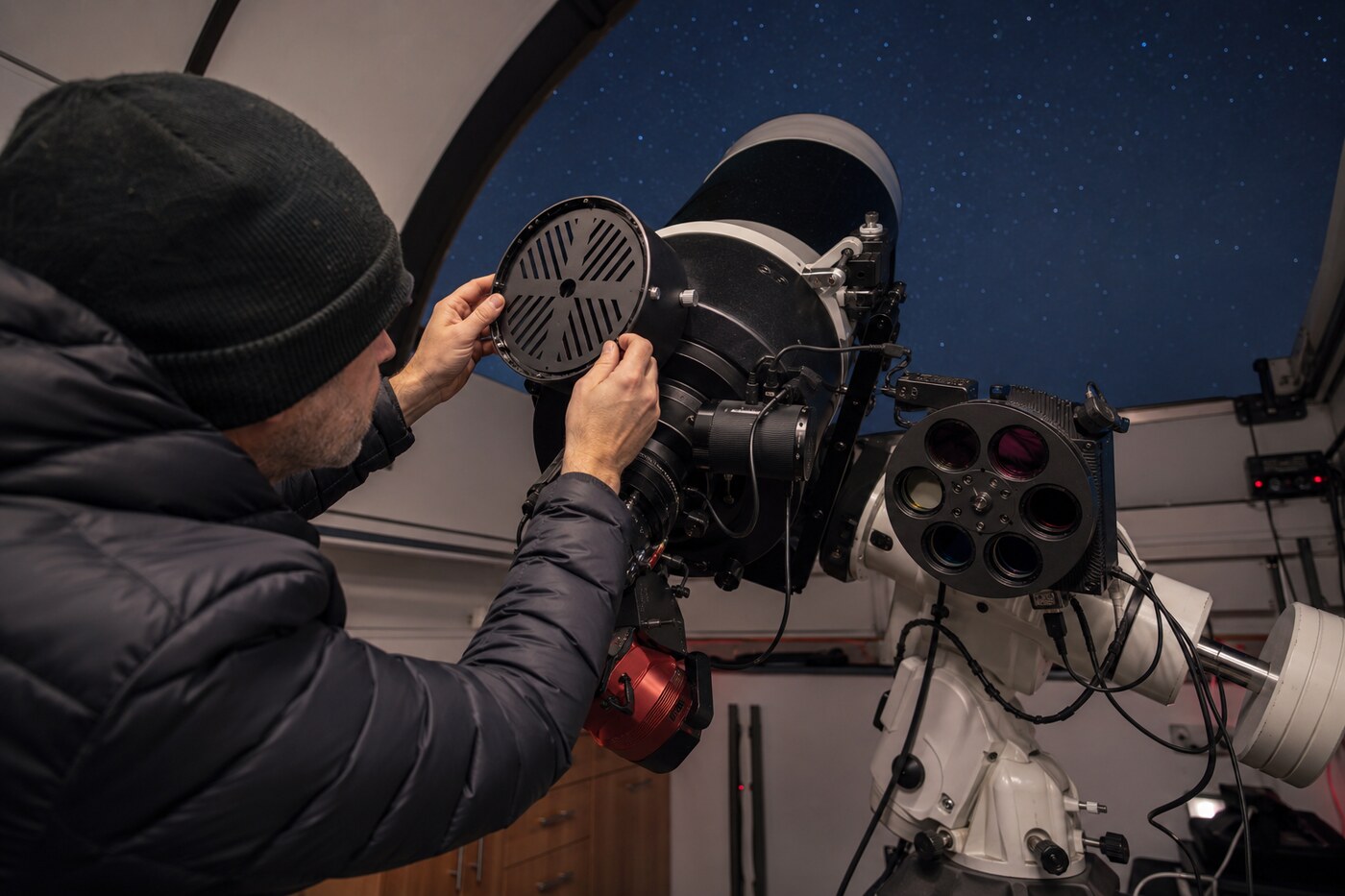
Short focal lengths are forgiving and suit large nebulae. Longer focal lengths enlarge small targets but demand better tracking, steadier air, and more precise focus.
Fast focal ratios collect extended-object signal more quickly. Yet a well-matched, easy-to-use system often beats a larger system that rarely gets outside.
A telescope is part of an imaging system, not an isolated specification.
03CHAPTER
Match the sensor to the sky and telescope.
Cameras and sampling
IN PLAIN LANGUAGE
Here is the big picture: Match the sensor to the sky and telescope. The main point to remember is this: Image scale links pixels and focal length.
See the fuller scientific explanation +
Pixel size and focal length determine image scale. If the scale is too coarse, detail is lost; if it is too fine, you mostly record atmospheric blur and demand more from tracking.
Sensor size controls field of view. Cooling reduces thermal noise, while quantum efficiency describes how effectively arriving photons become recorded signal.
Good sampling records available detail without magnifying blur.
04CHAPTER
Sharp stars depend on smooth motion.
The mount is the foundation
IN PLAIN LANGUAGE
Here is the big picture: Sharp stars depend on smooth motion. The main point to remember is this: Tracking protects every exposure.
See the fuller scientific explanation +
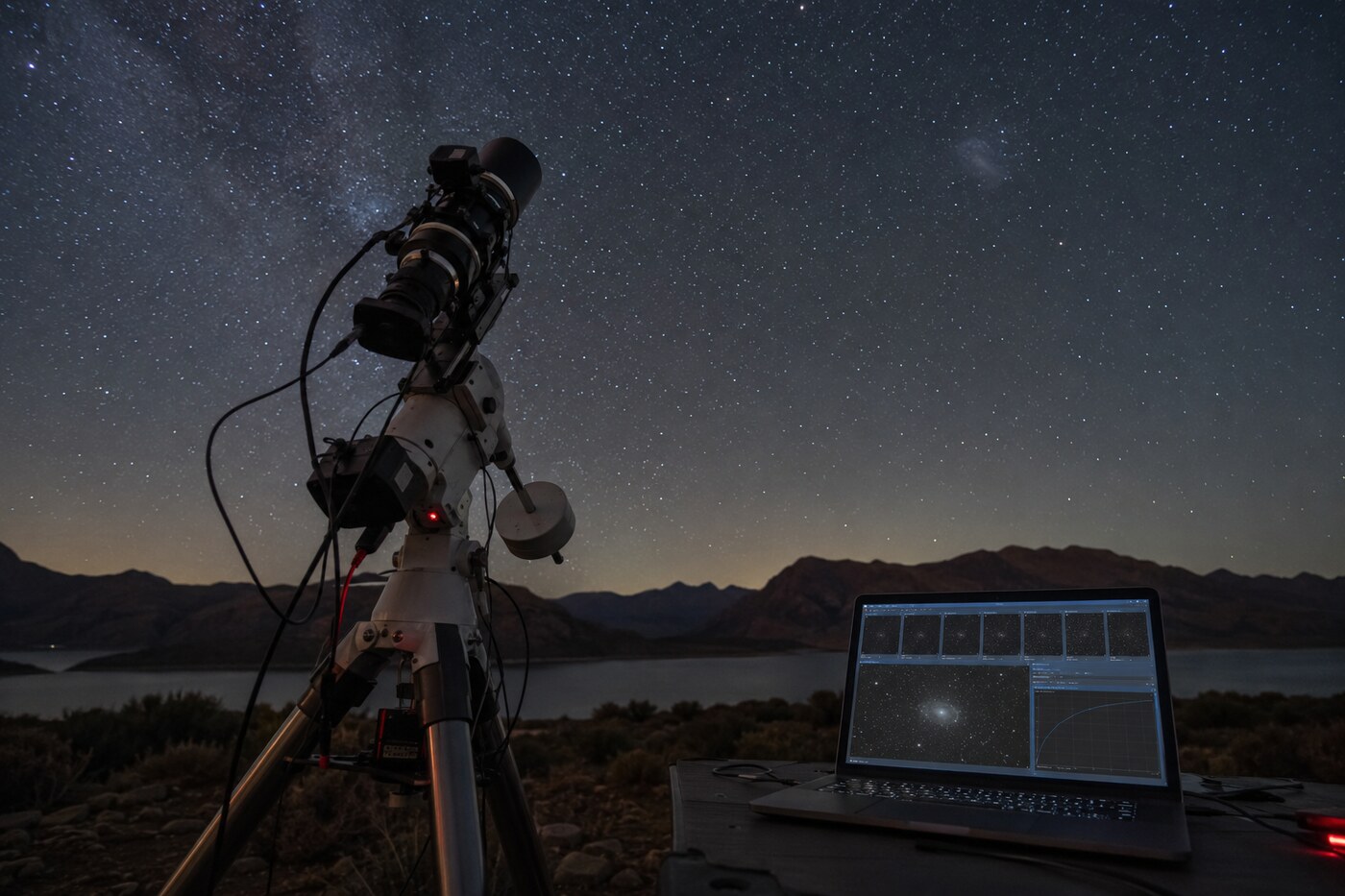
During a long exposure, the sky appears to move because Earth rotates. An equatorial mount follows that motion so starlight stays on the same pixels.
Accurate polar alignment, sensible payload, cable control, and balanced mechanics matter. Guiding can correct small errors, but it cannot rescue a mount that is overloaded or poorly set up.
THE POINTS TO REMEMBER
✦Tracking protects every exposure
✦Polar alignment reduces drift
✦Guiding corrects small errors, not structural ones
The mount quietly determines how much of the collected light becomes a sharp image.
05CHAPTER
Small setup choices shape the entire night.
Focus, filters, and framing
IN PLAIN LANGUAGE
Here is the big picture: Small setup choices shape the entire night. The main point to remember is this: Focus changes with temperature.
See the fuller scientific explanation +
Precise focus can change as temperature shifts, so it should be checked through the session. Framing also deserves care: leave room for the object's shape and avoid awkward edge placement.
Filters can reduce unwanted wavelengths or isolate emission lines. They are selective tools, not replacements for dark skies, adequate exposure, or good calibration.
Careful focus and composition make later processing easier and more natural.
06CHAPTER
Many photons tell a cleaner story.
Exposure and signal
IN PLAIN LANGUAGE
Here is the big picture: Many photons tell a cleaner story. The main point to remember is this: Subexposure length manages practical limits.
See the fuller scientific explanation +
One long exposure records signal but risks saturation, tracking loss, and aircraft trails. Many moderate subexposures spread that risk and can be combined later.
Total integration time is the larger goal. As more useful exposures accumulate, faint structure becomes easier to separate from random noise.
THE POINTS TO REMEMBER
✦Subexposure length manages practical limits
✦Total time builds depth
✦Avoid clipping bright stars and cores
NEXT Now that this piece is in place, we can turn to Calibration frames.
Depth comes from patient integration, not a single heroic exposure.
07CHAPTER
Measure the camera and optics so you can subtract their fingerprints.
Calibration frames
IN PLAIN LANGUAGE
Here is the big picture: Measure the camera and optics so you can subtract their fingerprints. The main point to remember is this: Darks model sensor signal.
See the fuller scientific explanation +
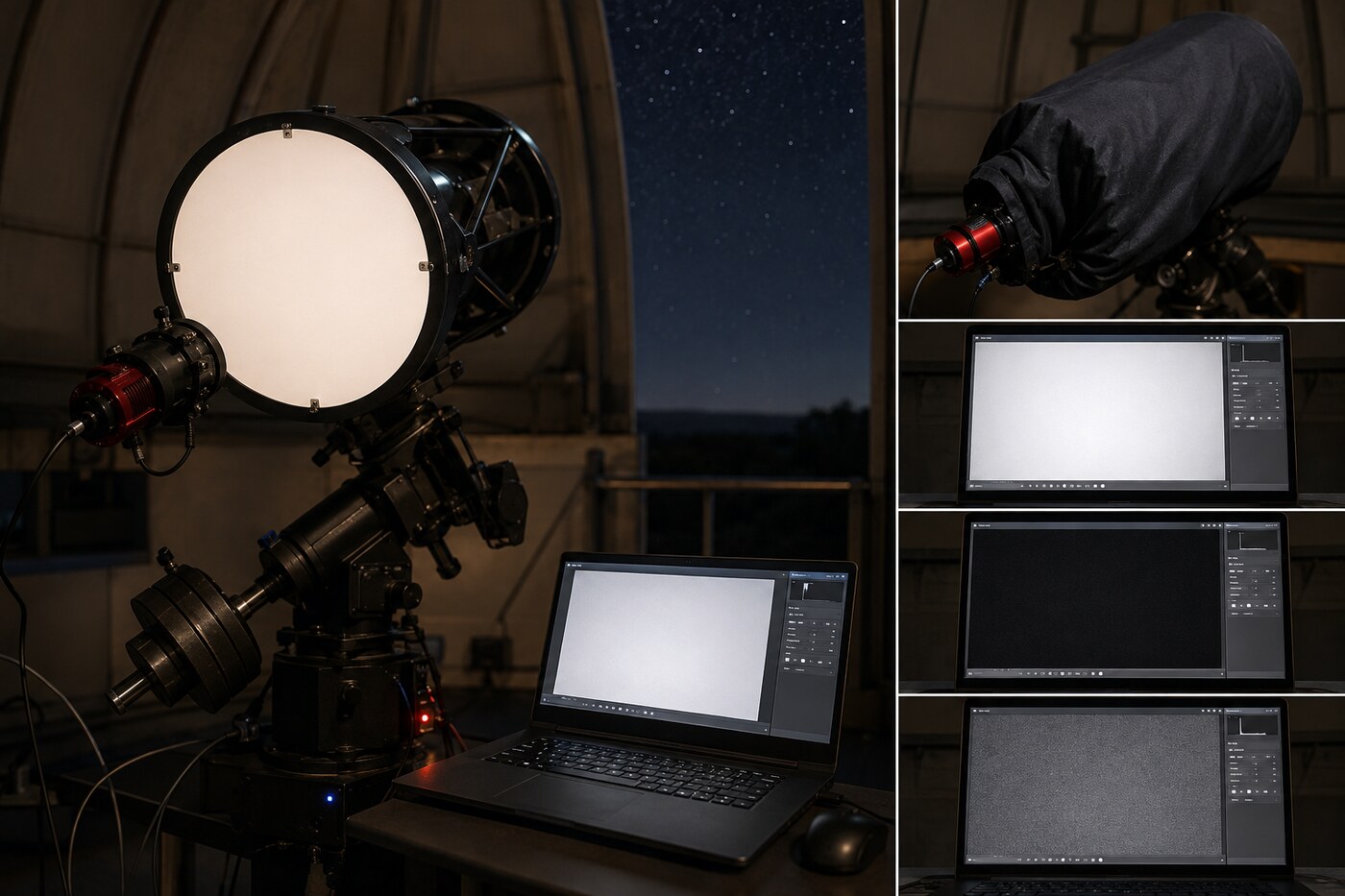
Dark frames record thermal signal and repeatable sensor patterns. Flats map dust shadows and uneven illumination. Bias or flat-dark frames support the math used by the chosen calibration workflow.
Calibration works best when frames match the relevant settings and conditions. Its purpose is simple: remove patterns that did not come from the sky.
Calibration separates the telescope-camera system from the celestial target.
08CHAPTER
Align the stars, reject accidents, and combine the rest.
Registration and stacking
IN PLAIN LANGUAGE
Here is the big picture: Align the stars, reject accidents, and combine the rest. The main point to remember is this: Registration aligns geometry.
See the fuller scientific explanation +
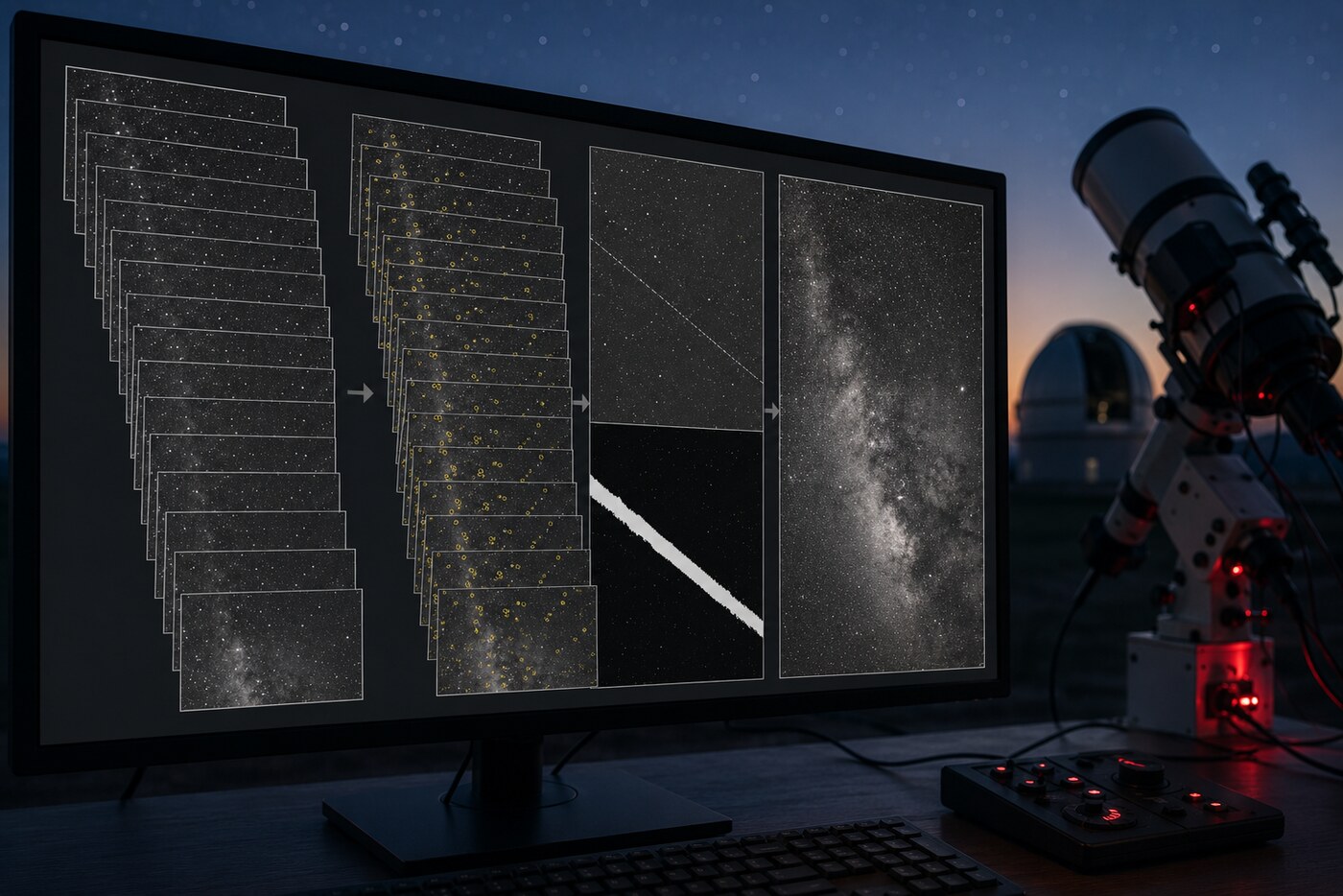
Registration places matching stars on the same coordinates. Stacking then combines exposures, strengthens repeated signal, and reduces random noise.
Good rejection methods can remove satellites, cosmic-ray hits, and other temporary marks. The result is a linear master image that often looks dark but contains far more usable information.
Stacking rewards consistency across many individual frames.
09CHAPTER
Reveal faint structure without forcing it.
Stretching and color
IN PLAIN LANGUAGE
Here is the big picture: Reveal faint structure without forcing it. The main point to remember is this: Stretching reveals existing signal.
See the fuller scientific explanation +
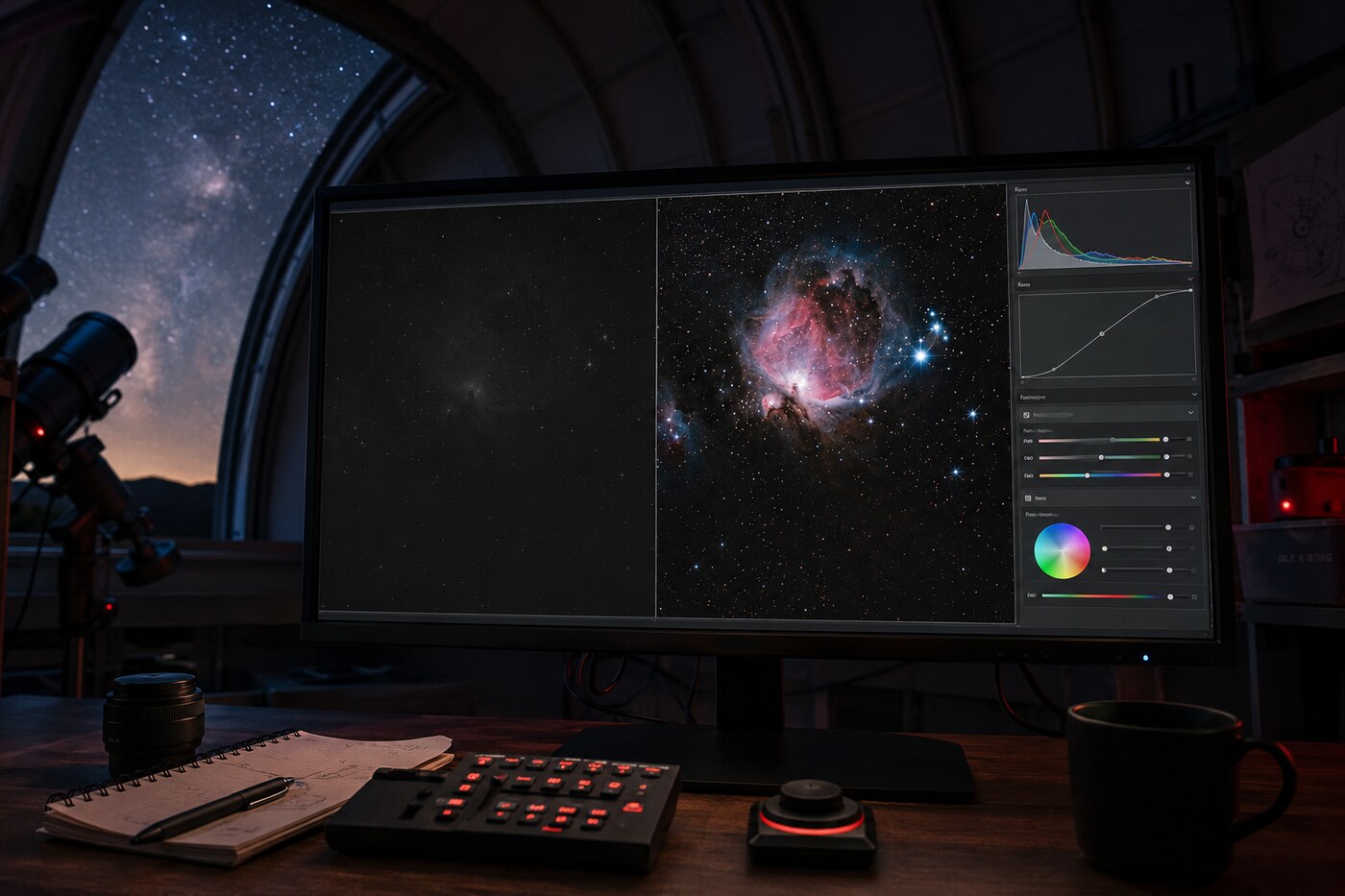
Astronomical data are usually linear, while screens and eyes need a nonlinear stretch to reveal faint detail. Gentle stages protect bright cores and star color while lifting the background.
Color calibration uses stars, known filters, or a chosen palette as a reference. Saturation should support structure, not hide clipping, noise, or halos.
Processing translates a high-dynamic-range dataset into a view the eye can explore.
10CHAPTER
Know when the picture is finished.
A natural final image
IN PLAIN LANGUAGE
Here is the big picture: Know when the picture is finished. The main point to remember is this: Process with a purpose.
See the fuller scientific explanation +
Noise reduction, sharpening, star control, and local contrast can all help when applied with restraint. Each step should solve a visible problem rather than follow a recipe automatically.
Keep an earlier version and step away before the final decision. If the subject reads clearly, the background feels calm, and the stars still look like stars, the image may already be done.
THE POINTS TO REMEMBER
✦Process with a purpose
✦Restraint preserves believable structure
✦A repeatable workflow improves faster than random tools
A strong final image feels deep and clear without calling attention to the processing.
THE ESSENTIAL THREAD
Three ideas worth keeping.
01Tracking and total exposure time matter more than extreme magnification.
02Calibration removes camera and optical artifacts before stretching begins.
03Processing should reveal real signal while keeping noise and color under control.